On many industrial and construction projects, delays do not begin on site. They begin much earlier, when a critical material is approved on paper but not actually available when purchasing needs it. That gap between specification and supply is where schedules often start to slip. For teams working with pressure piping, one practical way to reduce that risk is choosing a106 grade b carbon steel pipe in stock instead of waiting on mill production. For project managers, that decision is less about convenience and more about protecting sequence, labor planning, and handover dates.
The appeal is straightforward: when pipe is available for immediate dispatch, fabrication can begin sooner, installation crews are less likely to sit idle, and procurement stops being the bottleneck that holds up multiple trades. In projects where every week affects labor allocation, crane schedules, subcontractor coordination, or commissioning windows, in-stock material becomes a scheduling tool as much as a steel product.
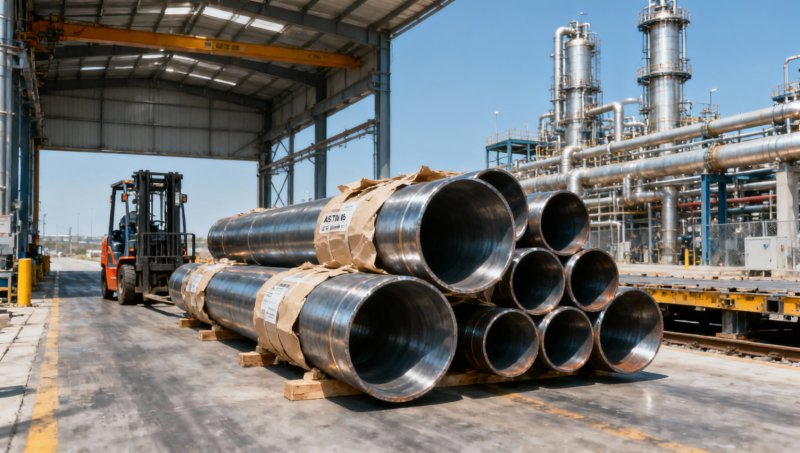
ASTM A106 Grade B carbon steel pipe is widely used for high-temperature and pressure service in refineries, power plants, processing systems, boiler lines, and general industrial piping. It is a familiar specification, which is exactly why supply issues can be frustrating. Everyone knows the material, many systems are designed around it, and yet procurement can still become unpredictable if stock position is not confirmed early. That is why buyers increasingly search for immediate-availability options rather than treating pipe sourcing as a routine, low-risk step.
Why “in stock” matters more than many procurement plans assume
When a project schedule is built, pipe supply is often assigned a standard lead time based on past orders or supplier estimates. In reality, those assumptions can break down quickly. Mill rolling schedules shift. Export documentation takes longer than expected. Surface treatment, cutting, testing, or bundling adds unplanned days. Even small deviations can affect the critical path if the piping package connects to equipment setting, support installation, hydrotesting, or insulation.
Buying a106 grade b carbon steel pipe in stock changes that equation. It shortens the distance between purchase order and actual site readiness. More importantly, it makes planning more credible. Project managers are not just trying to buy steel; they are trying to remove unknowns.
That distinction matters because procurement delay rarely stays isolated. One late pipe delivery can trigger a chain reaction:
- Fabrication slots in the workshop are missed.
- Spool drawing release loses momentum.
- Field crews are rescheduled at higher cost.
- Scaffolding or lifting equipment remains booked longer than planned.
- Pressure testing and commissioning shift into less favorable windows.
In-stock availability helps prevent that domino effect. It gives the team more control over sequencing, not just faster delivery.
Where schedule gains usually appear first
Immediate material access creates value at several points in the project cycle, and not always in the obvious places. The first gain is usually in purchasing response time. If the material has already been produced, inspected, and prepared for dispatch, buyers can move directly into confirmation of dimensions, quantities, documentation, and shipping arrangements.
The second gain often appears in fabrication. Workshops prefer certainty. If pipe arrives on time and with consistent quality, cutting, beveling, welding preparation, and spool assembly can proceed with fewer interruptions. This is particularly helpful when teams are managing multiple line classes or balancing short shutdown windows.
A third gain shows up on site. Installation teams can keep work fronts open without repeatedly adjusting daily plans. That may sound simple, but field productivity drops quickly when crews wait for missing lengths, substitute material, or last-minute procurement updates. Even a well-managed site can become inefficient if the material flow is unreliable.
Not all stock supply reduces risk in the same way
Project managers know that “available” and “usable” are not the same thing. A supplier may say material is in stock, but the real questions are more specific. Is the pipe traceable? Does it meet the required standard? Are dimensions and wall thicknesses aligned with the approved bill of materials? Can mill test certificates be provided promptly? Is the stock located where shipment can realistically happen within the required timeframe?
Those questions matter because rushed buying can solve one delay while creating another. If the pipe reaches the workshop quickly but document review drags on, the project still loses time. If dimensions vary from what the fabrication team expects, the installation benefit disappears.
For that reason, evaluating stock supply should include more than inventory confirmation. A practical supplier review often includes:
- Verification of ASTM A106 Grade B compliance and supporting documentation
- Available sizes, wall thicknesses, and quantity continuity
- Inspection status and readiness for shipment
- Packaging method for export or domestic transport
- Ability to coordinate cutting, bundling, or other processing if needed
- Clear communication on realistic dispatch timing
In other words, stock is valuable only when it is organized stock.
How in-stock A106 Grade B pipe supports better decision-making under pressure
One of the hardest parts of project management is making decisions when information is incomplete. You may know the site needs pipe within days, but not whether a mill order will land in time. You may know engineering is nearly frozen, but not whether a supplier can support quantity adjustments. This is where stock-based sourcing provides a planning advantage.
With in-stock material, project teams can make firmer decisions on fabrication release, logistics sequencing, and manpower deployment. That does not eliminate every risk, but it reduces the number of moving parts. In fast-track work, fewer variables often matter more than shaving a small percentage off unit price.
This is especially true when the pipe package is tied to larger steel or structural scopes. On many industrial jobs, piping and structural works advance side by side. Pipe supports, frames, access platforms, and equipment bases must align with installation progress. A delay in one category can slow the other.
That is why many buyers prefer to work with steel suppliers that understand broader project coordination, not only single-item sales. A manufacturer experienced in structural products can often support that wider view. For example, alongside piping procurement, some projects also need support members such as C Channel Beam for steel structure buildings or mechanical light industry manufacturing. These C-shaped sections, available in materials such as Q195, Q235, Q345, A36, SS400, and S235JR, are commonly used in purlins, wall beams, brackets, lightweight roof trusses, and secondary framing. When processing services like cutting, punching, welding, or bending are available from one source, coordination becomes simpler and site preparation can move with fewer handoffs.
That kind of sourcing alignment does not mean every material should come from one vendor. It does mean integrated supply can reduce communication gaps when schedule pressure is high.
What project leaders should check before placing the order
When availability looks attractive, there is a temptation to move straight to purchasing. A short review can save time later. Start with the actual use condition. ASTM A106 Grade B is commonly selected for pressure and temperature service, but the system design still determines whether seamless pipe, specific schedules, or additional testing requirements apply.
Next, confirm whether the in-stock quantity covers the full package or only part of it. Partial availability can still be useful, especially for launching fabrication early, but only if the balance material has a clear route. Splitting supply without a plan may complicate traceability and receiving inspection.
Documentation should be checked early rather than after dispatch. Mill test certificates, heat numbers, dimensional records, and any required third-party inspection status need to be aligned with the approval process. The fastest shipment is not helpful if QA approval stalls it in the yard.
It also helps to ask about processing capability. Some suppliers can provide cut lengths, end preparation, marking, and packing tailored to project needs. For export supply, practical details such as trade terms, loading method, and communication speed often influence actual delivery performance more than broad promises do.
The cost question: is in-stock pipe always more expensive?
Not necessarily, and even when unit pricing is slightly higher, the project cost outcome may still be better. Project managers rarely judge procurement only by material rate. Delay costs can be less visible but more damaging: idle labor, resequencing, temporary storage extension, subcontractor claims, extra transport, or compressed installation effort later in the schedule.
In-stock sourcing should therefore be evaluated against total project impact. A lower-priced mill order with uncertain lead time may look attractive in a spreadsheet, yet become expensive once disruption spreads across fabrication and field execution. On the other hand, if the project has a long runway and no schedule sensitivity, booked production may still be the right choice. The point is not that stock is always superior, but that schedule-critical work often justifies it.
Why supplier reliability matters as much as product availability
For international buyers, stock status alone is only part of the story. Reliable export handling, consistent quality control, and realistic lead time communication are just as important. A capable steel manufacturer and exporter should be able to support global projects with standards-based production, documentation discipline, and stable supply organization.
Hongteng Fengda, as a structural steel manufacturer and exporter from China, works with customers in construction, industrial, and manufacturing sectors that need dependable steel supply rather than procurement surprises. Beyond structural products such as angle steel, channel steel, steel beams, cold formed profiles, and customized components, the broader value lies in understanding how steel packages affect project delivery. For project teams balancing cost, risk, and schedule, that perspective can be useful when selecting a sourcing partner.
Consistency also matters across standards. Buyers working across North America, Europe, the Middle East, and Southeast Asia often need materials aligned with ASTM, EN, JIS, or GB expectations depending on end use and documentation requirements. A supplier used to international compliance workflows is generally better prepared to avoid the misunderstandings that slow down release and shipping.
When choosing stock is the smarter move
There are moments when in-stock material is more than a convenience. It is often the smarter choice when:
- The project is already in execution and fabrication cannot wait for mill lead time.
- A shutdown or maintenance window is fixed and missing it would be costly.
- The piping package is connected to other steel, equipment, or commissioning milestones.
- Design is stable enough that immediate procurement will not create rework risk.
- The buyer needs better certainty, not just a lower quoted price.
In those situations, a106 grade b carbon steel pipe in stock can act as a practical buffer against schedule volatility. It gives project managers something rare and valuable: a little more predictability.
Keeping a project on track is rarely about one dramatic decision. More often, it comes from a series of sensible moves that remove friction before it spreads. Choosing stock-ready A106 Grade B carbon steel pipe is one of those moves. It shortens procurement uncertainty, supports earlier fabrication, helps installation stay aligned, and reduces the risk that one delayed material package slows everything behind it. For teams judged on delivery dates rather than procurement theory, that can make all the difference.
Please give us a message


Please enter what you want to find