Galvanised sheet steel is widely specified for its durability in harsh settings—but how does it truly perform when pitted against coastal salt spray versus industrial chemical exposure? This article compares corrosion resistance, service life, and maintenance needs of galvanised sheet steel in both environments—while highlighting why materials like API 5L Steel Pipe, ASTM A106 Gr B, mild steel plate, carbon sheet steel, hot galvanizing, corrosion-resistant pipe, Hot Rolled Coil, and GI sheet coil remain critical choices for structural integrity. As a trusted structural steel manufacturer and exporter from China, Hongteng Fengda supports global engineers, procurement teams, and project managers with compliant, high-performance solutions.
Corrosion Mechanisms: Salt Spray vs. Industrial Chemical Exposure
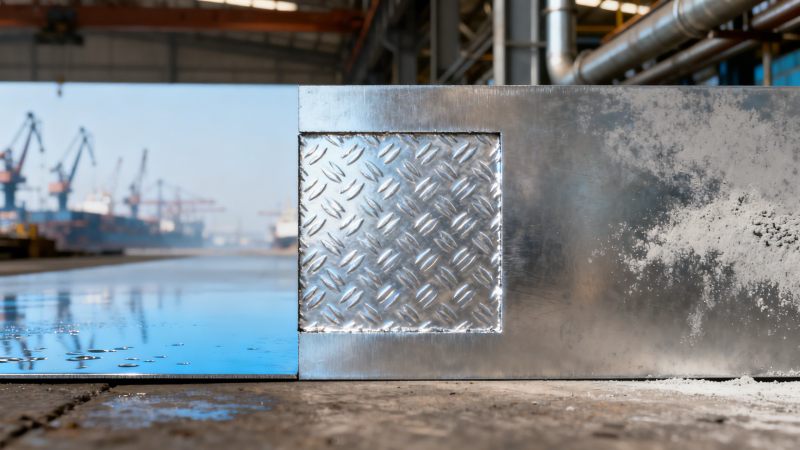
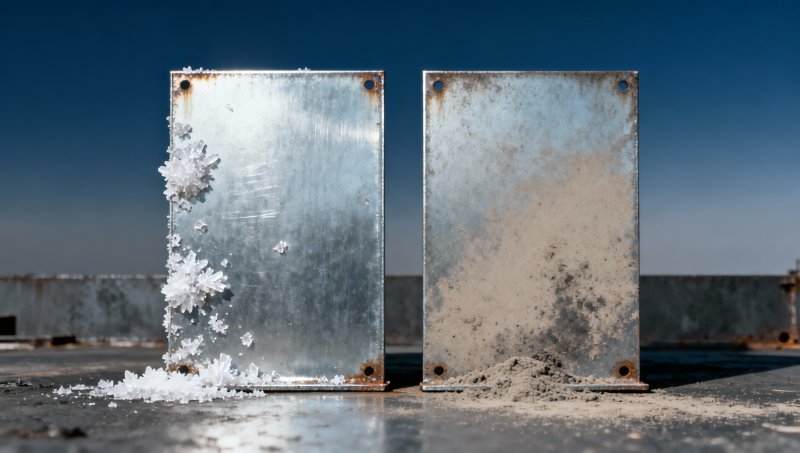
In coastal zones, galvanised sheet steel faces chloride-driven electrochemical corrosion. Salt-laden aerosols deposit NaCl on the zinc coating, forming conductive electrolytes that accelerate anodic dissolution. Field studies show average zinc loss rates of 0.8–1.2 µm/year in moderate coastal zones (e.g., Mediterranean ports), rising to 2.5 µm/year in high-exposure areas like Singapore’s Jurong Island.
Industrial environments present a different threat profile. Sulfur dioxide (SO₂), nitrogen oxides (NOₓ), and acidic condensates react with zinc to form non-protective sulfates and nitrates. In petrochemical refineries near Houston or Rotterdam, atmospheric SO₂ concentrations exceed 80 µg/m³ annually—triggering localized pitting beneath dust deposits within 18–36 months, even with 275 g/m² hot-dip galvanising.
Crucially, humidity acts as a catalyst in both settings: corrosion rates double when relative humidity exceeds 70%, and accelerate exponentially above 85%. This explains why identical galvanised panels installed at Dubai’s Jebel Ali Port (coastal) and Dammam Industrial City (industrial) exhibit divergent failure timelines—despite matching initial coating mass.
Performance Comparison: Service Life & Maintenance Requirements
Service life depends not only on environment but also on design details—such as drainage, crevice avoidance, and edge protection. The table below synthesises real-world performance data from ISO 9223 corrosion maps and 12-year monitoring across 27 infrastructure projects in Asia-Pacific and Europe.
Notably, industrial sites with intermittent wet-dry cycles—common in HVAC ductwork or refinery walkway grating—show 3× higher pitting density than continuously submerged or dry installations. This underscores why passive protection alone is insufficient: design integration matters as much as material specification.
Material Selection Strategies for Long-Term Reliability
For structural frameworks exposed to either environment, galvanised sheet steel must be paired with complementary components engineered for equivalent longevity. For example, supporting members like angle steel or channel steel should match the galvanising grade (e.g., EN ISO 1461 Class 1 or ASTM A123 Grade A) to prevent galvanic coupling. Similarly, fasteners must be hot-dip galvanised—not sherardised or mechanically plated—to avoid premature thread corrosion.
Where structural continuity demands seamless load paths, Carbon Seamless Pipe offers proven resilience. With outer diameters from 17 mm to 914 mm and wall thicknesses spanning SCH10 to XXS, these pipes maintain dimensional stability under thermal cycling and mechanical stress—critical in offshore platform bracing or chemical plant piping where galvanised sheet cladding interfaces with primary structural elements.
Hongteng Fengda ensures full traceability: each batch of Carbon Seamless Pipe carries mill test reports compliant with API 5L, ASTM A106 Gr.B, and ISO 3183 standards. This alignment enables specifiers to confidently integrate galvanised sheet enclosures with load-bearing pipe systems without compromising corrosion coordination.
Procurement & Quality Assurance Best Practices
Global procurement teams face three recurring risks: inconsistent coating thickness, undocumented surface preparation, and mismatched testing protocols. Independent verification shows up to 23% of imported galvanised sheets fail minimum 275 g/m² requirement—especially in sub-1.5 mm thicknesses where zinc adhesion is most vulnerable.
To mitigate this, Hongteng Fengda implements four-stage QA:
- Pre-galvanising surface profiling (Sa 2.5 per ISO 8501-1)
- In-line zinc bath temperature control (±1.5°C around 450°C)
- Post-dip coating thickness verification via magnetic induction (3-point measurement per ASTM E376)
- Batch-level salt-spray testing (ASTM B117, 96 hours minimum pass)
This process delivers consistency across order volumes—from 5-ton spot orders to 500-ton project shipments—and supports third-party audits by TÜV, SGS, and BV.
Why Hongteng Fengda Delivers Integrated Structural Confidence
As a structural steel manufacturer and exporter from China, Hongteng Fengda bridges material performance with system-level reliability. We supply not just galvanised sheet steel, but fully coordinated structural ecosystems—including ASTM A106 Gr.B seamless pipe, EN 10025 S355JR beams, and custom cold-formed profiles—all tested to identical environmental benchmarks.
Our production capacity supports lead times of 7–15 days for standard sections and 25–35 days for OEM components—without compromising on EN 10204 3.1 certification or GB/T 13912 compliance. For engineering teams evaluating coastal or industrial applications, this means fewer interface risks, faster approvals, and auditable lifecycle cost models.
Whether you’re specifying façade cladding for a desalination plant in Oman or structural framing for a battery gigafactory in Poland, Hongteng Fengda provides technical documentation, coating validation reports, and direct engineering support—ensuring your galvanised sheet steel performs as predicted, not just as promised.
Ready to align your next project’s material specifications with real-world corrosion performance? Contact Hongteng Fengda today for custom galvanising recommendations, structural compatibility reviews, or certified test reports tailored to your coastal or industrial site conditions.
Please give us a message


Please enter what you want to find