In complex construction and industrial projects, material waste can quickly drive up costs, delay schedules, and create sourcing challenges. Custom steel tubing helps project managers solve these issues by improving fit, reducing on-site cutting, and supporting more efficient fabrication. For teams handling demanding builds, choosing a reliable structural steel supplier can make the difference between avoidable waste and smooth project delivery.
Why does custom steel tubing reduce waste in complex builds?
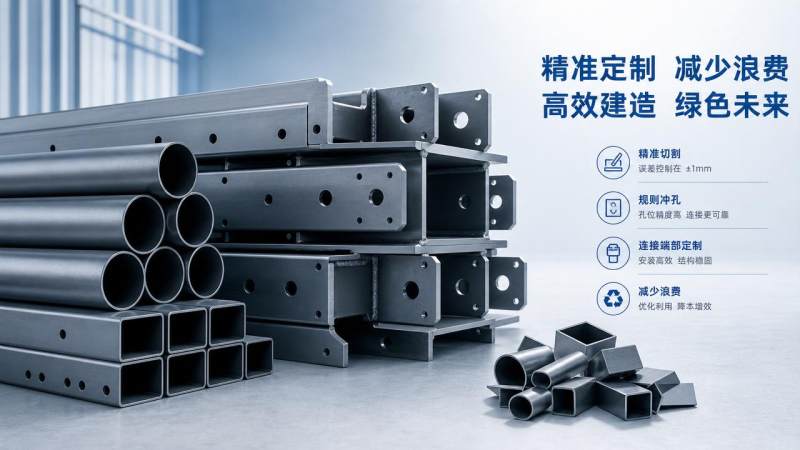
For project managers, waste is rarely just a scrap problem. It affects procurement accuracy, installation speed, labor planning, transport efficiency, and final project cost. In steel-intensive builds, standard sections often require trimming, splicing, hole modification, reinforcement changes, or secondary fabrication. Each adjustment adds time and raises the risk of dimensional error.
Custom steel tubing addresses these issues by aligning the steel component with the actual engineering requirement before shipment. Instead of forcing a standard product into a non-standard structure, the tubing is produced or processed to match project geometry, connection details, and load path needs. That change directly cuts offcuts, rework, and unnecessary site handling.
This matters most in projects with tight tolerances, repetitive assemblies, modular construction, equipment frames, industrial platforms, support systems, and export-driven jobs where material replacement is slow and costly. In these scenarios, custom steel tubing becomes a planning tool as much as a material choice.
- It reduces cutting losses because members arrive closer to final installation dimensions.
- It lowers labor waste by minimizing fit-up correction and field modification.
- It improves sequencing because steel packages can be prepared according to erection zones or fabrication stages.
- It decreases purchasing uncertainty when drawings, tolerances, and standards are reviewed early with the supplier.
Where project waste usually comes from in steel construction
Many teams focus on steel price per ton and overlook the bigger cost picture. In reality, waste in complex builds usually comes from mismatch between design intent, fabrication capability, and site conditions. When tubing lengths, wall thicknesses, end preparations, or connection points are not optimized upstream, downstream waste becomes inevitable.
The table below highlights common waste sources and shows how custom steel tubing supports more controlled execution across structural and industrial projects.
For project leaders, the key insight is simple: material waste is often a coordination problem before it becomes a cost problem. Early collaboration with a capable steel manufacturer reduces avoidable adjustments later in the project cycle.
How custom steel tubing compares with standard steel supply
Standard stock has a place in routine applications, especially when dimensions are common and field adaptation is acceptable. But in complex builds, project efficiency depends on more than availability. It depends on how well the product matches fabrication drawings, assembly logic, and compliance requirements.
When standard material may still work
- Simple support frames with generous tolerance and low repetition.
- Small maintenance jobs where labor cost is less critical than immediate availability.
- Projects with in-house fabrication capacity and low pressure on schedule.
When custom steel tubing is usually the better choice
- Multi-phase industrial installations with exact fit requirements.
- Modular building systems and prefabricated assemblies shipped to site.
- Export projects where replacement lead time creates major schedule risk.
- Projects subject to ASTM, EN, JIS, or GB specification alignment.
The comparison below can help procurement and engineering teams decide whether custom steel tubing creates enough savings to justify the upfront coordination effort.
The lowest unit price does not always deliver the lowest installed cost. Project managers should compare total cost, including scrap, labor, crane time, fabrication delays, and the financial impact of schedule slippage.
What technical details matter before you order custom steel tubing?
A successful custom steel tubing order begins with complete technical communication. If the supplier receives only rough dimensions, the chance of revision rises quickly. Clear data reduces ambiguity and prevents waste from being built into the order itself.
Key inputs project teams should prepare
- Section shape, wall thickness, steel grade, and target standards such as ASTM, EN, JIS, or GB.
- Exact cut lengths, quantity by item, and tolerance expectations for critical assemblies.
- End condition details, including beveling, squareness, slotting, hole punching, and connection preparation.
- Surface protection needs, packing requirements, shipment method, and destination constraints.
For international projects, technical clarity also improves customs preparation, inspection planning, and receiving efficiency. This is one reason experienced exporters are valuable: they understand how production details connect to logistics and documentation.
Hongteng Fengda supports this process through structural steel manufacturing and export experience across North America, Europe, the Middle East, and Southeast Asia. For buyers managing global builds, stable production capacity and strict quality control reduce the sourcing risk that often appears when customized steel components are ordered from fragmented supply channels.
How product combinations can further improve project efficiency
Complex projects rarely depend on one steel product alone. Tubing may form the structural or support framework, while coated sheet materials are selected for enclosure, roofing, wall systems, or decorative industrial applications. Coordinating these materials through one capable supplier can simplify communication and improve delivery planning.
For example, teams building workshops, equipment shelters, commercial structures, or public buildings may pair custom steel tubing with PPGI Steel Sheet for roof and wall systems. This product is commonly used in construction, manufacturing, roofing, wall panels, door frames, appliance housings, agricultural projects, residential applications, commercial applications, and public buildings.
Available substrates include galvanized iron and aluminum-zinc steel. Typical thickness ranges from 0.2mm to 1.2mm, width from 600mm to 1250mm, and length from 750mm to 1100mm. Surface systems can include PE, SMP, HDP, or PVDF paints, with options such as epoxy primer, polyester primer, water soluble acrylic primer, and polyurethane primer. These choices help buyers balance corrosion resistance, appearance, maintenance expectations, and environment exposure.
In practical terms, that means a project manager can align structural members and enclosure materials around the same delivery schedule. When the steel frame and coated sheet package are technically coordinated, site congestion is reduced and installation sequencing becomes easier to manage.
How to evaluate a steel supplier for custom work
Not every supplier that sells steel can manage customization well. For project managers, the real question is whether the supplier can control the full path from specification review to manufacturing consistency and shipment reliability.
Use the following checklist when assessing a custom steel tubing partner for complex builds.
Hongteng Fengda manufactures and exports structural steel products including angle steel, channel steel, steel beams, cold formed steel profiles, and customized structural steel components. For project-driven procurement, that range matters because many builds require multiple steel categories, not just one item. Consolidating them through a supplier with modern manufacturing facilities and disciplined quality control can reduce coordination loss across the purchase cycle.
What cost factors should project managers compare?
The cost discussion around custom steel tubing should go beyond ex-works price. The real decision is whether customization lowers the installed cost and protects the project timeline. In many complex builds, it does, especially when field labor is expensive or site access is constrained.
Cost items often reduced by customization
- Scrap handling and disposal from unnecessary offcuts.
- Site welding, drilling, and corrective fitting labor.
- Equipment standby time caused by missing or incorrect members.
- Re-order risk when imported steel components need replacement.
Cost items that may increase upfront
- Engineering review and drawing confirmation.
- Factory processing for holes, special lengths, or formed details.
- More careful packaging or itemized shipment preparation.
For high-volume or repeatable assemblies, the savings usually become more visible. The more identical components a project contains, the more valuable precision fabrication becomes. Even small reductions in scrap and labor can multiply across hundreds or thousands of pieces.
Common mistakes when buying custom steel tubing
Some waste comes from choosing the right product too late. Other waste comes from choosing it without enough detail. The following mistakes are common in fast-moving construction and industrial procurement.
Mistakes to avoid
- Treating custom steel tubing like a commodity item and skipping tolerance review.
- Ordering by nominal size only without confirming actual fabrication details.
- Leaving standards and inspection expectations unclear for export projects.
- Ignoring packing sequence, which can slow receiving and erection.
- Choosing the cheapest supplier without checking production and lead time stability.
Most of these problems are preventable. They require earlier technical alignment, not necessarily a larger budget. That is why supplier responsiveness and drawing-based communication are often more valuable than a slightly lower quote.
FAQ for project managers considering custom steel tubing
How early should custom steel tubing be specified in a project?
As early as the design coordination or procurement planning stage. If the decision is delayed until installation approaches, the team may lose the chance to optimize lengths, connection details, and bundle sequencing. Early specification also improves quotation accuracy and reduces change orders.
Is custom steel tubing only useful for large projects?
No. It is most visible in large or repetitive projects, but it also helps smaller builds with difficult geometry, strict tolerances, or expensive site labor. The right question is not project size alone, but whether field modification would create measurable cost or schedule risk.
What standards should international buyers confirm?
Buyers should confirm the applicable material and dimensional standards required by the project or local authority. Common references may include ASTM, EN, JIS, and GB. It is also wise to align inspection, documentation, and marking expectations before production starts.
Can a supplier support both standard and OEM structural steel needs?
Yes, and that flexibility can simplify sourcing. A supplier that offers angle steel, channel steel, steel beams, cold formed profiles, and customized components can help buyers reduce the complexity of multi-item procurement, especially when lead time and compatibility matter.
Why choose us for custom structural steel projects?
Hongteng Fengda works with global buyers who need more than steel supply. They need stable production, consistent quality, and dependable delivery support for real project conditions. As a structural steel manufacturer and exporter from China, we support construction, industrial, and manufacturing projects with standard specifications and customized solutions.
Our capabilities cover angle steel, channel steel, steel beams, cold formed steel profiles, and customized structural steel components. With modern manufacturing facilities and strict quality control, we help buyers align product requirements with ASTM, EN, JIS, and GB-related project needs in a practical and organized way.
If you are planning a complex build and want to reduce waste through custom steel tubing, you can contact us to discuss section sizes, processing details, technical parameters, applicable standards, delivery timelines, packing method, sample support, and quotation planning. We can also help review whether a custom solution or a standard supply route will better fit your schedule, budget, and installation strategy.
Please give us a message


Please enter what you want to find