For projects under pressure to control lifting costs, site labor, and installation timelines, choosing the right structural profile matters. A cold formed steel channel offers a lighter yet reliable alternative to many traditional hot-rolled sections, helping reduce handling difficulty without compromising project performance. By combining efficient geometry, consistent dimensional accuracy, and flexible customization, it supports faster assembly, easier transportation, and better cost control across construction and industrial projects.
Where cold formed steel channel reduces installation weight most effectively
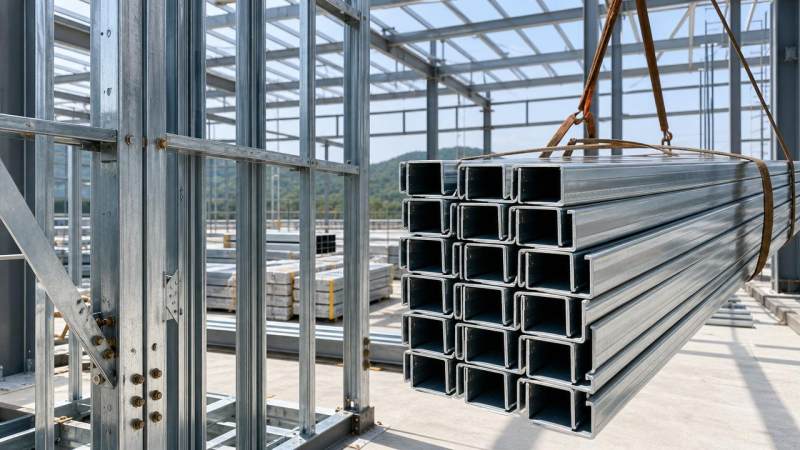
Installation weight is not only the mass of steel delivered to site. It also includes lifting effort, fixing complexity, temporary support, and assembly time.
A cold formed steel channel helps reduce this total burden because its section shape uses material efficiently. Strength is placed where bending resistance is needed.
Compared with heavier rolled profiles, cold formed steel channel can often meet load requirements with less steel weight per meter.
This advantage becomes clearer in secondary framing, equipment supports, wall systems, roof members, racks, and modular steel assemblies.
Hongteng Fengda supplies structural steel profiles for global construction, industrial, and manufacturing projects, with support for ASTM, EN, JIS, and GB requirements.
Scenario background: why weight reduction depends on the installation condition
The value of cold formed steel channel changes by scene. A light profile may save labor in one project but need reinforcement in another.
The main judgment is not whether lighter steel is always better. The real question is whether the profile matches load, span, connection, and environment.
Cold forming creates sections from steel sheet or strip at room temperature. This process allows precise dimensions, thin gauges, lips, flanges, and custom shapes.
Because of these features, cold formed steel channel is especially useful where repeated installation, prefabrication, and predictable tolerances matter.
Weight reduction should be evaluated together with deflection limits, local buckling, screw pull-out, corrosion protection, and transportation length.
Lightweight wall framing and partition systems
In wall framing, cold formed steel channel reduces installation weight because members are handled frequently and fixed at close spacing.
Every kilogram saved can reduce manual effort during cutting, positioning, alignment, and screw fastening.
The key judgment point is service load. Interior partitions usually need stiffness, straightness, and fixing quality more than heavy load capacity.
For exterior wall framing, wind load and cladding weight become more important. A deeper cold formed steel channel may be better than thicker steel.
Using the correct depth-to-thickness ratio can reduce installation weight while maintaining bending resistance and fastening reliability.
Roof purlins and secondary support members
Roof systems often benefit strongly from cold formed steel channel because elevated installation magnifies the cost of lifting and positioning.
Lighter members can reduce crane dependency, simplify manual adjustment, and speed up repetitive fixing across long roof bays.
The critical judgment is span. Longer spans may require lipped channels, bracing, or closer spacing to control deflection.
Cold formed steel channel performs well when roofing sheets, insulation, and service loads are calculated as a complete system.
Galvanized or anti-corrosion coated surfaces are often selected when roof members face condensation or coastal exposure.
Industrial platforms, equipment frames, and service supports
Industrial support structures need practical strength, installation access, and connection flexibility. Cold formed steel channel can reduce weight in non-primary members.
Typical uses include cable tray supports, light equipment frames, maintenance platforms, guards, brackets, and service racks.
The judgment point is vibration and concentrated load. Thin sections may need stiffeners, back-to-back channels, or reinforced connection plates.
Where piping systems are included, related steel products may also be specified. For example, High Carbon Steel Pipe supports global industrial applications.
Available models include A53 Gr.B, A36, ST52, ST35, ST42, ST45, X42, X46, X52, X60, X65, and X70.
Such complementary steel materials help align structural channels, pipe supports, and mechanical systems under unified project sourcing.
Modular construction and prefabricated steel assemblies
Modular construction rewards accurate, repeatable components. Cold formed steel channel is valuable because dimensional consistency reduces rework during assembly.
A lighter module frame can improve transport efficiency, reduce lifting pressure, and support faster stacking or placement at site.
The judgment point is tolerance control. Small dimensional errors can multiply when many modules connect together.
Cold formed steel channel can be supplied in customized lengths, hole patterns, surface treatments, and section forms to support prefabrication.
OEM structural steel solutions are useful when repeated modules require stable production capacity and dependable lead times.
Storage racks, shelving, and logistics structures
Storage systems often require many repeated members. Cold formed steel channel reduces installation weight across uprights, cross braces, rails, and support frames.
The benefit is cumulative. Even small weight savings per component can reduce total handling effort across large warehouse installations.
The judgment point is impact resistance. Forklift zones and loading areas may require thicker sections or local protection.
Cold formed steel channel should be checked for column stability, bolt-hole deformation, and connection slip under repeated loading.
Different scenario requirements for cold formed steel channel
This comparison shows why cold formed steel channel should be selected by scenario, not only by steel weight per meter.
How geometry reduces installation weight without losing function
The channel shape places flanges away from the neutral axis. This improves bending efficiency compared with flat strip of similar mass.
Lips, returns, and stiffened edges can improve local stability. They allow thinner steel to perform better under compression.
Cold formed steel channel also supports nesting and compact packing. This can lower transport volume and improve container loading efficiency.
Pre-punched holes and accurate lengths reduce drilling at site. Less site drilling means less labor, less noise, and fewer alignment errors.
The result is not only lighter steel. It is a lighter installation process from delivery to final fastening.
Practical adaptation advice before specification
- Confirm actual load cases, including dead load, live load, wind load, and temporary construction load.
- Compare section depth before increasing thickness, because geometry may save more weight than added steel.
- Check deflection limits, especially for roof purlins, wall rails, and cladding support members.
- Select surface treatment according to indoor, outdoor, humid, coastal, or chemical exposure conditions.
- Plan connection details early, including bolts, screws, welding limits, hole positions, and end treatments.
- Request mill certificates and standards alignment for ASTM, EN, JIS, or GB project documentation.
When these checks are complete, cold formed steel channel can be optimized for weight, strength, and installation speed.
Common misjudgments that reduce the benefit
One common mistake is replacing a hot-rolled member only by matching height. Section modulus and buckling behavior must also be compared.
Another mistake is ignoring connection design. A light channel can fail at holes, screws, or bearing zones if details are weak.
A third mistake is selecting the thinnest possible gauge without considering handling damage during shipping and installation.
Cold formed steel channel needs correct packaging, bundling, and lifting methods to prevent twisting or flange deformation.
Project teams also overlook coating compatibility. Galvanized, painted, oiled, or anti-corrosion coated finishes should match exposure risk.
Related steel material coordination in industrial projects
Structural channels often work with beams, angles, plates, and pipes. Coordinated sourcing can reduce mismatch across steel grades and standards.
For pipe-related packages, specifications may include API 5L, ASTM A106 Gr.B, ASTM A53 Gr.B, ASTM A179/A192, and EN 10217.
Outer diameters from 15mm to 1200mm and wall schedules from SCH10 to XXS can support varied industrial layouts.
Available end treatments may include plain end, bevelled end, grooved end, or threaded end with plastic caps.
This coordination helps cold formed steel channel integrate with pipe supports, equipment frames, and plant steelwork more efficiently.
Action guide: turning weight reduction into site savings
Start with drawings, load data, span information, coating requirements, and applicable standards. Then compare several cold formed steel channel options.
Evaluate total installed cost, not only unit price. Include lifting, labor, drilling, transport, packaging, and installation sequence.
Hongteng Fengda can support customized structural steel components, standard channel steel, cold formed steel profiles, beams, and angle steel.
With stable production capacity and strict quality control, cold formed steel channel can be supplied for global construction and industrial projects.
Share the application scene, required standard, section size, length, surface finish, and delivery schedule to receive a practical steel solution.
When selected by scenario, cold formed steel channel reduces installation weight, improves handling efficiency, and helps complete steel projects with better control.
Please give us a message


Please enter what you want to find