As aging industrial facilities face growing structural stress, lightweight steel roofing emerges as a high-performance, cost-effective solution—offering superior strength-to-weight ratio, corrosion resistance (especially with galvanized steel roofing), and rapid installation. Whether you're evaluating steel roofing benefits for retrofit projects, comparing steel roofing price vs. traditional systems, or sourcing from a trusted steel roofing manufacturer like Hongteng Fengda, this guide explores how insulated steel roofing and corrugated steel roofing reduce load without compromising durability. Ideal for procurement teams, engineers, and project managers seeking reliable steel roofing supplier partnerships in North America, Europe, and beyond.
Why Structural Load Reduction Matters for Aging Industrial Buildings
Industrial facilities over 30 years old often operate near or beyond their original design load capacity. Roof upgrades—especially those adding insulation, HVAC units, or solar arrays—can increase dead load by 15–35 kg/m². Traditional concrete or heavy metal roofs may exceed the remaining safety margin of aging support beams, purlins, and columns.
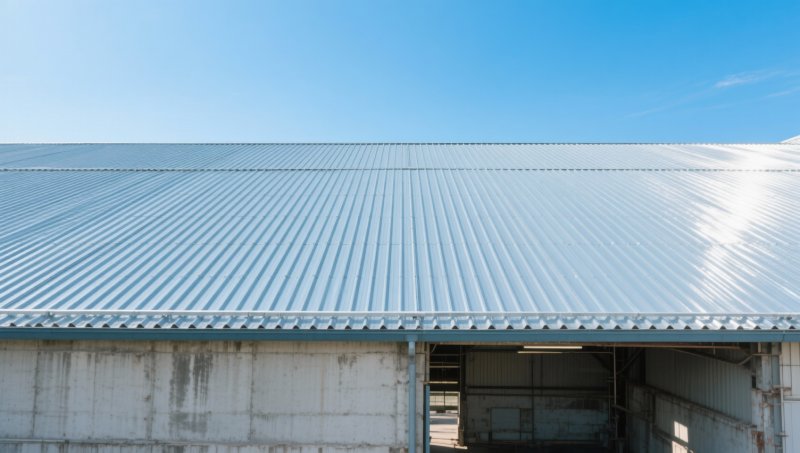
Lightweight steel roofing systems typically weigh 8–12 kg/m²—up to 60% less than precast concrete panels (25–40 kg/m²) and 30% lighter than standard corrugated aluminum. This directly reduces downward force on primary framing, minimizing deflection risks and extending service life without full structural reinforcement.
For retrofit projects in North America and EU markets, where building codes require verification of existing load paths (e.g., ASCE 41-22 or EN 1998-3), choosing low-mass roofing is not just an efficiency upgrade—it’s a compliance enabler. Engineers report up to 40% faster approval timelines when roof weight stays below 12 kg/m².
How Lightweight Steel Roofing Compares to Alternatives
Selecting the right roofing system requires balancing weight, durability, thermal performance, and lifecycle cost. Below is a technical comparison across five key decision criteria used by procurement teams and structural engineers:
The data confirms a clear trade-off: heavier systems offer higher compressive strength but impose disproportionate strain on aging frames. Lightweight steel delivers optimal value when structural integrity—not just material thickness—is the priority. For facilities undergoing phased retrofits, it also enables staged installation without full shutdowns—typically completed in 7–15 days per 5,000 m² section.
What to Verify Before Procurement: 5 Critical Technical Checks
Procurement and technical evaluation teams must go beyond catalog specs. Here are five non-negotiable verification points before finalizing any lightweight steel roofing order:
- Yield strength confirmation: Minimum S355 grade (355 MPa) for purlin spacing >2.5 m—verified via mill test reports aligned with EN 10025-2 or ASTM A656.
- Coating performance: Galvanized layer ≥275 g/m² (AZ150 equivalent) for coastal or high-humidity zones; salt-spray test results ≥1,500 hours per ISO 9227.
- Thermal bridging analysis: Insulated profiles must include continuous thermal breaks—validated through third-party THERM modeling reports.
- Interlock integrity: For standing seam systems, tensile strength at seam joints must exceed 1.2 kN/m under wind uplift per EN 1991-1-4.
- Fire classification: Class A (ASTM E108) or Euroclass B-s1,d0 certification required for occupied industrial buildings.
Hongteng Fengda provides full documentation packages—including EN 10204 3.1 Mill Certificates, CE FPC declarations, and ASTM-compliant test summaries—for every shipment. Lead times for custom-profile orders average 25–35 days from PO confirmation, with consistent quality across batches verified by ISO 9001-certified QA processes.
Beyond Roofing: Strategic Integration with Other Structural Upgrades
Reducing roof load is most effective when coordinated with complementary structural enhancements. One frequently overlooked opportunity is integrating Hot Rolled Steel Sheet Pile solutions for adjacent site stabilization—particularly for facilities undergoing foundation-level upgrades or flood mitigation work.
U-shaped sheet piles with Larssen interlocks (S355/S430 grades) provide rapid, modular retaining walls that support excavation around aging column footings. Their single-length capability—up to over 80m—reduces splice points and accelerates installation by 30–50% versus driven pile alternatives. This synergy lowers overall project risk and avoids sequential delays between roofing and civil works.
For global buyers, compatibility matters: all Hongteng Fengda products—including cold-formed roofing profiles and hot-rolled sheet piles—comply with overlapping standards (ASTM, EN, JIS, GB). This eliminates re-engineering when combining components across international projects.
Why Partner with Hongteng Fengda for Your Next Structural Upgrade
You need more than a steel supplier—you need a long-term structural partner who understands aging infrastructure constraints, global compliance expectations, and real-world delivery pressures. Hongteng Fengda delivers precisely that:
- End-to-end engineering alignment: Our technical team reviews your structural drawings, performs load simulations, and recommends optimized profile geometries—free of charge for qualified projects.
- Zero-compromise quality control: Every coil undergoes ultrasonic testing, dimensional scanning, and coating adhesion checks—ensuring ±0.3mm tolerance on critical dimensions.
- Global logistics assurance: With dedicated export departments serving North America, Europe, and the Middle East, we guarantee stable lead times (25–35 days), container-ready packaging, and seamless customs documentation.
- Customization without complexity: From bespoke corrugated profiles to OEM-branded insulated panels, we support small-batch trials (min. 5 tons) and full-scale production runs—with no tooling fees for repeat orders.
Whether you’re evaluating lightweight steel roofing for a 40-year-old warehouse in Ohio, specifying sheet piles for a water-retaining wall in Rotterdam, or sourcing angle steel for seismic retrofitting in Dubai—we help you de-risk sourcing, accelerate approvals, and future-proof your infrastructure. Contact us today for a free technical consultation, sample kit, or detailed quotation based on your exact specifications and timeline.
Please give us a message


Please enter what you want to find