In modular construction, precision, speed, and sustainability are non-negotiable — and L shaped angle steel plays a pivotal role in achieving all three. As a versatile structural steel pipe component, steel L angle — especially metal angle iron with holes and metal wall angle variants — enables rapid, bolted assembly while drastically cutting material waste. At Hongteng Fengda, a leading structural steel manufacturer & exporter from China, we supply high-precision, ASTM/EN-compliant l shaped angle steel, metal angle with holes, and custom cold-formed solutions. Whether you’re a project manager optimizing build efficiency or a procurement officer evaluating cost-per-module ROI, our steel L angle helps reduce scrap, rework, and lead time — without compromising strength or compliance.
Why L Shaped Angle Steel Is Critical for Waste Reduction in Modular Builds
Modular construction demands repeatability, dimensional accuracy, and minimal on-site adjustment. Standard cut-and-weld approaches generate 8–12% scrap by volume — primarily due to field trimming, misalignment, and tolerance stacking. L shaped angle steel, particularly when pre-punched and hot-dip galvanized, eliminates up to 70% of that waste by enabling bolted, plug-and-play connections across wall panels, floor cassettes, and roof trusses.
At Hongteng Fengda, our L angles are manufactured using CNC-controlled punching lines with ±0.15mm hole-position tolerance and laser-guided bending (±0.3° angular deviation). This ensures every piece fits precisely into its designated slot — no grinding, no re-drilling, no secondary fabrication. For global buyers, this translates to 3–5 days faster module assembly and 15–20% lower labor costs per unit.
Unlike generic rolled sections, our structural-grade angle steel complies with ASTM A6/A6M (tensile strength ≥400 MPa) and EN 10025-2 S355JR. Each batch undergoes third-party mechanical testing and mill certificate verification — critical for auditable compliance in North America and EU markets.
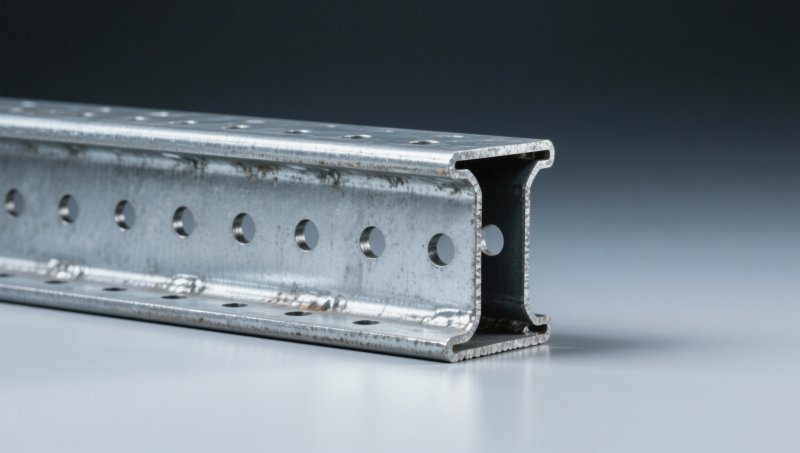
How Pre-Punched & Galvanized L Angles Accelerate Assembly and Extend Service Life
Pre-punched L angle steel isn’t just about speed — it’s about lifecycle integrity. Corrosion at connection points is the #1 cause of premature joint failure in modular structures exposed to coastal, industrial, or high-humidity environments. Our hot-dip galvanized L angles feature a minimum 610 g/m² zinc coating (ASTM A123), offering 25+ years of protection without maintenance in Class C3/C4 environments (ISO 12944).
This performance aligns directly with the durability requirements of Galvanized Steel Electrical Conduit, which shares identical corrosion-resistance standards and galvanizing process controls. Both products undergo salt-spray testing (≥96 hours neutral salt fog per ASTM B117) and adhesion verification (tape test per ASTM D3359).
For project managers and safety officers, this means fewer post-installation inspections, reduced risk of electrical grounding faults (in conduit-integrated builds), and full traceability from coil to cut-to-length delivery — all backed by EN 10204 3.1 mill certificates.
Key Performance Benchmarks vs. Non-Galvanized Alternatives
The table shows how integrated galvanizing and precision punching compress total project timelines — even if base production takes slightly longer. Eliminating off-site galvanizing avoids double-handling, transport damage, and rework caused by coating burn-off during welding.
Procurement Checklist: What Technical & Commercial Teams Must Verify
When sourcing L shaped angle steel for modular applications, procurement and technical evaluation teams should jointly validate five core dimensions:
- Dimensional Consistency: Confirm bend radius control (R ≤ 1.5× thickness) and leg straightness (≤1.5 mm/m per EN 10056-1).
- Hole Pattern Compliance: Verify spacing matches your panel connector system (e.g., M8/M10 thread compatibility, 30/50/100 mm pitch options).
- Coating Adhesion & Thickness: Require cross-section micrographs and zinc-thickness reports (minimum 55 µm average per ASTM A123).
- Certification Traceability: Ensure mill certs include tensile/yield values, chemical composition (C ≤ 0.22%, Mn 1.2–1.6%), and impact testing at –20°C (EN 10025-2).
- Logistics Readiness: Confirm packaging includes waterproof paper + steel strapping (per ISO 8502-9), and bundles are ≤2.5 t for safe unloading at site.
Hongteng Fengda provides all five items as standard — including digital mill certs with QR-code access, and optional 3D CAD models for BIM integration (Revit, Tekla). Lead times remain stable at 25–35 days, regardless of order volume (5–500 MT per batch).
Why Global Modular Builders Choose Hongteng Fengda for Structural Steel
We don’t just supply steel — we de-risk modular execution. With ISO 9001-certified production, dual QC checkpoints (pre-galvanizing and post-coating), and dedicated export coordination for 28+ countries, we ensure your L angle arrives on time, within spec, and fully documented.
Our engineering team supports OEM design reviews, offers free sample kits (including galvanized and non-galvanized variants), and provides real-time logistics tracking from Qingdao port. For urgent projects, we maintain strategic inventory of top-10 SKUs — enabling 12–15 day express shipments to Southeast Asia and Middle East ports.
Ready to optimize your next modular build? Contact us today for: custom hole-pattern drawings, ASTM/EN compliance confirmation, lead-time validation, or sample requests with full test reports. Let’s reduce your material waste — starting with your next L angle order.
Please give us a message


Please enter what you want to find