When sourcing structural steel across borders, understanding international standards for structural steel products is essential for reducing risk, ensuring compliance, and protecting project quality.
These standards shape material selection, testing scope, supplier approval, delivery planning, and final cost. In structural steel orders, standards are not paperwork. They are purchasing criteria.
For projects involving China supply and overseas delivery, the right standard match helps avoid rejected cargo, fabrication delays, and costly redesign. It also improves traceability and contract clarity.
Why standards matter in different structural steel sourcing scenarios
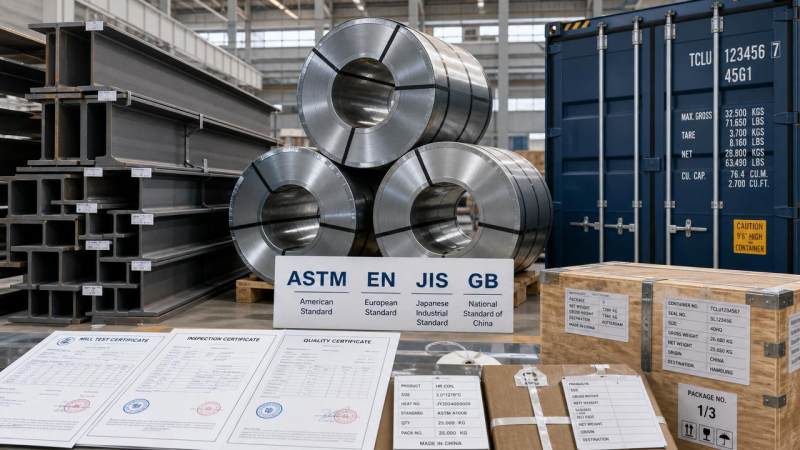
Not every steel order faces the same compliance pressure. A warehouse expansion, bridge package, machinery frame, and pressure vessel support structure all require different verification depth.
That is why international standards for structural steel products should be reviewed by application, destination market, fabrication method, and inspection expectations before ordering.
In practice, standards affect five decision points:
- Grade equivalency and substitution limits
- Mechanical property requirements
- Dimensional tolerance and surface condition
- Inspection, certification, and test records
- Import acceptance in the destination market
Suppliers with export experience usually align production with ASTM, EN, JIS, or GB. However, cross-standard conversion still requires careful technical confirmation.
How project scenarios change the standard selection logic
Building structures require code-compatible material documentation
Commercial buildings and industrial plants often need structural sections accepted under local design codes. Here, international standards for structural steel products influence both engineering approval and site inspection.
For example, projects tied to North American codes may prioritize ASTM grades, while European jobs often specify EN 10025 series with tighter traceability expectations.
Heavy equipment frames need strength, weldability, and processing consistency
Construction machinery and fabricated frames often involve bending, cutting, welding, and punching. In this scenario, standard choice affects workshop efficiency as much as strength performance.
A practical insert here is Steel Cold Rolled Coil, especially for forming parts that need high strength and stable workability.
Using Q355 carbon steel, it supports applications in construction machinery, building structures, and pressure vessels with enhanced toughness, good weldability, and good workability.
Available thickness is 0.12-12mm, width 600-2000mm, and coil weight 3-20 tons. Surface options include black, galvanized, coat, oiled, and painting finishes.
Its listed references include ASTM A36/A36M-08, JIS G3101-2004, EN 10025-2, GB/T 700-2006, DIN 17100-80, BS 4360-90, plus MTC, ISO, SGS, and BV support.
Pressure-related structures require tighter material confidence
When steel supports equipment under temperature, vibration, or pressure-related service, material mismatch creates a higher safety and audit risk.
In these cases, international standards for structural steel products must be checked beyond nominal grade names. Buyers should confirm chemistry range, impact properties, and certificate format.
What changes between ASTM, EN, JIS, and GB in real orders
Different standards may appear similar on paper, but their purchasing implications can differ in important ways. Direct substitution should never be assumed without technical review.
This comparison shows why international standards for structural steel products should be tied to project destination, not only mill availability.
Scenario-based checks before placing a structural steel order
A reliable order process starts with a short but disciplined review. These checks help prevent disputes after fabrication or customs clearance.
- Confirm the exact grade and governing standard in the contract.
- Check whether equivalent grades are permitted or forbidden.
- Verify required test reports, MTC format, and third-party inspection scope.
- Match tolerance needs with fabrication method and downstream processing.
- Review coating, oiling, or surface treatment requirements for storage and use.
- Align packing, marking, and traceability with destination acceptance rules.
These steps are especially important when ordering mixed items like angle steel, channel steel, beams, cold formed profiles, and custom fabricated components.
How standards influence lead time, cost, and supplier qualification
International standards for structural steel products do more than define quality. They also affect production scheduling and commercial terms.
A standard grade with routine testing often moves faster than a special export specification requiring extra impact tests, third-party witnessing, or custom marking.
Cost can also shift in several ways:
- Higher inspection scope increases documentation and coordination expense
- Special dimensions may reduce raw material availability
- Export-recognized certification may add handling time
- Incorrect standard selection may trigger remake or requalification costs
This is where an experienced China exporter creates value. Strong quality control and familiarity with ASTM, EN, JIS, and GB reduce avoidable sourcing risk.
Common mistakes when evaluating international standards for structural steel products
One common mistake is treating grade names as automatically equivalent. Similar yield strength does not guarantee identical chemistry, impact performance, or inspection rules.
Another mistake is focusing only on price per ton. Lower unit cost can disappear if the steel fails local approval or requires extra processing.
A third issue is incomplete document planning. Missing heat numbers, unclear MTC data, or inconsistent product marking can delay site acceptance.
Finally, some orders define the standard but ignore the application. Building frames, machine parts, and pressure-related structures may need different review depth.
A practical sourcing approach for globally compliant steel orders
The best results come from linking project use, destination standards, and mill capability at the start of the inquiry process.
Share drawings, end-use conditions, target standard, test expectations, and any substitution limits before quotation. That saves time and improves quotation accuracy.
Hongteng Fengda supports global projects with structural steel manufacturing, export coordination, custom processing, and quality control aligned with major international standards.
For orders involving angle steel, channel steel, beams, cold formed profiles, or custom structural components, early technical confirmation helps secure better compliance and steadier lead times.
If your next project depends on international standards for structural steel products, prepare a specification checklist first, then request a standard-matched review before finalizing the order.
Please give us a message


Please enter what you want to find