For distributors and import agents sourcing structural steel from China, understanding how GB steel compares with common export grades is essential for reducing specification risks and meeting project requirements.
GB standards are widely used in China and often align closely with ASTM, EN, and JIS equivalents, but differences in dimensions, chemistry, tolerances, and testing rules can affect purchasing decisions.
This guide explains the key comparison points to help global buyers evaluate GB steel more confidently and source reliable products for construction, industrial, and manufacturing applications.
Why GB steel comparison needs a structured checklist
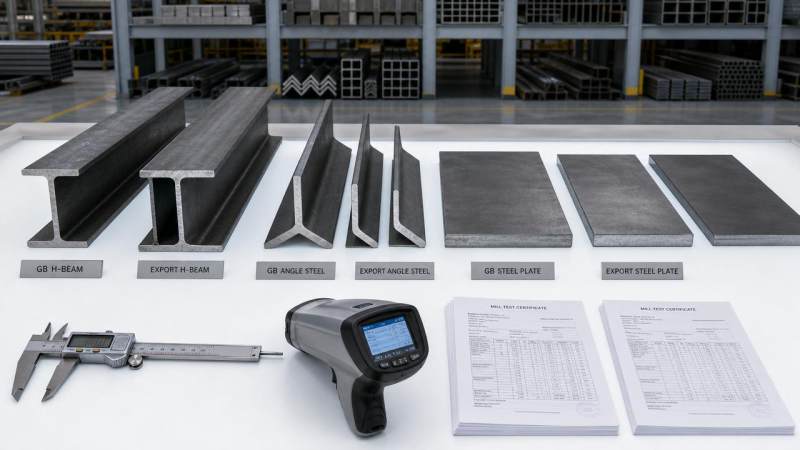
GB steel is not simply a local label. It is a complete Chinese standards system covering grades, shapes, testing, tolerances, marking, and delivery rules.
Common export grades follow ASTM, EN, JIS, AS/NZS, or project-specific specifications. Similar names may still represent different technical assumptions.
A checklist helps compare GB steel by function, not by grade name alone. This reduces disputes during inspection, fabrication, and site acceptance.
For structural steel exports, the most important question is practical equivalence. The material must meet strength, weldability, dimensional, and documentation expectations.
Core checklist for comparing GB steel with export grades
Use the following checklist before confirming orders, quotations, drawings, and mill certificates. Each point affects cost, availability, or project compliance.
- Confirm the exact GB steel standard number, grade, and product type before comparing it with ASTM, EN, or JIS alternatives.
- Check yield strength, tensile strength, elongation, and impact requirements instead of relying only on similar grade names.
- Compare chemical composition limits, especially carbon, manganese, sulfur, phosphorus, silicon, and micro-alloy elements affecting weldability.
- Review dimensional tolerances for angles, channels, beams, plates, and cold formed profiles before approving shop drawings.
- Match testing rules, sampling frequency, inspection method, and certificate format with the destination market requirements.
- Verify surface condition, straightness, edge quality, and marking rules because these details often affect fabrication efficiency.
- Request written equivalence confirmation when GB steel is offered as an alternative to an ASTM, EN, or JIS grade.
- Separate structural equivalence from commercial substitution, since a cheaper grade may not satisfy the same design assumptions.
Key grade comparisons buyers often review
Many projects compare GB steel grades such as Q235, Q355, and Q420 with familiar export standards. These comparisons require technical caution.
Q235 is often discussed against ASTM A36, JIS SS400, or EN S235. The mechanical range may look close, but details still matter.
Q355 is frequently compared with EN S355, ASTM A572 Gr.50, or similar high-strength structural grades. Impact options may differ by order condition.
Q420 and higher grades require closer review. Strength gains may influence welding procedures, preheating decisions, and fabrication qualification.
How dimensions and tolerances affect export acceptance
Dimensional comparison is as important as grade comparison. GB steel profiles may use size series that differ from overseas catalogues.
Angle steel, channel steel, H beams, and I beams can have different flange thicknesses, web dimensions, radii, and theoretical weights.
A project drawing may accept a strength equivalent but reject a profile if connection holes, bolts, or bearing plates no longer align.
Before ordering GB steel, compare section modulus, area, weight per meter, and load path. Do not compare nominal depth only.
- Measure actual profile geometry against the approved drawing, including flange width, web thickness, root radius, and length tolerance.
- Calculate theoretical weight differences, because freight cost, coating area, and project budget can change significantly.
- Confirm whether substitution needs engineer approval, especially for load-bearing steel beams and connection-critical members.
Chemistry, weldability, and fabrication behavior
Chemical composition determines more than strength. It affects weldability, toughness, galvanizing behavior, cutting quality, and long-term structural reliability.
When comparing GB steel with export grades, carbon equivalent is a useful indicator. Higher values may require controlled welding procedures.
Sulfur and phosphorus limits also matter. Excessive levels can reduce toughness and increase cracking risk during forming or welding.
For galvanized structures, silicon and phosphorus may influence coating appearance and thickness. This should be checked before hot-dip galvanizing.
Application scenarios where GB steel comparison matters
Construction and infrastructure steel
Construction projects often use GB steel for columns, beams, bracing, platforms, stairs, roof frames, and secondary support systems.
In these applications, grade equivalence must support structural calculations. Dimensional accuracy must also support bolted and welded connections.
Industrial equipment and manufacturing frames
Industrial fabrication may focus on repeatability, straightness, machining behavior, and weld distortion. GB steel should be evaluated by production performance.
For OEM components, drawings should define both standard references and acceptance limits. This prevents confusion between function and catalogue description.
Corrosion-resistant screening and support materials
Some projects combine carbon structural sections with stainless or specialty mesh materials for filtration, separation, protection, or architectural details.
For such needs, Stainless Steel Welded Mesh can support filters, sieves, chemical industry, mining, architecture, and residential uses.
Available grades include SS 201, 304, 304L, 316, 316L, and 430, using stainless steel wire with plain or twill weave options.
Typical ranges include 0.0008″-0.12″ diameter, 2-635 mesh, 25-84.6 open area, and customizable roll width or length.
Its resistance to rust, acid, alkali, heat, chemicals, and corrosion complements GB steel structures in demanding industrial environments.
Documentation checklist before approving GB steel
Documents should confirm the material, not simply accompany the shipment. A complete file helps avoid customs, inspection, and installation delays.
- Request mill test certificates showing heat number, GB steel grade, chemical analysis, mechanical results, and applicable standard.
- Check whether impact testing, ultrasonic testing, or third-party inspection is required by contract or destination regulation.
- Compare certificate values with the purchase specification, not only with the supplier’s quotation or commercial invoice.
- Require traceable marking on bundles, tags, or members when the shipment includes mixed sizes or multiple grades.
- Keep drawing revisions, packing lists, inspection photos, and loading records together for easier claims management.
Common risks when substituting GB steel
Assuming one-to-one equivalence
A GB steel grade may be similar to an export grade without being identical. Similar strength does not guarantee full compliance.
Always check the full technical requirement, including test temperature, thickness range, surface condition, and delivery state.
Ignoring tolerance differences
Tolerance differences can create problems during prefabrication. Small deviations may affect hole alignment, welding gaps, or assembly speed.
Use approved drawings and inspection records to define acceptable deviations before production begins.
Overlooking coating and finishing requirements
Painted, galvanized, or blasted GB steel needs finish specifications that match the service environment and project maintenance plan.
Surface preparation grade, coating thickness, zinc layer, and packaging should be confirmed before shipment.
Practical execution steps for reliable sourcing
Reliable sourcing starts with a clear specification. The supplier should know the end use, standard target, and acceptance process.
- Send drawings, target export standard, service environment, required certificates, and any mandatory inspection rules before quotation.
- Ask for a written GB steel comparison sheet showing grade, chemistry, mechanics, dimensions, and tolerance references.
- Approve samples, trial pieces, or first-article inspection when the order involves fabricated structural components.
- Confirm packaging, bundle weight, marking language, shipping marks, and moisture protection for long-distance export transport.
- Arrange third-party inspection when project risk, contract value, or destination regulation requires independent verification.
Hongteng Fengda supports structural steel exports with angle steel, channel steel, steel beams, cold formed profiles, and customized components.
Production can follow GB, ASTM, EN, and JIS requirements, helping reduce sourcing uncertainty across construction, industrial, and manufacturing projects.
Summary and next action guide
GB steel can be a reliable choice for export projects when comparison is based on engineering requirements, not only grade names.
The best approach is to compare strength, chemistry, dimensions, tolerances, testing, certificates, and application conditions before purchase approval.
For the next order, prepare drawings, target standards, quantity, finish requirements, and inspection expectations before requesting a quotation.
A clear GB steel checklist helps control risk, improve communication, and secure dependable structural steel for global projects.
Please give us a message


Please enter what you want to find