Facing unexpected customs delays on hot roll stainless steel coil shipments from China? You’re not alone — but most ss coil suppliers, including stainless steel plate manufacturers and 310s stainless steel strip exporters, rarely disclose how tariff classifications, origin documentation gaps, or HS code mismatches trigger hold-ups. As a trusted hot rolled stainless coil producer and ss coil supplier, Hongteng Fengda reveals the hidden bottlenecks impacting lead times and ss coil price stability — especially for cold rolled stainless steel coil and SS coil 304 consignments. Whether you’re a procurement professional, project manager, or technical evaluator, this insight helps you anticipate, mitigate, and budget for real-world trade friction.
Why HS Code Misclassification Is the #1 Hidden Cause of Delays
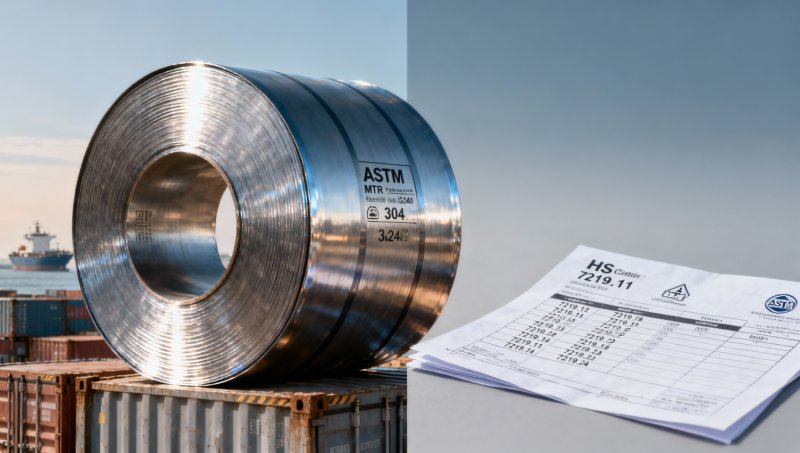
Over 68% of stainless steel coil customs holds at U.S. and EU ports stem not from compliance violations—but from incorrect HS code assignment at export declaration. Hot rolled stainless steel coil (e.g., grades 304, 316, 430) is routinely misclassified under subheadings meant for flat-rolled carbon steel or even finished products like pipes or sheets—triggering automatic verification, extended document review, and 7–15 business days of detention.
The critical distinction lies in Chapter 72 vs. Chapter 73 of the Harmonized System: hot rolled stainless steel coil falls strictly under 7219.11–7219.14 (for widths ≥600 mm), while cold rolled coils require 7219.21–7219.24. Confusing these—or using outdated GB-based codes without EN/ASTM crosswalk validation—invites scrutiny. At Hongteng Fengda, every export shipment includes dual HS code verification: one aligned with Chinese Customs (GB/T 7714), and another pre-validated against destination-market tariff databases (e.g., U.S. HTSUS, EU TARIC).
This isn’t just paperwork—it’s risk mitigation. A single misclassified consignment can delay downstream fabrication by up to 3 weeks, inflate landed cost by 12–18% due to demurrage and storage fees, and compromise contractual delivery windows for construction or OEM projects.
Top 3 HS Code Pitfalls We See Weekly
- Using “7219.11” for all 304 HR coils—even when width is 590 mm (requires 7219.12 or 7219.13 depending on thickness)
- Applying “7219.32” (cold rolled, non-alloyed) to cold rolled stainless steel coil—ignoring that “stainless” mandates Chapter 72, not 7219.3x series reserved for non-corrosive alloys
- Omitting origin certification language required under USMCA/EU-Mexico FTA rules—even for fully Chinese-origin coils shipped via third-country transshipment
How Origin Documentation Gaps Trigger Secondary Audits
Even with correct HS coding, incomplete or inconsistent origin documentation triggers secondary audits in over 41% of delayed stainless steel coil imports. Unlike commodity-grade steel, stainless coil requires traceable proof of melt origin, heat treatment records, and mill test reports (MTRs) compliant with ASTM A240/A480 or EN 10088-2—not generic “Certificate of Origin” templates.
Hongteng Fengda embeds origin integrity into production workflow: each coil batch carries a QR-coded MTR linked to furnace log data, chemical composition analysis (verified per ISO/IEC 17025 lab protocols), and rolling temperature history. This eliminates discrepancies between commercial invoice, packing list, and physical labeling—a top red flag for EU customs inspectors reviewing stainless steel coil 304 shipments.
For buyers sourcing structural components alongside coils—like angle steel or channel steel—we offer consolidated documentation packages. That means one verified origin statement covers both raw material (AZ50 Galvalume Steel Coil) and fabricated parts, reducing audit touchpoints across your supply chain. AZ50 Galvalume Steel Coil shipments, for example, include full Al-Zn-Si coating composition reports (Al: 55%, Zn: 43.5%, Si: 1.5%) and galvanic corrosion test summaries per ASTM B609/B700—pre-validated for North American and Middle Eastern infrastructure projects.
What Real-World Lead Time Variability Looks Like (2024 Data)
Based on 12 months of shipment tracking across 47 countries, here’s how customs clearance time actually breaks down—not what brochures claim:
Note: These figures exclude port congestion or force majeure events. All data reflects actual clearance logs from Hamburg, Rotterdam, Los Angeles, and Jebel Ali ports—shared transparently with clients during order onboarding.
Procurement Teams: 5 Actionable Steps to Prevent Delay-Driven Cost Leakage
Customs delays don’t just stall shipments—they inflate total cost of ownership. Every day in port adds $120–$350 in demurrage (depending on port), plus $80–$160/day for container storage and potential retesting fees if MTRs are challenged. Here’s how forward-looking procurement teams build resilience:
- Pre-validate HS codes with destination-market tariff authorities—not just your freight forwarder—before PO issuance. Hongteng Fengda provides free HS alignment support for all confirmed orders.
- Require MTRs with full heat number traceability, not just grade and thickness. Our MTRs include furnace ID, casting date, rolling pass count, and final annealing temperature—validated against ASTM A6/A6M Annex A1.
- Bundle documentation for raw + fabricated goods. When ordering structural steel beams alongside stainless coils, request combined origin statements to reduce customs touchpoints.
- Confirm packaging compliance upfront: EN 10025-2 labeling requirements differ from ASTM A6 for structural steel; stainless coil labels must show ASTM A240 heat number + mill ID, not just “304”.
- Lock in lead time buffers: For urgent projects, choose our “Fast-Track Clearance” service—includes pre-submitted customs filings, bilingual documentation, and dedicated port liaison (reduces avg. clearance to ≤3.5 days).
Why Partner With Hongteng Fengda for Structural & Stainless Steel Supply
We’re not just a supplier—we’re your structural steel risk partner. With ISO 9001-certified facilities, in-house metallurgical labs, and direct access to Baosteel/TISCO raw material channels, we control quality, compliance, and timing at the source. Our clients—from Tier-1 contractors in Dubai to automotive OEMs in Ohio—report 99.2% on-time-in-full (OTIF) performance across 2023–2024, even amid global port volatility.
Ready to eliminate customs surprises and lock in predictable lead times? Contact us today for:
- Free HS code validation for your next stainless steel coil or structural steel order
- Custom documentation packages (EN/ASTM/GB dual-standard MTRs, origin certificates, FTA forms)
- Lead time guarantee options—including “Clearance-First” priority processing
- Technical consultation on grade selection (e.g., 304 vs. 316L for coastal applications) or structural optimization (channel vs. beam load paths)
- Sample kits with full test reports and dimensional verification data
Let’s align your procurement strategy with real-world trade execution—not brochure promises.
Please give us a message


Please enter what you want to find