Understanding Hot Rolled Steel Coil price factors in 2026 matters because steel budgets are no longer shaped by mill quotes alone.
Raw materials, power costs, logistics, policy shifts, and regional demand now move together, often changing sourcing assumptions within a single quarter.
For projects tied to construction, manufacturing, and fabricated steel components, a clearer reading of these drivers helps reduce pricing surprises and timing risks.
Why 2026 pricing deserves closer attention
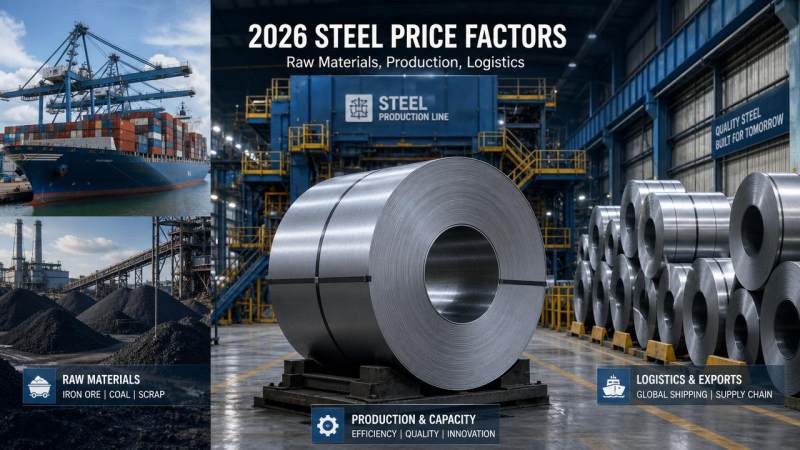
Hot Rolled Steel Coil remains a benchmark material across welded structures, pipe, machinery, storage systems, and downstream coated products.
That makes its price trend a useful signal for broader steel market conditions, not just for flat steel purchasing.
In 2026, the market is expected to stay sensitive to uneven industrial recovery, energy transition pressures, and trade measures across major importing regions.
A small change in ore, coking coal, natural gas, freight, or exchange rates can quickly affect delivered coil prices.
What shapes Hot Rolled Steel Coil prices at the mill level
The starting point is production cost.
For integrated mills, iron ore, coking coal, sintering costs, blast furnace efficiency, and rolling line utilization directly influence the base price.
For electric arc furnace producers, scrap availability and electricity pricing become more important.
Energy has become a stronger variable than many buyers expected.
Electricity tariffs, gas prices, and carbon-related compliance costs can lift conversion costs even when raw materials look stable.
Mill operating rates also matter.
When utilization drops, fixed costs are spread across fewer tons, which can limit price concessions.
When capacity rises too fast, mills may discount to keep order books full.
Core cost drivers to monitor
Demand, inventory, and trade are just as important
Hot Rolled Steel Coil pricing is never a pure cost calculation.
Demand from automotive, machinery, infrastructure, shipbuilding, and general fabrication can tighten supply faster than raw materials suggest.
Inventory levels across mills, traders, and ports help explain the gap between quoted prices and actual transaction prices.
Low visible inventory often supports firmer offers.
High inventory may pressure sellers, especially when cash flow or storage costs increase.
Trade policy adds another layer.
Anti-dumping duties, safeguard quotas, origin rules, and carbon border measures can reshape where material is sold and how prices reset by region.
This is especially relevant when comparing Asian supply with North American, European, or Middle Eastern landed prices.
Freight and downstream conversion costs change the real buying picture
The cheapest mill price does not always produce the lowest final steel cost.
Ocean freight, port handling, inland transport, insurance, financing, and customs timing all affect the delivered value of Hot Rolled Steel Coil.
For many projects, downstream processing is where the budget risk grows.
Pickling, slitting, cutting, coating, forming, and fabrication can magnify the impact of even modest coil price changes.
That is why evaluation should include related materials, not only the original coil input.
For example, some applications move from hot rolled substrate into galvanized sheet products for corrosion resistance and wider field use.
A relevant reference is Galv Sheeting, used in construction, transportation, energy, appliances, and industrial settings.
With grades such as DX51D+Z, SGCC, and S350GD+Z, thickness from 0.12mm to 6.00mm, and zinc coatings up to 275g/m², it shows how downstream specifications reshape final cost analysis.
Products meeting ASTM, EN, JIS, and GB standards also reduce compliance uncertainty when comparing international suppliers.
How supplier capability influences price stability
A low quote has limited value if execution risk is high.
In steel procurement, consistency in production, documentation, dimensional control, and delivery often matters as much as the initial offer.
This is where supplier profile becomes part of the price discussion.
A manufacturer with stable output, modern facilities, and clear quality control can help reduce rework, claims, and schedule disruption.
Hongteng Fengda, as a structural steel manufacturer and exporter from China, reflects this broader evaluation logic.
Its focus on angle steel, channel steel, beams, cold formed profiles, and customized structural components supports buyers needing coordinated steel sourcing.
For projects spanning standard sections and processed flat steel, dependable lead times and standards compliance can offset part of the apparent price gap.
Signals that matter more than headline price
- Ability to hold specifications across repeat orders
- Traceable compliance with ASTM, EN, JIS, or GB requirements
- Realistic lead times instead of aggressive promises
- Export experience across multiple regions
- Support for customized processing or OEM requirements
A practical framework for evaluating 2026 coil offers
A useful review starts by separating price into layers.
One layer is market direction.
Another is supplier execution.
The third is project-specific conversion and risk cost.
This prevents a common mistake: comparing only FOB or EXW numbers while ignoring total delivered impact.
When these factors are reviewed together, Hot Rolled Steel Coil quotes become easier to compare on a true commercial basis.
What to watch next
The 2026 market will likely reward disciplined monitoring rather than one-time price checking.
Shortlisting suppliers, mapping cost drivers, and testing delivered-price scenarios can reveal which offer is genuinely competitive.
It also helps to review related steel categories, especially when projects include structural sections, processed coil, or coated sheet in the same supply chain.
A grounded decision on Hot Rolled Steel Coil should connect market data, technical fit, and supplier reliability.
That approach creates a stronger basis for budgeting, contract timing, and long-term sourcing choices in a volatile steel environment.
Please give us a message


Please enter what you want to find