As global construction and industrial demand evolves, understanding hot rolled h beam pricing in 2026 is essential for informed sourcing decisions. From raw material costs and production capacity to export dynamics and regional demand shifts, several factors will shape the market. For budget control, risk reduction, and supply stability, market awareness matters more than ever.
Why hot rolled h beam price trends matter across different project scenarios
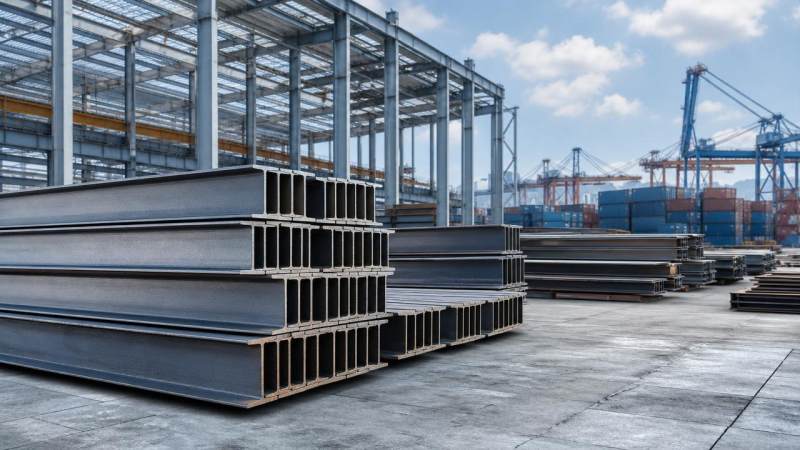
The hot rolled h beam market does not move in isolation. Prices respond to steelmaking costs, freight rates, energy markets, and end-use demand.
However, the real impact appears differently by application. A bridge project reacts differently than a machinery plant or a warehouse structure.
That is why 2026 sourcing decisions should begin with scenario-based analysis. The right buying strategy depends on where, how, and when steel will be used.
In structural steel planning, hot rolled h beam demand often rises when large infrastructure approvals, industrial investment, and export manufacturing recover together.
Which market background will shape hot rolled h beam supply in 2026
Several upstream and downstream forces are expected to influence hot rolled h beam availability and price direction in 2026.
First, iron ore, scrap, coking coal, and electricity costs will remain core price drivers. Even small changes can affect mill offers quickly.
Second, environmental controls may limit output in some regions. Temporary production cuts can tighten supply during already active construction periods.
Third, shipping conditions will continue to affect landed cost. Ocean freight, port congestion, and currency movement may reshape import competitiveness.
Fourth, demand may become more regional. North America, Europe, the Middle East, and Southeast Asia could show different buying cycles.
As a result, hot rolled h beam price trends in 2026 will likely show short-term volatility, not a single flat yearly pattern.
How demand differs in major construction and industrial scenarios
Steel structure buildings and warehouses
This scenario usually values cost efficiency, fast installation, and stable section availability. Standard sizes and repeat orders are common.
When warehouse and factory expansion accelerates, hot rolled h beam consumption often rises steadily rather than suddenly.
Bridge and infrastructure works
Infrastructure projects are more sensitive to specification compliance, traceability, and long delivery coordination.
In this case, price is important, but delivery reliability and standard conformity can matter even more than spot discounts.
Mechanical manufacturing and equipment frames
These applications may require tighter dimensional consistency and mixed material grades for fabrication performance.
Here, hot rolled h beam sourcing is less about bulk tonnage alone and more about processing suitability and predictable supply batches.
Shipbuilding and transport-related structures
This segment can react quickly to export cycles, steel certification requirements, and marine environment expectations.
Supply planning should account for grade availability, corrosion considerations, and shipment timing, especially for export-focused manufacturing.
What hot rolled h beam buyers should compare between scenarios
The same market movement can create different risks in different applications. Comparing demand logic helps improve sourcing accuracy.
This comparison shows why a single hot rolled h beam buying rule rarely fits all projects.
How product specification choices affect 2026 price outcomes
Specification selection directly affects budget. Grade, dimensions, coatings, and standards all influence the final hot rolled h beam price.
For example, common grades such as Q235, Q345B, SS400, S275JR, S355JR, A572, and A992 usually offer broader supply options.
Special materials, galvanized options, or stainless selections may increase cost but improve suitability in demanding conditions.
Typical dimensions also matter. Flange thickness can range from 8-64mm, while web thickness may reach 5-36.5mm.
Length flexibility from 1m-12m can support fabrication efficiency, but non-standard cutting plans may add processing and logistics complexity.
For projects balancing strength, construction simplicity, and material efficiency, H Section Beam solutions often provide a practical option.
Products aligned with JIS G3101, EN10025, ASTM A36, ASTM A572, and ASTM A992 are especially relevant in cross-border sourcing.
Which supply trends are most likely to influence hot rolled h beam sourcing from China
China will remain an important source for structural steel in 2026, especially where scale, lead time, and customization are key.
Supply trends may include more disciplined production planning, stricter quality documentation, and stronger export coordination.
For global projects, dependable mills and exporters can reduce uncertainty more effectively than chasing the lowest short-term quote.
Hongteng Fengda, a structural steel manufacturer and exporter from China, supports this need with stable capacity and customized solutions.
Its product range covers angle steel, channel steel, steel beams, cold formed profiles, and structural steel components for global applications.
With compliance to ASTM, EN, JIS, and GB standards, supply planning becomes easier for projects with multi-market specification requirements.
This matters when hot rolled h beam purchasing must align with both technical approval and shipment reliability.
Scenario-based sourcing suggestions for hot rolled h beam in 2026
A practical sourcing plan should match the project scenario, not just the latest price movement.
- For fast-track buildings, lock standard sizes early and confirm rolling schedules before peak season.
- For infrastructure, request test certificates, standard references, and delivery milestones before final confirmation.
- For manufacturing, verify dimensional tolerance and processing compatibility with the fabrication line.
- For marine or export use, review coating, corrosion resistance, and grade documentation in advance.
- For long-cycle projects, combine price tracking with phased ordering to reduce timing risk.
Where optimized strength-to-weight ratio is required, a suitable H Section Beam configuration can also support cost-saving design decisions.
Common mistakes when judging hot rolled h beam market conditions
One common mistake is focusing only on ex-works steel price. Actual cost also includes freight, packaging, inspection, and timing risk.
Another mistake is assuming all grades and sizes move together. In reality, some specifications tighten faster than others.
A third mistake is delaying technical confirmation. Late changes in standard or dimension can erase any early price advantage.
There is also the risk of underestimating lead time during demand rebounds. Hot rolled h beam supply can tighten quickly after major project releases.
Finally, relying on one market indicator alone is risky. Better judgment combines raw materials, production policy, regional demand, and shipment status.
What to do next for better hot rolled h beam planning
The 2026 hot rolled h beam market will reward preparation more than reactive buying. Scenario-based evaluation can improve cost visibility and supply confidence.
Start by defining the application, target standard, dimension range, and delivery window. Then compare suppliers on capacity, quality control, and export support.
For projects requiring stable structural steel sourcing from China, early technical alignment and phased planning can reduce both budget pressure and schedule risk.
A clear review of hot rolled h beam demand scenarios, price factors, and supplier reliability will help build stronger project outcomes in 2026.
Please give us a message


Please enter what you want to find