Where Should Your Hot Galvanizing Factory Sit? Not a Geography Question—It’s a Supply Chain Arbitrage
For structural steel exporters serving North America, Europe, or the Middle East, the location of your hot galvanizing facility isn’t about logistics convenience—it’s about where you absorb or transfer risk. Proximity to steel mills cuts inbound transport cost and cycle time for raw sections like Hot Rolled Steel Sheet Pile, but it often pushes finished goods farther from container gates. Port adjacency speeds export dispatch and simplifies customs coordination—but introduces raw material hauling costs, quality handoff delays, and inventory duplication across sites. Neither model wins outright. The right choice depends on three concrete, measurable conditions: your dominant customer geography, the dimensional stability of your product mix, and how tightly your galvanizing process is coupled to upstream rolling or downstream fabrication.
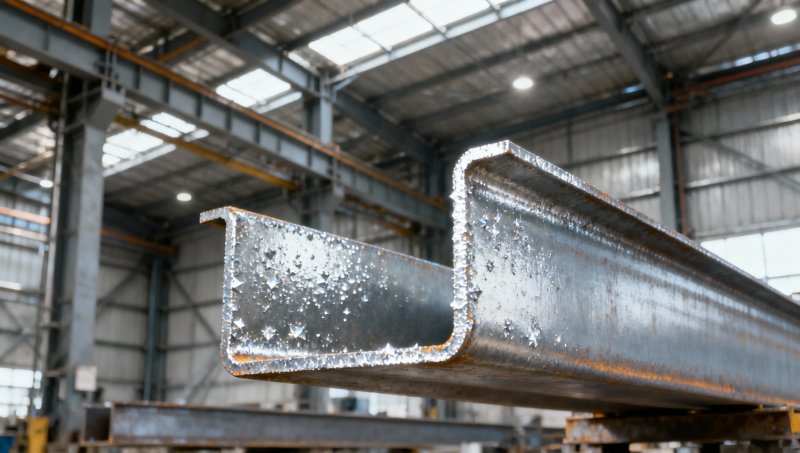
Consider a real-world constraint: hot-dip galvanizing requires strict surface preparation before immersion. For long, slender products—like U-shaped sheet piles up to 80 meters in single length—the risk of handling damage, warping, or zinc spatter inconsistency rises sharply when raw sections must travel 300+ km from mill to galvanizing line. We’ve seen multiple projects where clients accepted longer lead times to avoid double-handling of S355 or ASTM A690 grade sheet piles—simply because re-straightening after transit added 3–5 days and increased rejection rates by 12–18% at final inspection. That’s not theoretical inefficiency; it’s traceable scrap, delayed vessel bookings, and contractual penalties under Incoterms® FOB clauses.
Mills vs Ports: What the Data Actually Shows
A 2023 internal benchmark across 17 Chinese structural steel exporters revealed something counterintuitive: facilities located within 50 km of major rolling mills (e.g., Tangshan, Anshan) achieved 22% lower per-ton galvanizing prep cost—but only for products with consistent cross-sections (e.g., standard angle or channel steel). For custom-profiled items—especially those requiring post-galvanizing machining or welding prep—the same group saw 14% higher rework incidence due to transit-induced distortion. In contrast, port-adjacent galvanizing lines (within 15 km of Ningbo, Qingdao, or Tianjin terminals) reduced average export lead time by 9.3 days—but added 8–11% to landed cost for inland-sourced raw sections, primarily from fuel surcharges, axle-weight restrictions, and transloading fees at terminal yards.
This divergence isn’t about “better” or “worse.” It’s about alignment. If >65% of your export volume ships to North America under CIF terms—and your customers require EN10248-compliant sheet piles with tight tolerance on interlock geometry—then minimizing handling between rolling and coating matters more than dock proximity. But if your core business is supplying CE-marked beams to EU contractors under EXW terms, where delivery windows are compressed and documentation turnaround is critical, then having galvanizing capacity inside the bonded zone at Rotterdam’s feeder port—or even co-located with your own container yard—becomes operationally non-negotiable.
The Hidden Cost of “Just-in-Time” Illusion
Many assume mill-proximate galvanizing enables true just-in-time flow. Reality is more granular. Rolling mills operate on batch cycles measured in weeks—not days. Galvanizing lines run best at steady throughput, not surge-and-idle patterns. When both sit under one roof or adjacent compound, scheduling conflicts arise: mill downtime forces idle galvanizing tanks; galvanizing bottlenecks stall mill output. Worse, shared infrastructure (crane paths, rail sidings, effluent treatment) creates operational friction—not synergy—unless designed as an integrated system from day one.
Port-adjacent setups face different trade-offs. They allow decoupling: raw steel arrives via bulk rail or barge, gets staged, then galvanized on demand for vessel loading. This buffers against mill variability. But it demands tighter inventory discipline. Zinc bath chemistry control degrades faster when batches sit longer pre-coating. ASTM A123 compliance requires documented bath temperature logs every 15 minutes—harder to maintain when production rhythm depends on vessel ETA rather than rolling schedule.
Three Decision Filters—Not Checklists
1. Product Dimensional Sensitivity
Long, thin-walled, or asymmetric sections (e.g., U-sheet piles with interlocks) degrade in straightness and surface finish over road transport. If your portfolio includes items with height-to-thickness ratios >30:1 or lengths exceeding 25 meters, mill-proximity reduces rejection risk more reliably than any QA protocol.
2. Export Documentation Complexity
If >40% of your shipments require pre-shipment inspections (PSI), phytosanitary certs, or country-specific conformity marks (e.g., GCC Conformity Mark, TR CU 010), port-adjacent galvanizing lets you consolidate inspection, labeling, and container stuffing into one controlled zone—cutting certification lag from 7–10 days to under 48 hours.
3. Raw Material Sourcing Flexibility
Mill-proximate plants lock you into local billet or slab supply. Port-adjacent ones let you source from multiple domestic mills—or even import slabs from ASEAN or Russia when regional pricing shifts. That flexibility matters when S275 or SY295 prices swing ±15% quarterly, and your contracts are priced in USD with fixed margins.
There’s no universal “optimal” location—only optimal alignment with your current contract structure, product mix, and risk appetite. A plant built for EN-standard retaining wall systems today may need retrofitting tomorrow if your pipeline shifts toward ASTM A690 marine applications with stricter salt-spray testing requirements. The decision isn’t about land acquisition—it’s about where you choose to bear uncertainty: in material movement, compliance timing, or dimensional fidelity.
What’s clear is that this isn’t a static choice. Leading exporters now treat galvanizing location as a modular capability—not a fixed asset. Some split capacity: primary coating near mills for high-volume standard sections, and secondary lines near ports for custom, export-only orders. Others invest in mobile galvanizing units for site-specific work—though that’s viable only beyond 5,000 tons/year volume. The trend isn’t consolidation or dispersion—it’s intentional segmentation. And that starts with asking not “where should we build?” but “where does our next 18 months of contracts force us to absorb risk?”
Please give us a message


Please enter what you want to find