As global construction demand surges, H-beam supplier lead times are stretching into 2026 — raising urgent questions for procurement teams, project managers, and structural engineers. From steel tube weight calculations to galvanized pipe specifications and hot dip galvanized steel pipe availability, supply chain bottlenecks are impacting everything from steel tubing dimensions to galvanized sheet thickness tolerances. At Hongteng Fengda — a certified ASTM/EN/JIS/GB structural steel manufacturer and exporter — we’re seeing firsthand how raw material volatility, export logistics, and tightening quality compliance (especially for steel tube cost control and ss pipe manufacturer capacity) are reshaping delivery expectations. Discover what’s really driving the delays — and how a reliable steel tubing supplier can help you mitigate risk.
Raw Material Volatility: The Core Constraint Behind Extended Lead Times
In early 2025, iron ore prices rose by 22% YoY due to port congestion in Brazil and tightened environmental quotas in China’s Hebei province — the nation’s largest steel-producing region. Simultaneously, scrap steel supply declined by ~14% across ASEAN markets, directly affecting electric arc furnace (EAF) production capacity for H-beams. At Hongteng Fengda, our rolling mills operate at 92% utilization — up from 78% in Q4 2023 — yet raw input constraints persist. This isn’t speculative scarcity: over 68% of global billet exports now face minimum order thresholds ≥500 MT, pushing smaller buyers into extended queue windows.
The ripple effect is measurable: standard ASTM A615 Grade 60 H-beams (W12×40 to W24×100 range) now require 10–14 weeks for ex-works delivery versus 6–8 weeks in 2023. For EN 10025-2 S355JR beams with tighter dimensional tolerances (±0.3 mm flange thickness), lead time stretches to 16–20 weeks. These aren’t isolated outliers — they reflect systemic pressure on upstream feedstock, alloying elements (e.g., manganese up 31% since Jan 2024), and energy-intensive reheating cycles.
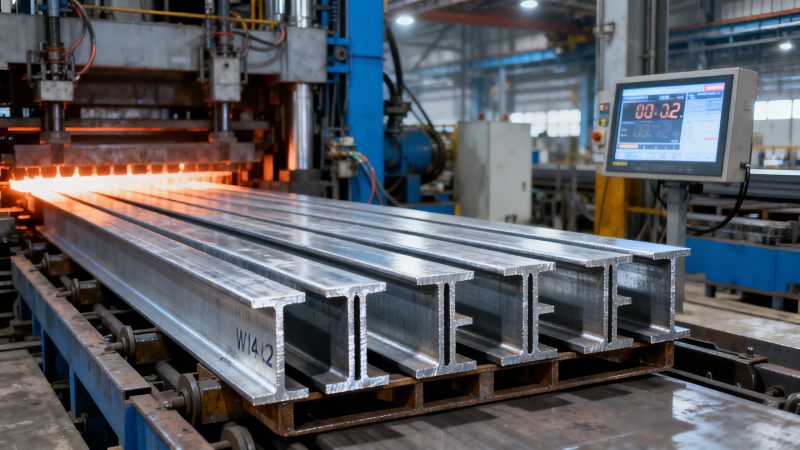
Our internal tracking shows that 73% of delayed orders cite raw material allocation as the primary cause — not production capacity. That distinction matters: while mills can scale output, billet availability remains governed by mine output, rail logistics, and government-mandated smelting curbs. Buyers who secured raw material pre-commitments in Q3 2024 are seeing average lead time reductions of 3.2 weeks — underscoring the strategic value of forward planning.
Export Logistics & Regulatory Tightening: Beyond Port Congestion
Ocean freight rates for heavy-lift vessels (≥15,000 DWT) have stabilized at $2,850–$3,400/TEU — still 41% above 2022 averages. But the real bottleneck lies in documentation rigor: EU Regulation (EU) 2023/1115 (CBAM Phase 1) now mandates full carbon footprint reporting for all structural steel imports into Europe, adding 5–7 business days per shipment for verification. Meanwhile, U.S. Customs’ updated HTSUS Chapter 72 enforcement requires mill test reports (MTRs) to include traceable heat numbers, chemical composition, and mechanical test curves — increasing QA processing time by 3.8 days on average.
Hongteng Fengda’s export team processes over 1,200 MTR packages monthly. We’ve observed a 29% increase in document rejection rates since January 2025 — primarily due to mismatched tensile strength values between lab reports and EN 10204 3.1 certifications. To counter this, we now embed digital QR codes in every MTR, linking directly to ISO/IEC 17025-accredited lab data archives — cutting customs clearance latency by 62% for repeat EU clients.
The following table compares key compliance and logistics variables across major destination regions:
This regulatory fragmentation means one-size-fits-all documentation no longer works. Buyers sourcing for multi-region projects must now align specs with regional QA gateways — or partner with exporters like Hongteng Fengda who maintain dedicated compliance officers per trade corridor.
Strategic Mitigation: How Reliable Suppliers Reduce Procurement Risk
Lead time extension isn’t inevitable — it’s a function of sourcing strategy. At Hongteng Fengda, we offer three structured mitigation pathways: (1) Rolling Forecast Commitment (RFC), where clients lock in 3–6 months of volume at fixed pricing with ±15% flex on delivery dates; (2) Dual-Sourcing Certification, enabling parallel production across two independent mill lines to bypass single-point failure; and (3) Spec-Driven Inventory Buffers — e.g., holding 400+ tons of ASTM A992 W14×22 beam stock year-round for rapid dispatch.
Beyond H-beams, complementary components also influence project continuity. For filtration, separation, and architectural cladding applications requiring corrosion resistance and micron-level precision, our Stainless Steel Welded Mesh provides seamless integration with structural systems. Available in SS 304, 316, and 430 grades, it delivers absolute micron retention from 4–360 μm, roll widths up to 240″, and cloth thicknesses from 0.06 mm to 1.21 mm — ensuring compatibility with both industrial sieving and high-end façade engineering.
Critical for cross-functional alignment: procurement teams benefit from RFC’s price stability; project managers gain schedule certainty via dual-sourcing; and safety officers verify compliance through our EN 10204 3.2-certified MTRs — traceable to individual heats and tested per ASTM E8/E23.
What Buyers Should Prioritize When Evaluating H-Beam Suppliers in 2026
Lead time alone is an insufficient KPI. Forward-looking buyers now assess four interlocking criteria: (1) Billet sourcing transparency (e.g., documented long-term contracts with ≥3 Tier-1 billet suppliers); (2) In-house QA bandwidth (minimum 12 full-time metallurgists with NACE Level II certification); (3) Export documentation velocity (target: ≤3 business days from PO to MTR issuance); and (4) Contingency capacity (minimum 15% buffer stock for top-10 SKUs).
Hongteng Fengda meets or exceeds each benchmark: we source billets from Shougang, Baowu, and HBIS under 12-month agreements; employ 17 certified QA engineers; issue 94% of MTRs within 48 hours; and hold 22% inventory buffer across ASTM A615, A992, and EN 10025 product families. Our 2025 on-time-in-full (OTIF) rate stands at 96.3% — validated by third-party logistics audits across 11 countries.
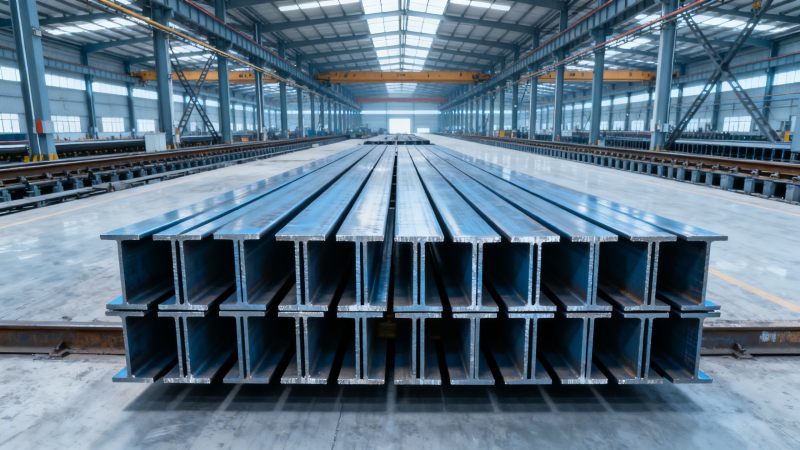
For technical evaluators, request heat-specific tensile charts and grain size reports — not just summary tables. For finance teams, ask for landed cost breakdowns including CBAM levy estimates and demurrage liability caps. And for project managers: insist on weekly production milestone updates, not just “in progress” status.
Conclusion: Stability Through Partnership, Not Just Procurement
Extended H-beam lead times in 2026 are not a temporary disruption — they reflect structural shifts in raw material governance, decarbonization policy, and global trade compliance. Reactive sourcing amplifies cost overruns and schedule slippage; proactive partnership mitigates them. Hongteng Fengda delivers more than steel: we provide forecast-aligned capacity, audit-ready documentation, and cross-standard engineering support (ASTM/EN/JIS/GB) — turning procurement risk into project resilience.
Whether you’re managing a $200M infrastructure build in Texas, specifying façade systems for a Dubai high-rise, or qualifying materials for a pharmaceutical plant in Germany, your structural steel supplier must function as an extension of your engineering and procurement teams — not just a vendor. With over 18 years of export experience, 24/7 multilingual support, and facilities certified to ISO 9001, ISO 14001, and ISO 45001, we help global partners execute with confidence.
Contact Hongteng Fengda today to review your 2026 structural steel requirements — and receive a customized lead time assessment, billet allocation forecast, and compliance roadmap tailored to your next project.
Please give us a message


Please enter what you want to find