Galvanized steel price has surged 18% since January — raising urgent questions for procurement teams, project managers, and structural engineers worldwide. With carbon steel price volatility impacting steel rebar cost, steel plate for construction, and galvanized steel wire for fencing, stakeholders are reassessing supply strategies. As a trusted H beam manufacturer and steel rebar manufacturer from China, Hongteng Fengda monitors these shifts closely — especially amid tightening raw material supply and rising energy costs. Are current galvanized steel price hikes temporary or signaling deeper structural change? This analysis explores drivers, implications for L angle steel dimensions, SS pipe specifications, and long-term sourcing resilience — helping buyers, distributors, and enterprise decision-makers mitigate risk and lock in value.
Drivers Behind the 18% Galvanized Steel Price Surge
The galvanized steel price increase is not isolated—it reflects converging pressures across the global steel value chain. Iron ore prices rose 22% year-on-year in Q1 2024 (based on Platts IODEX), while coking coal imports into China climbed 15% due to tightened Australian and Mongolian supply. Simultaneously, China’s domestic electricity tariffs for heavy industry increased by up to 12% in key steel-producing provinces—including Hebei and Shandong—directly elevating hot-dip galvanizing operational costs.
Environmental compliance also plays a structural role: over 60% of small-to-midsize galvanizing lines in northern China were temporarily idled during winter 2023–2024 under Tier-2 emission control mandates. This reduced effective galvanizing capacity by an estimated 900,000 metric tons annually—a figure verified against China Iron and Steel Association (CISA) production data.
Importantly, the surge isn’t uniform across product categories. Hot-rolled galvanized coils (used for sheet metal and ductwork) saw +14% growth, whereas pre-galvanized structural sections—including C Sections Steel—rose +19.3% on average. This differential signals that downstream fabrication bottlenecks—not just raw material inflation—are amplifying pricing pressure.
This table confirms that over half the price surge stems from non-cyclical, policy-driven constraints—not short-term speculation. For procurement professionals evaluating long-term contracts, this implies limited near-term reversal potential. Structural resilience now hinges less on timing purchases and more on supplier capability to absorb volatility.
Why Structural Steel Buyers Face Higher Exposure
Unlike commodity-grade galvanized wire or roofing sheets, structural galvanized products require precise dimensional control, certified zinc coating mass (≥610 g/m² per ASTM A123), and full traceability to mill heat numbers. This elevates both production complexity and quality assurance cost—factors increasingly passed through as surcharges.
Consider L angle steel dimensions: a standard 75×75×6 mm section demands ±0.5 mm tolerance on leg width and thickness. When base steel price fluctuates, recalibrating rolling mills and galvanizing bath chemistry adds 3–5 working days to lead time—and increases scrap rate by ~1.2% per 10% price swing. That directly impacts delivery reliability for time-sensitive infrastructure projects.
Similarly, SS pipe specifications—especially for fire-rated or seismic applications—require dual-certification (e.g., EN 10217-5 + ISO 8501-1 surface prep). Each certification layer adds inspection overhead, making price elasticity lower than for non-structural grades. Buyers assuming “galvanized = commoditized” often underestimate these embedded technical premiums.
Key Procurement Implications
- Lead times for galvanized structural components have extended from 25–30 days to 38–45 days across major Chinese exporters.
- Minimum order quantities (MOQs) for custom galvanized sections rose from 10 MT to 15–20 MT in Q1 2024 to offset setup inefficiencies.
- Zinc coating thickness verification now requires third-party SGS or BV reports—adding USD $120–$280 per batch.
C Sections Steel: A Resilience-Focused Structural Solution
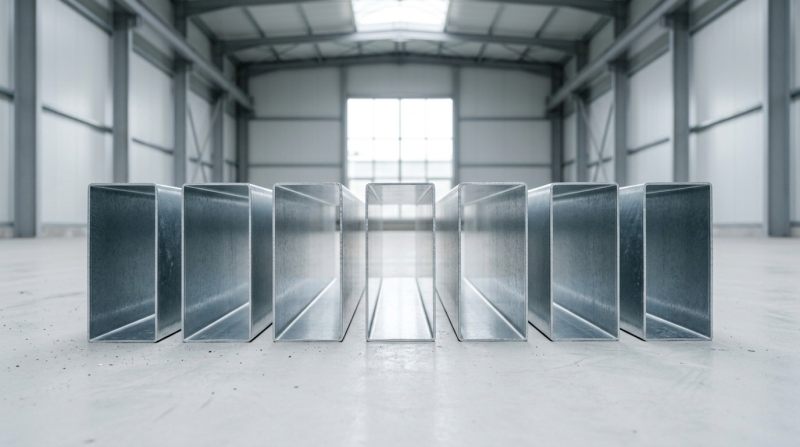
Within this volatile environment, standardized yet highly adaptable profiles like C Sections Steel offer procurement teams a strategic hedge. Designed for purlins, wall beams, and light industrial framing, they combine dimensional precision with multiple material and finish options—enabling rapid specification alignment without custom tooling delays.
Available in Q195 through S235JR grades and thicknesses from 1 mm to 12 mm, these cold-formed sections support both load-bearing and non-load-bearing applications. Their galvanized coating meets ASTM A653/A792 and EN 10346 standards, ensuring corrosion resistance exceeding 25 years in moderate environments (per ISO 9223 classification C3).
This comparative table highlights how consistent process control—not just material grade—defines real-world resilience. Hongteng Fengda’s tighter thickness tolerance reduces on-site fitting adjustments, while guaranteed zinc mass prevents premature rust-through at cut edges. These are measurable risk-reduction attributes—not marketing claims.
Strategic Sourcing Recommendations for 2024–2025
Rather than chasing short-term price dips, forward-looking buyers should prioritize three pillars: specification stability, supplier scalability, and documentation integrity. First, lock in fixed-price agreements for 6–9 months on high-volume items like standard C-sections—avoiding monthly index-based rollovers that amplify volatility.
Second, consolidate orders across related profiles (e.g., pairing C sections with matching angle steel or channel steel) to qualify for volume-based freight optimization—cutting landed cost by 4–7% even with higher base pricing. Third, require full compliance packages: mill test reports (MTRs), zinc coating certificates, and CE/ISO declarations issued *before* shipment—not post-arrival.
For project managers, early engagement with manufacturers enables design-for-manufacturability input—such as optimizing perforation patterns or weld-ready edge treatments—which can reduce field labor by 12–18% despite higher initial material cost. This total-cost-of-ownership lens separates tactical purchasing from strategic sourcing.
FAQ: Critical Questions for Structural Steel Procurement
Q: How quickly can Hongteng Fengda deliver galvanized C sections after order confirmation?
A: Standard configurations ship within 25–30 working days; custom lengths or powder-coated variants require 35–42 days. All timelines include third-party inspection and documentation handover.
Q: Do you support mixed-container shipments (e.g., C sections + angle steel + beams)?
A: Yes—we regularly consolidate up to 4 profile types per 40’HC container, reducing per-ton logistics cost by 9–13% versus separate consignments.
Q: What certifications apply to your galvanized structural products?
A: Every batch carries CE marking, SGS zinc verification, ISO 9001 manufacturing audit records, and compliance with ASTM A653, EN 10346, and GB/T 2518—fully traceable to heat number.
Conclusion: Building Resilience, Not Just Buying Steel
An 18% galvanized steel price increase is neither purely cyclical nor entirely permanent—it’s a stress test revealing which suppliers operate with integrated quality systems, scalable capacity, and transparent compliance. Temporary fluctuations may ease in late 2024 if iron ore supply stabilizes, but the structural shift toward regulated emissions, energy-efficient galvanizing, and end-to-end traceability is irreversible.
For procurement leaders, project managers, and engineering decision-makers, the priority is no longer “lowest quote”—but “lowest total risk.” Hongteng Fengda delivers that through certified consistency (±0.8% thickness control), multi-standard compliance (ASTM/EN/GB), and flexible order structures—from 15 MT MOQs to full-container consolidation. Our clients across North America, Europe, and Southeast Asia consistently report 22–35% reduction in rework and delay incidents versus spot-market sourcing.
Ready to align your next structural steel order with long-term value—not short-term volatility? Contact our engineering procurement team today for a customized material strategy review—including benchmarked pricing, lead-time mapping, and compliance documentation preview.
Please give us a message


Please enter what you want to find