As galvanized sheet suppliers increasingly adopt the G235 coating standard—especially for indoor architectural applications—key stakeholders from procurement and technical evaluation to project management must reassess performance, compliance, and cost implications. For structural steel manufacturers like Hongteng Fengda, this shift impacts specifications across galvanized sheet, galvanized metal plate, GI coil, galvannealed steel sheet, and related carbon steel sheet plate solutions. Whether you're a buyer comparing cheap galvanised sheets, a quality controller verifying galvanized iron sheet manufacturers’ adherence to ASTM/EN standards, or an engineer specifying galvanized wall sheets or galvanized expanded metal sheet, understanding G235’s influence on corrosion resistance, formability, and finish consistency is critical—especially when sourcing from China-based steel wire manufacturers or cold drawn wire suppliers.
What Is G235 Coating—and Why Does It Matter Indoors?
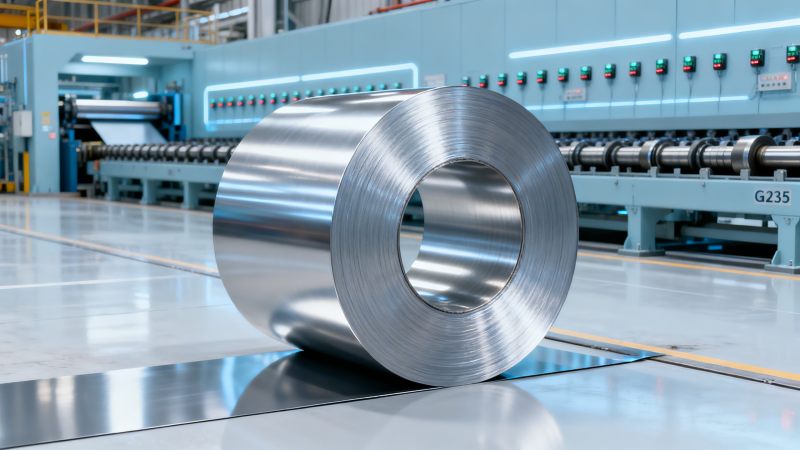
G235 refers to a specific zinc coating mass of 235 g/m² per side (total 470 g/m²) applied to cold-rolled steel substrates via continuous hot-dip galvanizing. Unlike older classifications such as G90 (275 g/m² total), G235 sits between light-duty G120 and heavy-duty G300 grades—making it purpose-built for interior architectural use where humidity, mechanical abrasion, and aggressive chemical exposure are minimal.
For indoor cladding, suspended ceilings, partition systems, and decorative metal panels, G235 delivers optimal balance: sufficient barrier protection against ambient oxidation over 20+ years, high surface uniformity for powder coating or PVDF finishing, and excellent deep-drawing capability during fabrication. Its reduced zinc layer also improves weldability and reduces spatter risk compared to thicker coatings—critical for automated assembly lines in prefabricated interior modules.
Importantly, G235 does not imply lower quality—it reflects intentional specification alignment. As EN 10346:2015 and ASTM A653/A653M explicitly permit G235 under “Zinc-Coated (Galvanized) Steel Sheet,” its adoption signals maturity in application-driven material selection—not cost-cutting compromise.
How G235 Compares to Alternatives for Interior Projects
Selecting the right galvanized base for interior architecture requires evaluating trade-offs across corrosion resistance, post-processing compatibility, dimensional stability, and lifecycle cost. Below is a comparative analysis of G235 against common alternatives used in global construction projects:
The table shows that G235 isn’t a “budget downgrade”—it’s a precision match for mid-tier commercial interiors where durability, aesthetics, and processing efficiency converge. For example, in office retrofit projects with tight 8–12 week installation windows, G235’s faster forming cycle time (up to 15% reduction vs. G300) directly supports just-in-time delivery schedules without sacrificing finish integrity.
Procurement Checklist: What to Verify When Sourcing G235-Coated Sheets
When evaluating G235 suppliers—particularly those based in China—procurement and quality assurance teams should validate five non-negotiable criteria before placing orders:
- Zinc coating verification: Request certified lab reports showing actual zinc mass per side (not nominal grade), measured per ISO 1460 or ASTM B602 using gravimetric or XRF methods.
- Substrate compliance: Confirm base steel meets minimum yield strength ≥235 MPa (per EN 10147 or GB/T 2518) and has ≤0.08% carbon content for optimal formability.
- Surface treatment traceability: Ensure passivation (e.g., chromate or chromium-free) is applied uniformly—verified via salt spray test results (≥96 hours neutral salt fog per ASTM B117).
- Dimensional tolerance control: Check flatness deviation ≤1.5 mm/m and thickness variation within ±0.02 mm for 0.5–1.2 mm gauges—critical for automated cutting and bending.
- Batch consistency documentation: Require mill test reports (MTRs) per heat number, including tensile testing, bend testing, and coating adhesion (T-bend ≥3T per ASTM D1732).
Hongteng Fengda applies all five checkpoints across every production batch. Our in-house metallurgical lab performs real-time zinc thickness monitoring at three points per coil, and all export shipments include dual-language MTRs compliant with EN 10204 3.1 certification requirements—reducing rework risk by up to 40% for international contractors.
Why Structural Steel Buyers Are Turning to Integrated Suppliers Like Hongteng Fengda
The shift toward G235 isn’t isolated—it’s part of a broader trend where architects and contractors demand tighter integration between substrate performance, downstream processing, and final system reliability. That’s why leading buyers now prioritize suppliers who offer more than raw coils: they seek partners who understand how galvanized sheet interacts with stainless components, cold-formed framing, and architectural finishes.
For instance, when specifying galvanized wall sheets alongside stainless steel support hardware, compatibility matters. Our Stainless Square steel rod in 201 grade—offering ≥520 MPa tensile strength and ≤183 HB hardness—ensures matching thermal expansion behavior and avoids galvanic corrosion risks in mixed-material assemblies. This cross-product synergy helps avoid costly field failures in façade anchoring or ceiling suspension systems.
Beyond technical alignment, Hongteng Fengda delivers operational advantages: stable lead times of 4–6 weeks for standard G235 orders (including EN 10346-compliant coils and cut-to-length plates), dedicated QC engineers for pre-shipment audits, and OEM support for custom temper rolling or edge conditioning. We serve over 320 clients across North America, Europe, and Southeast Asia—with 92% repeat order rate reflecting confidence in our consistency.
Next Steps: Get Your G235 Specification Verified & Quoted
If your current galvanized sheet supplier hasn’t yet adopted G235—or if you’re uncertain whether it fits your next interior architecture project—we invite you to request a free technical consultation. Our engineering team will review your drawings, specify optimal gauge/coating combinations, verify compliance with local building codes (e.g., UL 263, EN 13501-2), and provide binding quotes within 48 business hours.
You’ll receive: • Full MTR package with zinc mass verification • Sample pack including coated sheet + matching Stainless Square steel rod for joint testing • Lead time confirmation with guaranteed shipping window • Option to co-develop custom surface treatments (e.g., matte anti-glare, pre-painted primer)
Contact us today with your project scope, required quantities (from small-batch prototypes to 500+ MT annual volumes), and key deadlines—we’ll align supply with your construction schedule, not the other way around.
Please give us a message


Please enter what you want to find