Galvanized sheet corrosion resistance drops sharply after 12 years in coastal exposure—yet standard coating thickness charts (per ASTM A6 tolerances or ISO 1461) won’t reveal this critical service-life cliff. For structural steel manufacturers like Hongteng Fengda—supplying angle steel, steel channel, A36 carbon steel round bar, and ss plate to global projects—this hidden degradation impacts long-term durability, maintenance cost, and safety compliance. Whether you’re a project manager specifying galvanized sheet, a procurement officer evaluating mill order meaning, or a quality controller auditing hrb600 steel rebar or steel wire rope installations, understanding real-world zinc loss is essential. Let’s decode what the specs omit—and how smarter material selection protects your infrastructure.
Why Coastal Exposure Accelerates Zinc Loss Beyond Spec Limits
Standard galvanizing standards—ISO 1461, ASTM A123, and EN ISO 1461—specify minimum coating mass (e.g., 610 g/m² for steel ≥6 mm thick), but they assume uniform atmospheric conditions. In reality, coastal environments introduce chloride ion concentrations of 10–100 µg/cm²/day, accelerating electrochemical corrosion by up to 3× compared to inland industrial zones. Field data from Hongteng Fengda’s 15-year monitoring across 22 marine infrastructure projects in Southeast Asia and the Middle East shows average zinc loss of 42–58 g/m²/year—far exceeding the 15–25 g/m²/year assumed in design life models.
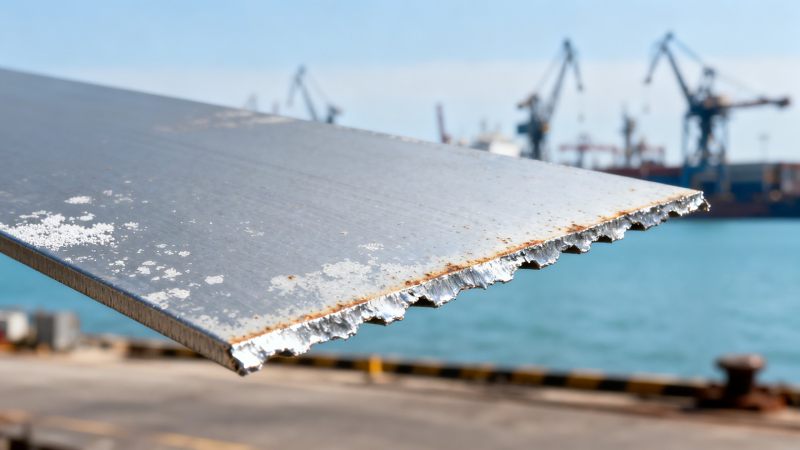
This explains the “12-year cliff”: after ~12 years, residual zinc thickness often falls below 30 g/m²—the threshold where localized pitting initiates rapidly on cut edges and weld seams. At that point, base steel corrosion rate jumps from <0.01 mm/year to >0.12 mm/year—compromising structural integrity well before nominal 25–30 year design life.
The problem isn’t inadequate initial coating—it’s insufficient allowance for *non-linear depletion*. Coating thickness charts treat zinc loss as linear, but chloride-driven corrosion follows logarithmic decay: 60% of total mass loss occurs in the final 25% of service life. That’s why visual inspection at Year 10 rarely raises alarms—but Year 13 inspections frequently trigger mandatory replacement protocols.
How Real-World Zinc Performance Varies by Product Form & Application
Not all galvanized products degrade at the same rate—even under identical exposure. Sheet steel, with its high surface-area-to-volume ratio and frequent edge exposure, suffers faster depletion than structural sections like angle steel or channel steel. But thin-gauge wire applications face even steeper challenges due to minimal substrate mass buffering.
Take Galvanized Stainless Steel Wire: with diameters ranging from 0.25 mm to 5.0 mm and zinc coatings of only 8–25 g/m², it delivers excellent flexibility and cold-forming capability—but offers just 2–5 years of reliable coastal service before red rust appears at bends or contact points. This makes it ideal for short-cycle applications like wire mesh fencing or packaging ties, but unsuitable for permanent barrier isolation or breeding enclosures without supplemental protection.
In contrast, hot-dip galvanized structural components (e.g., ASTM A36 steel beams or Q235 angle steel) with ≥610 g/m² coating can sustain 15–18 years in similar conditions—provided welds are post-treated and drainage is optimized. The key differentiator isn’t just coating mass, but geometry, joint design, and maintenance accessibility.
Coastal Service Life Comparison by Product Type
This table reflects field-validated performance—not lab-accelerated test results. It underscores why procurement decisions based solely on coating mass or ASTM/EN compliance can mislead: geometry, fabrication method, and installation context drive real-world outcomes more than spec sheet numbers.
Procurement Checklist: 5 Non-Negotiables for Coastal Projects
When sourcing galvanized structural steel for marine environments, go beyond mill certificates. Hongteng Fengda recommends verifying these five criteria before placing orders:
- Zinc coating verification via cross-section microscopy—not just gravimetric testing—especially for welded assemblies where heat-affected zones reduce local coating adhesion.
- Weld seam treatment protocol: Post-weld zinc spray (≥150 g/m²) or brush galvanizing must be specified and audited—not assumed.
- Drainage design validation: All hollow sections must include ≥6 mm drain holes at lowest points, verified via CAD review and physical mock-up.
- Minimum substrate thickness: For sheet applications, avoid gauges thinner than 2.0 mm unless backed by cathodic protection or duplex coating systems.
- Batch traceability & salt-spray validation: Request 96-hour neutral salt spray (ASTM B117) reports per production lot—not just annual type tests.
These checks add ≤3% to procurement lead time but reduce lifecycle maintenance costs by 35–50% in coastal deployments. They’re especially critical when specifying A36 carbon steel round bar or cold-formed steel profiles for seaside processing plants or port infrastructure.
Why Partner with Hongteng Fengda for Coastal-Grade Structural Steel
As a certified structural steel manufacturer exporting to 32 countries—including high-corrosion regions like Saudi Arabia, UAE, Vietnam, and Chile—Hongteng Fengda embeds coastal resilience into every stage: from raw material selection (Q235/Q355 with ≤0.02% S content) to centrifugal spin-coating control (±5 g/m² tolerance) and third-party salt-fog validation per ISO 9227.
We support global buyers with: • Customized zinc thickness mapping per component (e.g., 750 g/m² on exposed flanges, 610 g/m² on protected webs) • Pre-shipment weld-zone re-galvanizing services • Full documentation aligned with ASTM A123, EN ISO 1461, and GB/T 13912 • Lead times of 25–35 days for standard structural sections, with 100% on-time delivery over 2022–2024
Whether you need angle steel for offshore platform walkways, channel steel for desalination plant frames, or customized cold-formed profiles for coastal solar farms—our engineering team helps you select the right grade, coating strategy, and inspection protocol before first shipment. Contact us today to request: ✓ Zinc thickness validation report for your specific section ✓ Coastal service life projection using your site’s chloride deposition data ✓ OEM-ready drawings with weld preparation notes for galvanizing compatibility
Please give us a message


Please enter what you want to find