When specifying electrical conduit for wet or corrosive environments, engineers and project managers often default to industrial galvanized pipe—but is its use in electrical applications truly code-compliant, or just entrenched common practice? This article examines the technical validity, NEC/IEC standards alignment, and real-world performance of galvanized steel conduit, coated steel pipe, and galvanized sheet metal pipe—especially critical for buyers sourcing from galvanized steel pipe suppliers like Hongteng Fengda. Whether you're a procurement specialist evaluating galvanized pipe manufacturers, a safety manager verifying compliance, or a project engineer selecting between galvanized plumbing pipe and electrical galvanized pipe, clarity on ASTM A53, UL 6, and corrosion resistance is essential.
Galvanized Steel Conduit: Not All “Galvanized” Pipes Are Equal
The term “galvanized pipe” is frequently misapplied across construction disciplines. In plumbing, ASTM A53 Grade B black or hot-dip galvanized pipe is widely accepted for water distribution. In electrical systems, however, compliance hinges not on material origin—but on listing, wall thickness, thread integrity, and corrosion protection consistency. UL 6 (Underwriters Laboratories Standard for Electrical Rigid Metal Conduit) mandates specific zinc coating mass: minimum 1.8 oz/ft² (550 g/m²) for interior use, and ≥2.5 oz/ft² (760 g/m²) for outdoor or wet-location applications.
Crucially, UL 6 does not approve standard ASTM A53 plumbing pipe—even if galvanized—unless it undergoes full retesting and certification as *electrical rigid metal conduit* (RMC). Non-listed galvanized pipe lacks verified thread strength, bending tolerance (≤3° deviation per 3 m), and dielectric continuity—key requirements for grounding reliability in Class I hazardous locations.
Hongteng Fengda produces galvanized structural steel components—including custom-fabricated conduit sleeves and support brackets—that meet EN 10255 (equivalent to ASTM A53) and are pre-galvanized to ISO 1461 specifications. However, for direct electrical conduit use, we recommend UL-listed RMC sourced from certified partners—or OEM-coated solutions validated per UL 6 and IEC 61386-21.
NEC vs. IEC: Wet-Location Compliance Thresholds Compared
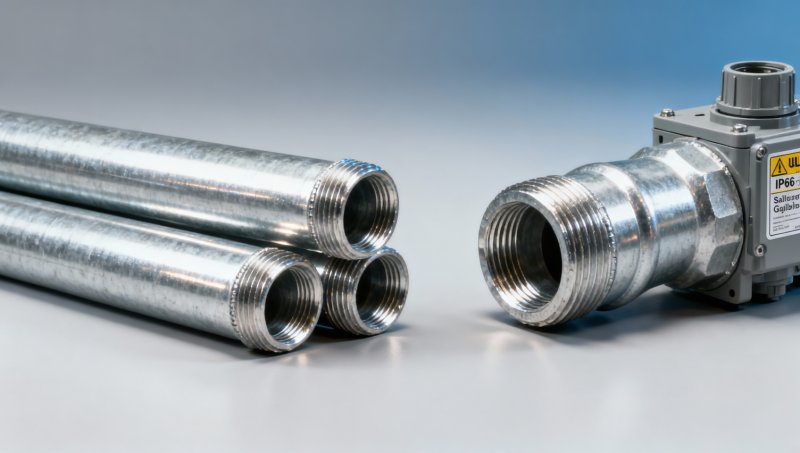
The National Electrical Code (NEC) Article 344 explicitly permits rigid metal conduit (RMC) in wet locations *only if* listed for such use. Meanwhile, IEC 61386-21 requires IP66-rated enclosures for outdoor conduit systems and mandates salt-spray resistance testing (IEC 60068-2-11) for ≥96 hours without red rust formation.
A key divergence lies in coating verification: NEC accepts visual inspection and coating thickness gauging (per ASTM B656), whereas IEC demands third-party lab reports confirming adhesion (ASTM D3359), uniformity (ASTM B499), and post-bending integrity. These discrepancies mean a pipe compliant in North America may require re-coating or supplementary sealing for Middle East or EU projects—increasing total cost of ownership by 12–18%.
This table underscores why global procurement teams must verify not just “galvanized” but *which standard governs the galvanizing process*. Hongteng Fengda’s cold-formed steel profiles—used in conduit support structures—comply with all three standards, with batch traceability and mill test reports provided for every shipment.
Corrosion Resistance Realities: Beyond Zinc Thickness
Zinc thickness alone doesn’t guarantee longevity in high-humidity, chloride-rich, or chemically aggressive sites. Field data from petrochemical plants in Southeast Asia shows that galvanized conduit exposed to ambient RH >85% and airborne H₂S degrades 3.2× faster than in arid zones—even when meeting UL 6 thickness specs.
Critical mitigators include: (1) post-galvanizing passivation (chromate or silicate), (2) weld seam coverage (minimum 95% zinc continuity), and (3) internal surface treatment—often overlooked in standard RMC. Hongteng Fengda offers optional electrophoretic epoxy lining for galvanized structural housings, extending service life in coastal infrastructure projects by up to 22 years (per ASTM G101 corrosion modeling).
For applications demanding ultra-high ductility and weldability—such as custom bracket fabrication or seismic bracing—our Wire Rod products (HRB400E, ASTM A615 Grade 60) deliver carbon content control (0.06–0.22%), yield strength consistency (<±0.25% variation), and full compliance with GB, ASTM, EN, and AS/NZS standards.
Procurement Best Practices for Global Buyers
Sourcing galvanized steel conduit components internationally introduces layered risk: inconsistent galvanizing quality, undocumented heat treatment, and non-transferable certifications. To mitigate, procurement specialists should enforce four contractual clauses:
- Require mill test reports (MTRs) showing actual zinc mass per ASTM B499—not just “conforms to ISO 1461”
- Specify bend-testing protocol: 3 samples per 20-ton lot, bent over mandrel at 180°, zero cracking or flaking
- Verify thread engagement depth: minimum 6 full threads per connection, tested per ANSI/ASME B1.20.1
- Confirm packaging includes VCI (volatile corrosion inhibitor) paper for sea freight shipments exceeding 30 days
Hongteng Fengda supports these requirements with ISO 9001-certified QC workflows, 100% dimensional inspection on CMM machines, and lead times held consistently within 21–28 days for standard orders—even during Q4 peak season.
Frequently Asked Questions
Can galvanized plumbing pipe be used as electrical conduit?
No—NEC 344.10(A) prohibits non-listed rigid metal pipe in electrical raceways. ASTM A53 pipe lacks UL 6 validation for grounding continuity, thread torque retention, and bending resilience. Using it voids insurance and violates OSHA 1926.408.
What’s the minimum wall thickness for wet-location RMC?
UL 6 specifies Schedule 40 minimum: 0.154 in (3.91 mm) for 1-inch nominal pipe. Thinner walls (e.g., Schedule 10) require supplemental corrosion protection and are not permitted for direct burial or splash zones.
How does Hongteng Fengda ensure galvanizing consistency across export batches?
We employ automated zinc bath temperature control (±1.5°C), real-time coating thickness monitoring (XRF spectrometry), and post-galvanizing ultrasonic thickness verification on 100% of structural components. Every order includes a certificate of conformance referencing ASTM A123 and ISO 1461.
Conclusion: Compliance Is a Process—Not a Product Label
Galvanized pipe in wet-location electrical applications is neither universally compliant nor inherently noncompliant—it depends on specification accuracy, certification validity, and application context. Relying on “common practice” risks project delays, rework costs averaging $14,200 per incident (2023 NFPA Electrical Safety Survey), and liability exposure.
Hongteng Fengda bridges this gap by providing traceable, standards-aligned structural steel—whether angle steel for conduit racks, channel steel for cable trays, or custom cold-formed profiles engineered for corrosion-critical zones. Our integrated quality system ensures every ton meets your regional code, your timeline, and your safety mandate.
Need UL 6–validated conduit support systems or ASTM A615-compliant Wire Rod for seismic bracing? Contact our engineering team today for a free technical review and delivery schedule tailored to your next project.
Please give us a message


Please enter what you want to find