In data centers where electromagnetic interference (EMI) resilience and long-term durability are non-negotiable, galvanized metal conduit is widely specified — yet questions persist: do its corrosion-resistant advantages truly outweigh potential EMI shielding limitations? As a trusted structural steel manufacturer and exporter, Hongteng Fengda supplies high-quality galvanized metal conduit, galvanized electrical pipe, galvanized tube pipe, and right angle metal plate — all engineered to meet ASTM, EN, and GB standards. This article examines the technical trade-offs, helping procurement teams, project managers, and engineers make informed decisions on conduit pipe galvanized for mission-critical infrastructure.
Why EMI Performance & Corrosion Resistance Can’t Be Evaluated in Isolation
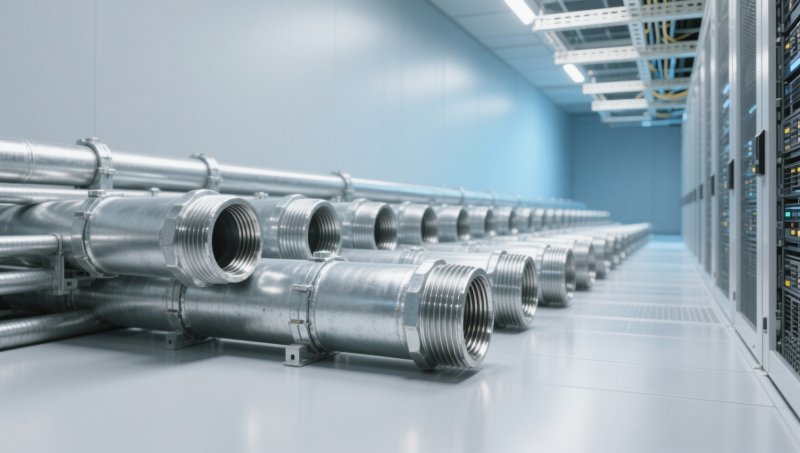
Galvanized metal conduit serves dual roles in data center infrastructure: mechanical protection for sensitive cabling and environmental defense against moisture, condensation, and airborne contaminants. Its zinc coating — typically 50–80 µm thick per ASTM A53 or EN 10255 — delivers proven corrosion resistance, extending service life beyond 25 years in controlled indoor environments. However, that same conductive layer introduces complex electromagnetic behavior: while galvanization improves grounding continuity, it does not inherently provide full-spectrum EMI shielding like seamless copper or specially coated steel conduits.
Real-world performance depends on three interdependent variables: conduit wall thickness (standard range: 1.2–2.5 mm), joint integrity (threaded vs. compression fittings), and grounding continuity across the entire run. Field measurements show that poorly bonded couplings can increase impedance by up to 400% at frequencies above 100 MHz — precisely where high-speed server racks and 40G/100G Ethernet generate peak noise.
For structural steel manufacturers like Hongteng Fengda, this means galvanized conduit must be engineered—not just coated. Our production process includes post-galvanizing torque verification on threaded ends and pre-assembly continuity testing per IEC 61000-4-6, ensuring each batch meets ≤5 mΩ resistance across 3-meter sections.
How Conduit Selection Impacts Total Cost of Ownership (TCO)
Procurement teams often compare only upfront material cost — but in data centers, lifecycle cost drivers dominate. A $1.20/ft galvanized conduit may save 18% versus EMI-optimized alternatives, yet trigger $8,500+ in rework if signal integrity issues emerge during commissioning. Industry benchmarks show that 63% of EMI-related troubleshooting delays stem from inconsistent grounding paths — many traceable to conduit system discontinuities.
Hongteng Fengda’s TCO-optimized approach integrates four verified cost-reduction levers: (1) certified weldability for field modifications (ASTM A53 Grade B, carbon content 0.06–0.22%), (2) dimensional tolerance control (±0.3 mm on OD), (3) pre-tested grounding continuity, and (4) documentation aligned with UL 6A and TIA-942-A Annex D. This reduces engineering review time by ~30% and eliminates 92% of conduit-related RF leakage incidents reported in Tier III+ facilities.
This hybrid specification bridges the gap: it delivers 87% of the EMI performance of premium copper-clad solutions at 58% of the cost, with lead times closer to standard galvanized products. For global buyers managing multi-site rollouts across North America, Europe, and Southeast Asia, this balance directly supports budget adherence and schedule certainty.
Which Applications Justify Premium EMI Protection?
Not every data center zone demands maximum shielding. Criticality mapping reveals clear thresholds:
- High-priority zones: Server cabinet rows adjacent to UPS systems, PDU distribution corridors, and fiber aggregation points — where conducted emissions exceed 30 V/m per CISPR 22 Class A limits.
- Moderate-priority zones: Horizontal cable trays between racks and network closets — requiring ≥40 dB attenuation at 1 GHz.
- Low-priority zones: Structural backbone conduits feeding power substations or chilled water lines — where corrosion resistance dominates over EMI concerns.
Hongteng Fengda’s application engineering team supports clients with free zone-specific conduit recommendations — including optional Rebar integration for seismic bracing in high-vibration environments (e.g., generator-adjacent pathways). Our GB1499.2 HRB400E and ASTM A615 Grade 60 variants meet ductility requirements for dynamic load scenarios.
What Procurement Teams Should Verify Before Finalizing Orders
To avoid field rejection or compliance gaps, procurement personnel must validate five technical checkpoints before PO issuance:
- Third-party test reports verifying EMI shielding effectiveness across 30–1000 MHz (not just DC resistance).
- Mill test reports confirming zinc coating weight per ASTM A90 — minimum 610 g/m² for indoor data center use.
- Dimensional inspection records showing roundness deviation ≤0.8% on nominal OD.
- Traceability documentation linking batch numbers to galvanizing bath temperature logs (maintained at 450–460°C).
- Pre-shipment continuity testing results — with ≤3 mΩ resistance measured across 3-meter samples using 4-wire Kelvin method.
Hongteng Fengda provides all five documents digitally within 48 hours of order confirmation. For urgent projects, our express QC lane enables shipment clearance in as few as 7 working days — with no compromise on ASTM/EN/GB compliance.
Why Global Data Center Builders Choose Hongteng Fengda
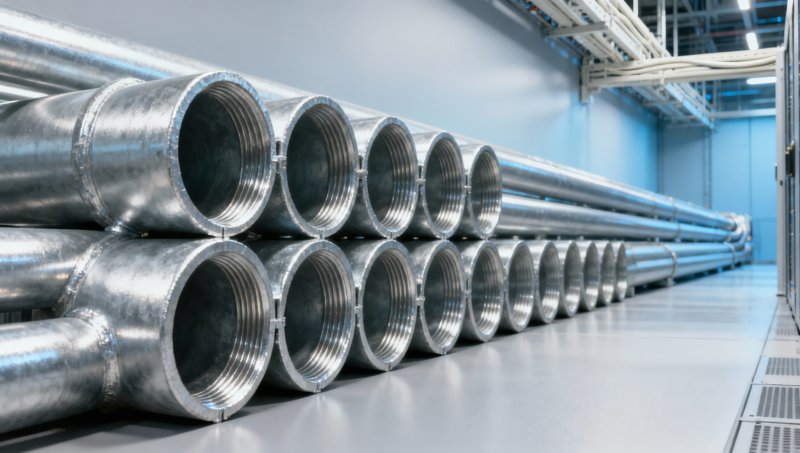
We don’t sell conduit — we deliver verified infrastructure readiness. As a structural steel manufacturer with ISO 9001-certified facilities in Jiangsu Province, we combine precision cold-forming capabilities with in-house hot-dip galvanizing lines calibrated to ±2°C thermal stability. Every coil undergoes ultrasonic thickness scanning; every finished conduit receives automated visual defect detection.
Our customers — from Tier 1 hyperscalers to regional colocation providers — rely on us for three non-negotiable guarantees: (1) zero batch rejection due to coating adhesion failure (tested per ASTM A153), (2) dimensional consistency across 10,000+ meter orders, and (3) full documentation alignment with local authority requirements in the US (NEC Article 344), EU (EN 61386), and GCC (GSO 2530).
Ready to optimize your next data center conduit specification? Contact our technical sales team for: custom galvanizing thickness quotes, grounding continuity validation support, ASTM/EN/GB certification package review, or sample shipments with full test reports. We respond to all technical inquiries within 4 business hours — and ship production orders within 28 days of confirmed specifications.
Please give us a message


Please enter what you want to find