For buyers managing structural performance, cost, and long-term durability, galvanized steel angle is not just a standard product—it is a decision that can affect project reliability.
When the coating really matters, zinc protection, production quality, and application fit become central to steel selection.
In construction and industrial use, the right galvanized steel angle helps reduce corrosion risk, improve service life, and support predictable maintenance planning.
Understanding Galvanized Steel Angle in Structural Use
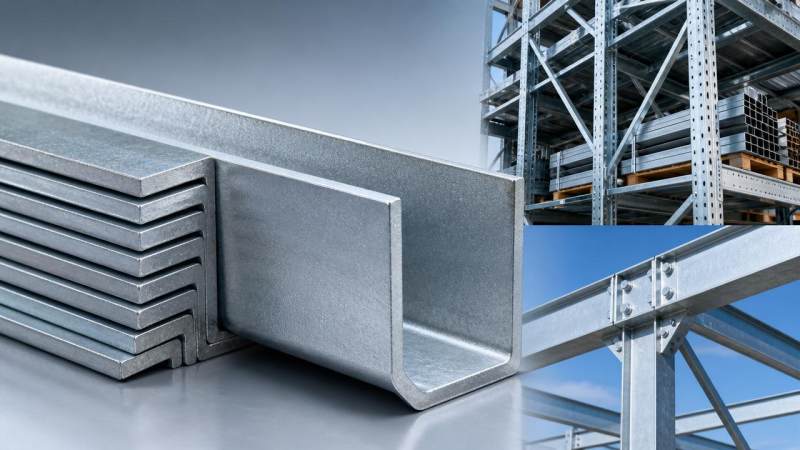
Galvanized steel angle is an L-shaped structural section protected by a zinc coating.
It is widely used in frames, supports, brackets, edge protection, towers, and secondary steel components.
The base material provides strength and formability. The zinc layer adds corrosion resistance.
That combination makes galvanized steel angle valuable in exposed, humid, or variable environments.
Common production routes include hot-dip galvanizing and pre-galvanized processing.
Hot-dip galvanized steel angle usually offers thicker coating and stronger outdoor protection.
Pre-galvanized options may suit lighter indoor applications where corrosion pressure is lower.
The coating matters most when the steel will face weather, water, chemicals, or long replacement cycles.
Why coating quality changes performance
Zinc acts as a barrier between steel and the environment.
It also offers sacrificial protection, slowing rust even if the surface gets scratched.
If coating thickness is inconsistent, edge zones and drilled areas may corrode earlier.
That is why galvanized steel angle should be evaluated beyond dimensions alone.
Current Industry Focus on Corrosion Protection
Steel users increasingly compare not only section size and price, but also lifecycle value.
For galvanized steel angle, current market attention often centers on the following signals:
- Coating thickness consistency across the full angle surface
- Adherence to ASTM, EN, JIS, or GB material standards
- Surface finish quality after galvanizing
- Hole, cut, and weld area treatment requirements
- Traceability and mill quality records
- Lead time stability for export and project scheduling
Global projects also place more emphasis on specification compliance.
That trend is especially visible in infrastructure, power systems, logistics facilities, and industrial expansion projects.
Business Value of Choosing the Right Galvanized Steel Angle
The correct galvanized steel angle can improve more than corrosion resistance.
It can influence fabrication speed, installation efficiency, and total project cost over time.
Reliable coating quality helps avoid premature repainting, replacement, and shutdown-related repairs.
This is especially relevant where steel remains visible, exposed, or difficult to access later.
Where lifecycle value becomes visible
- Outdoor structures with long service expectations
- Industrial sites with moisture or process emissions
- Coastal or high-humidity installations
- Projects requiring lower maintenance interruption
A stable supply partner also supports value.
Hongteng Fengda, a structural steel manufacturer and exporter from China, supplies angle steel, channel steel, beams, and custom profiles.
With modern production and strict quality control, the company supports ASTM, EN, JIS, and GB requirements.
That matters for projects seeking dependable lead times, consistent quality, and reduced sourcing uncertainty.
Typical Applications and Selection Paths
Galvanized steel angle serves both primary and secondary structural functions.
Selection usually depends on environment, load demand, fabrication method, and compliance needs.
In mixed structural packages, angle sections may be specified together with reinforcing steel.
For heavily loaded concrete structures, HRB500 Rebar is often relevant.
Its high-strength seismic-resistant performance suits super high-rise buildings, long-span bridges, and heavy-duty industrial plants.
Available sizes range from φ6 to φ50, with standards including ASTM, DIN, GB, and JIS.
What to Check Before Ordering
Not every galvanized steel angle is equal in field performance.
A clear review process can prevent mismatch between specification and actual use conditions.
Key review points
- Confirm steel grade, section dimensions, and length tolerances
- Request coating thickness data and galvanizing method details
- Check whether cutting, punching, or welding is required after delivery
- Review environment severity, including coastal, chemical, or wet exposure
- Verify packaging, labeling, and traceability for export handling
- Align inspection standards before production begins
If post-fabrication galvanizing is planned, dimensions and venting design should be coordinated early.
If pre-galvanized stock is used, edge treatment may need additional attention after cutting.
These details directly influence how galvanized steel angle performs in real service conditions.
Common mistakes to avoid
- Selecting by unit price without coating review
- Ignoring weld area protection after fabrication
- Using indoor-grade assumptions for outdoor exposure
- Missing documentation for standards compliance
Practical Direction for Stable Supply and Long-Term Performance
When the coating really matters, galvanized steel angle should be treated as a performance-critical material choice.
The right decision combines section design, zinc protection, manufacturing consistency, and project environment understanding.
For global construction and industrial sourcing, stable production capacity and reliable quality control remain essential.
A supplier able to provide standard specifications and customized structural steel solutions can simplify execution across multiple project phases.
Review technical requirements early, compare coating options carefully, and confirm standards before ordering galvanized steel angle in volume.
That approach helps control cost, reduce corrosion-related risk, and support consistent structural performance over the full service life.
Please give us a message


Please enter what you want to find