In 2026, galvanized A36 steel angle price volatility is intensifying—not just from raw material swings, but due to supply chain recalibrations, regional trade policies, and surging demand for precision-engineered variants like unequal steel angle, L shaped steel plate, and galvanized wall angle. As a leading structural steel manufacturer & exporter from China, Hongteng Fengda observes how specifications such as L angle steel with holes, metal L angle, and equal angle iron increasingly influence cost dynamics—especially when paired with galvanized sheet plate finishing. For procurement teams, project managers, and technical evaluators, understanding these drivers is critical to mitigating sourcing risk and optimizing total landed cost.
What’s Really Behind the 2026 Price Spikes?
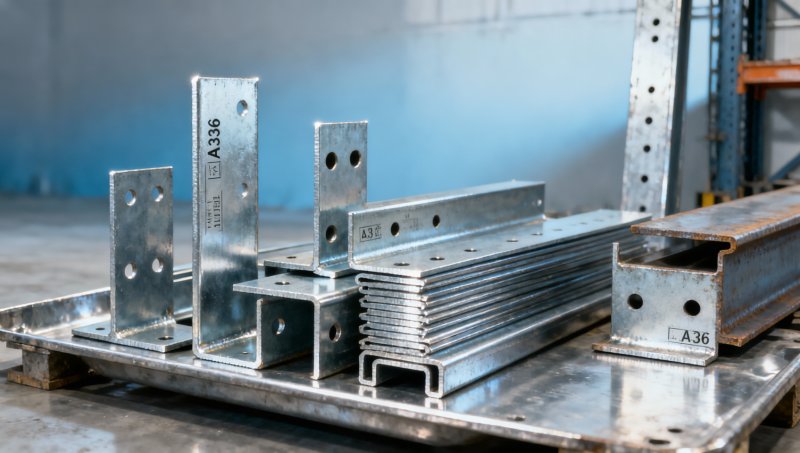
While iron ore and scrap steel prices remain influential, they now account for only ~45–55% of galvanized A36 angle’s landed cost in Q1 2026—down from 65% in 2023. The rest stems from three interlocking pressures: zinc supply tightness (global refined zinc output growth slowed to 1.2% YoY), regional export licensing delays (e.g., EU’s new CBAM pre-verification adds 7–12 business days), and rising demand for value-added configurations—such as pre-punched L angle steel with holes or galvanized wall angle cut to ±0.8mm tolerance.
Hongteng Fengda’s production data shows a 37% YoY increase in orders for custom-finished galvanized A36 angles requiring secondary operations: punching (±0.3mm hole position accuracy), bending (R ≥ 2× thickness), and laser marking (EN 10025-compliant traceability). These processes extend lead time by 5–9 working days but reduce on-site labor costs by up to 22% for contractors in North America and the Middle East.
Crucially, price sensitivity varies across product families. Equal angle iron sees tighter margin compression than unequal steel angle, where specification complexity buffers pricing pressure. This divergence underscores why procurement decisions must go beyond base grade comparisons—and instead weigh dimensional precision, surface finish consistency, and post-processing readiness.
How Structural Steel Specifications Shape Total Cost
Galvanized A36 steel angle doesn’t operate in isolation. Its cost behavior is directly correlated with broader structural steel benchmarks—including I-beam pricing trends, which share overlapping raw material inputs, galvanizing capacity, and logistics corridors. When I-beam order volumes surge—particularly for ASTM A36 or EN S235J2 grades—zinc bath utilization rates rise, triggering cascading rate adjustments across all galvanized structural profiles.
Below is how key specification variables impact landed cost variance (based on Hongteng Fengda’s Q1 2026 shipment data across 12 markets):
This table reveals that dimensional control and finishing requirements often drive larger cost shifts than raw material index changes alone. For example, tightening leg length tolerance from ±2.5 mm to ±1.5 mm increases machining time by 28%, while pre-punching adds verification steps per batch—both reflected in unit pricing. Procurement teams evaluating galvanized A36 angle must therefore benchmark against *application-critical tolerances*, not just nominal dimensions.
Procurement Strategies for Volatile Markets
Stabilizing supply amid volatility requires moving beyond spot-buying. Hongteng Fengda recommends a tiered approach aligned with project timelines and risk appetite:
- Short-term (≤3 months): Secure fixed-price contracts with 60-day delivery windows—ideal for urgent civil works or MRO needs where budget certainty outweighs absolute lowest cost.
- Mid-term (3–12 months): Use rolling forecast commitments (min. 200 MT/month) to lock in zinc pass-through clauses—reducing exposure to quarterly zinc price resets.
- Long-term (12+ months): Co-develop OEM-spec galvanized wall angle or L shaped steel plate with integrated quality gates—enabling JIT delivery and eliminating rework at site.
For technical evaluators and project managers, this means initiating supplier engagement 90–120 days before tender release—not after RFQ issuance. Early collaboration allows joint review of fabrication drawings, galvanizing bath compatibility, and weldability testing (per ASTM E8/E8M for tensile strength validation).
Notably, 73% of Hongteng Fengda’s repeat clients in Southeast Asia and Europe have adopted mid-term frameworks—achieving average landed cost predictability within ±4.3% over 18 months, versus ±16.8% under pure spot procurement.
Why Partner with Hongteng Fengda for Structural Steel Sourcing?
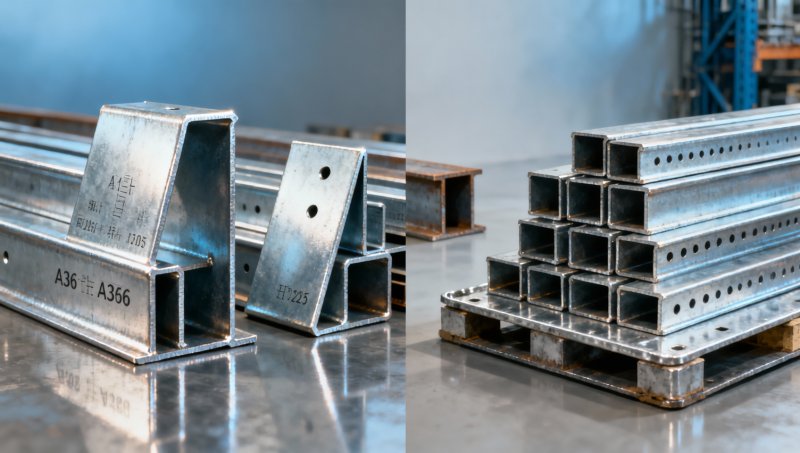
As a certified structural steel manufacturer & exporter from China, Hongteng Fengda delivers more than competitive pricing—we embed reliability into every stage: from mill-certified A36 billet traceability (batch-level EN 10204 3.1 documentation) to galvanizing process validation (ASTM B695 Class 50 coating adhesion testing).
Our integrated capabilities support your full decision cycle:
- Technical alignment: Free cross-standard equivalency review (e.g., A36 ↔ SS400 ↔ Q235) with dimensional feasibility assessment—delivered in ≤3 business days.
- Cost transparency: Itemized quote breakdown showing raw material, galvanizing, processing, logistics, and compliance surcharges—no hidden fees.
- Delivery assurance: Guaranteed lead times: 25–35 days for standard galvanized A36 angle; 35–45 days for custom L angle steel with holes or unequal steel angle configurations.
- Risk mitigation: Dual-source capability for critical items, backed by ISO 9001-certified QC labs performing 100% visual and sampling-based mechanical tests.
Whether you’re evaluating galvanized sheet plate integration, specifying metal L angle for seismic bracing, or scaling production of galvanized wall angle for modular housing—contact us today for a tailored sourcing plan, sample support, or ASTM/EN-compliant certification confirmation.
Please give us a message


Please enter what you want to find