Galvanised sheet steel earns attention when roofing and cladding must balance cost, durability, and buildability
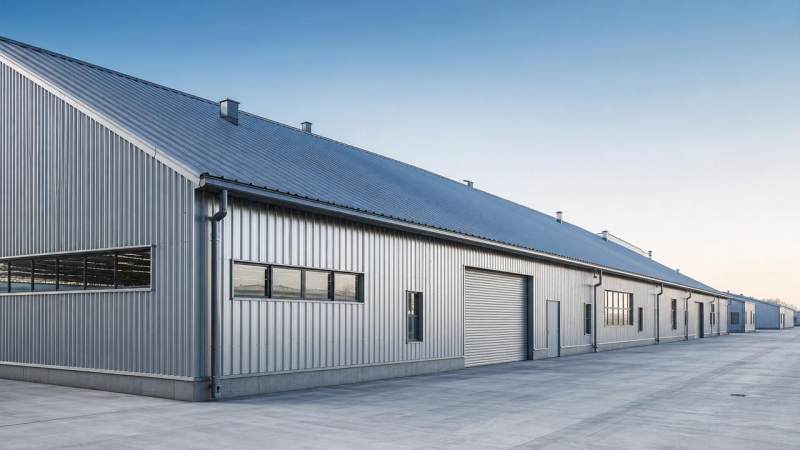
In roofing and wall systems, material choice rarely depends on price alone.
Galvanised sheet steel is widely used because it combines practical corrosion resistance with manageable fabrication cost.
That advantage matters in warehouses, workshops, agricultural buildings, transport shelters, and light industrial facilities.
Still, service life is not fixed by the base metal alone.
Coating mass, local atmosphere, drainage detail, fastener choice, and maintenance habits all change the outcome.
In actual projects, the better question is not whether galvanised sheet steel is good.
The better question is where it fits well, where it reaches its limit, and what conditions protect its value.
For companies supplying global steel solutions, that distinction is important.
Hongteng Fengda, as a structural steel manufacturer and exporter from China, often works across standards, climates, and project types.
That cross-market view makes one point clear: roofing and cladding decisions should start from service conditions, not generic assumptions.
Why the same galvanised sheet steel performs differently from one site to another
The zinc coating protects steel by acting as a barrier and by offering sacrificial protection at damaged spots.
This is why galvanised sheet steel remains attractive for exposed building envelopes.
But exposure conditions are rarely equal.
A dry inland warehouse may see slow corrosion for many years.
A coastal plant with salt air and constant condensation may consume the zinc layer much faster.
Roof geometry also matters more than many expect.
Steep roofs shed water quickly, while low-slope areas retain moisture and dirt.
Folded seams, cut edges, overlaps, and screw penetrations create local risk points.
Even a well-coated sheet can fail early if water stays trapped near laps or debris builds up in gutters.
This is why project planning should connect material grade, coating level, profile design, and maintenance access.
In common building scenarios, the judgment focus is not always the same
Industrial roofing with large spans
Large industrial roofs often favor galvanised sheet steel for speed, weight control, and cost discipline.
Here, corrosion is only one part of the decision.
Span layout, purlin spacing, thermal movement, and the risk of foot traffic damage matter just as much.
If the building contains humidity, fumes, or process heat, internal corrosion may become the real issue.
In such cases, underside protection and ventilation design deserve early review.
Agricultural buildings and storage sheds
This is a frequent application, but also a frequent source of underestimation.
Moisture, fertilizers, animal waste, and cleaning chemicals create a more aggressive atmosphere than appearance suggests.
Galvanised sheet steel can still work well, yet heavier coating and better internal air movement are often justified.
Ignoring the interior environment leads many projects to overestimate service life.
Commercial cladding and visible façades
On façades, visual stability becomes part of performance.
Water streaking, uneven weathering, edge rust, and oil canning may affect acceptance even before structural issues appear.
Where appearance matters, profile selection and surface finish deserve closer attention.
Some projects pair galvanised substrates with painted systems for added life and better visual control.
Benefits are real, but they should be tied to the way the building will actually operate
The strongest case for galvanised sheet steel usually comes from its balanced performance profile.
- Good corrosion resistance for many inland and moderate outdoor environments.
- Lower initial cost than many premium coated or stainless alternatives.
- Wide availability in standard profiles, thicknesses, and forming options.
- Reliable compatibility with roll forming, bending, and common fastening methods.
- Reasonable service life when drainage and maintenance are properly managed.
That balance explains why galvanised sheet steel remains common in export-oriented construction supply chains.
Projects spanning North America, Europe, the Middle East, and Southeast Asia may share similar envelope systems.
What changes is the environmental loading and compliance target.
Material selection works best when standards such as ASTM, EN, JIS, or GB are matched to actual exposure conditions.
In related fabrication work, some projects also compare sheet options with Carbon Steel Plate.
Grades such as SPCC, SPCD, and SPCE are valued for formability, smooth surface finish, and broad dimensional flexibility.
Those properties matter when roof-adjacent parts, formed components, or customized steel assemblies require tighter shaping control.
Where galvanised sheet steel reaches its limits
The material performs well, but it is not a universal answer.
Marine atmospheres are a clear example.
Salt deposition accelerates zinc consumption, especially on sheltered surfaces that do not wash clean in rain.
Another limit appears where acidic or alkaline contaminants are frequent.
Food processing exhaust, livestock environments, chemical plants, and some urban industrial zones can be harder on coatings than expected.
Mechanical damage is another common weakness.
Scratches, cut edges, aggressive forming, and improper stacking can expose vulnerable areas before installation is complete.
Thermal performance should also be judged separately.
Galvanised sheet steel is not insulation.
When condensation control, acoustic reduction, or energy targets are strict, the full roof or wall assembly must be evaluated.
A practical comparison helps clarify service life expectations
Expected life varies by exposure and detailing quality, so estimates should remain conditional.
In many moderate environments, galvanised sheet steel can provide long service.
Yet the difference between acceptable life and premature replacement often comes from design details, not only coating specification.
The most common misjudgments happen before installation begins
One frequent mistake is assuming all outdoor exposure is similar.
Rainwashed coastal roofs and sheltered coastal soffits do not age the same way.
Another mistake is comparing only purchase price.
If cleaning access is poor, replacement labor expensive, or downtime critical, a cheaper sheet may become the costlier option.
Cut edge treatment is also overlooked too often.
Fabrication quality affects corrosion start points, especially in complex cladding shapes.
Fastener compatibility deserves the same care.
Mixed-metal contact can trigger localized corrosion and undermine an otherwise suitable galvanised sheet steel system.
A better way to match galvanised sheet steel to roofing and cladding work
A useful selection process starts with five checks.
- Map the site atmosphere, including salt, humidity, fumes, and cleaning chemicals.
- Review whether the critical exposure is outside, inside, or both.
- Match coating mass and profile design to drainage and dirt retention behavior.
- Check forming, cutting, and fastening details before finalizing supply.
- Set a realistic inspection and maintenance interval from the start.
Where custom fabrication is involved, stable production and standard compliance reduce avoidable risk.
That is especially relevant when projects require ASTM, EN, JIS, or GB alignment across multiple steel items.
Some assemblies may also combine roofing sheet with formed support parts made from Carbon Steel Plate, depending on load and fabrication needs.
In those cases, dimensional range, formability, and surface condition should be considered as part of the full system, not as separate purchases.
What to confirm next before setting service life expectations
Galvanised sheet steel remains a practical roofing and cladding material because it solves many projects well without pushing cost too high.
Its strengths are clear in moderate environments, efficient building systems, and applications that need dependable corrosion protection with workable fabrication.
Its limits appear when atmosphere, moisture retention, chemical exposure, or maintenance constraints are underestimated.
Before final selection, it helps to define the real exposure pattern, review detailing points, compare lifecycle implications, and confirm standard compliance across the whole assembly.
That approach leads to more reliable service life forecasts and fewer surprises after installation.
Please give us a message


Please enter what you want to find