A tougher year for GI coil supply
As 2026 begins, GI coil manufacturers are working in a market that looks stable on the surface but feels tighter underneath.
Demand has not disappeared. It has simply become more selective, more price-sensitive, and more dependent on delivery discipline.
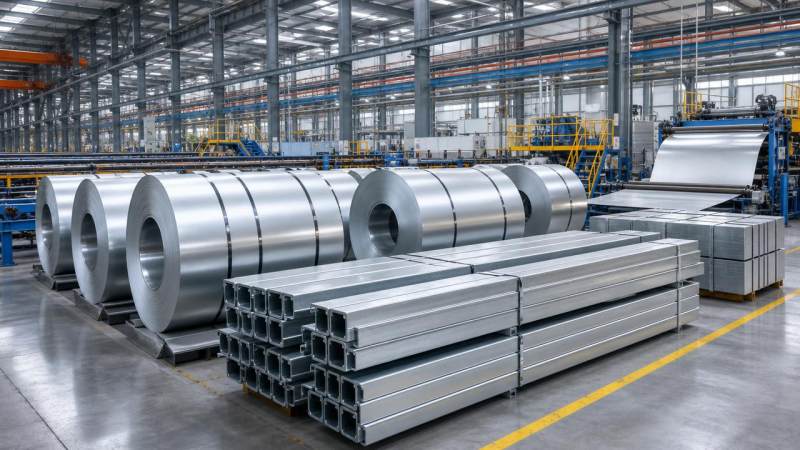
That matters across the steel trade because galvanized coil sits close to construction, light industry, ducting, panels, framing, and downstream fabricated products.
For companies balancing inventory, customer lead times, and margin protection, the real issue is no longer price alone.
The bigger question is which gi coil manufacturers can still offer reliable output, acceptable zinc quality, and workable commercial terms when cost pressure keeps rising.
This is especially relevant in the broader steel supply chain, where structural products, coated steel, and fabricated sections often move together in project-based orders.
A supplier that understands this linkage usually creates more value than one selling a single item in isolation.
What is changing for gi coil manufacturers in 2026
The operating environment for gi coil manufacturers is being shaped by several forces at the same time.
Raw material costs remain unstable. Zinc pricing still reacts quickly to energy, mining output, and financial sentiment.
Hot rolled substrate costs also move unpredictably. That makes it harder to hold long quotations without building in extra risk.
At the same time, buyers in many regions are resisting sharp price adjustments. End users want shorter lead times but lower stock exposure.
This mismatch squeezes the middle of the market. Mills want cost recovery. Customers want flexibility. Trading margins get thinner.
Another shift is supply differentiation. Not all capacity is equal, even if products look similar on paper.
Some gi coil manufacturers can manage thickness tolerance, coating consistency, and packaging quality with fewer claims and less rework.
Others compete mainly on headline price, which can create hidden cost later through coating variation, edge damage, or delayed shipment.
Why margins feel tighter even when orders continue
Margin pressure in 2026 is not only about weak demand. It is also about the cost of staying dependable.
Freight remains sensitive. Financing costs are still meaningful. Compliance documentation is more important in cross-border trade.
Quality expectations are rising as well. Buyers increasingly expect traceability, coating clarity, and export-safe packing as standard practice.
That means gi coil manufacturers with modern lines and strict process control may keep customers, but they cannot always keep older margin levels.
How supply risk now shows up in everyday business
In practical terms, supply risk is showing up in smaller but more frequent disruptions.
A quotation may look competitive, yet the booking window may be narrow. A promised grade may require substitution review. A shipment may need split delivery.
These are not dramatic failures. They are operational frictions that slowly reduce margin.
For steel trading and project fulfillment, that can be more damaging than a single visible price increase.
This is why comparing gi coil manufacturers only by ton price often gives an incomplete picture.
Consistency, documentation, and shipment control now affect profit almost as much as the initial unit cost.
The value of broader steel capability
In 2026, one useful filter is whether a supplier understands steel demand beyond one coated product line.
Projects rarely consume GI coil in isolation. They often involve structural sections, fabricated members, cold formed profiles, and customized support components.
A company like Hongteng Fengda operates from that wider perspective.
Its business covers angle steel, channel steel, beams, cold formed profiles, and custom structural steel solutions for global construction and industrial use.
That matters because supply coordination improves when the supplier understands grade selection, fabrication fit, international standards, and delivery timing across the full steel package.
Products aligned with ASTM, EN, JIS, and GB standards also support clearer cross-market communication, especially when orders move across North America, Europe, the Middle East, and Southeast Asia.
In practice, broader capability helps reduce sourcing fragmentation, which is often an overlooked source of margin loss.
Where adjacent products influence GI coil decisions
Coated steel decisions are often connected to framing and secondary structure choices.
For example, purlins, wall beams, roof trusses, brackets, and light industrial supports may be specified alongside galvanized materials in the same project flow.
That is where a product such as C Sections Steel fits naturally into the discussion.
It is commonly used in steel structure buildings, lightweight roof trusses, brackets, and mechanical light industry applications.
Available materials such as Q195, Q235, Q345, A36, SS400, and S235JR give flexibility across regional specifications and design needs.
Thickness from 1mm to 12mm, lengths of 6m, 9m, and 12m, and options including perforated or not perforated configurations help match site conditions.
Surface choices such as galvanized finish, powder coating, and black varnish also matter when corrosion performance and fabrication sequence need coordination.
When gi coil manufacturers are evaluated together with related structural items, the sourcing decision becomes more complete and commercially stronger.
How to assess gi coil manufacturers more accurately
A useful review should combine technical, commercial, and operational criteria.
Price still matters, but it should sit inside a wider decision framework.
- Check whether coating, thickness tolerance, and base material are specified clearly in the quotation.
- Review production capacity against realistic lead times, not only target shipment dates.
- Confirm export packing, edge protection, labeling, and traceability before finalizing terms.
- Ask how the supplier handles standard compliance, especially for ASTM, EN, JIS, or GB requirements.
- Look at how claims are resolved, since after-sales discipline often reveals actual supplier strength.
It is also worth separating short-term low pricing from sustainable value.
Some gi coil manufacturers can offer cheaper numbers for a single order but struggle to maintain consistency over repeated deliveries.
Others may quote slightly higher yet protect margin through stable production, dependable lead times, and lower claim exposure.
Questions that deserve closer attention
- Is the supplier managing costs through efficiency, or simply cutting service depth?
- Can the supplier support mixed steel orders when a project includes sections, profiles, and customized items?
- Does the mill or exporter communicate early when substrate, zinc, or shipping conditions change?
- Are certifications such as CE, SGS, BV, and ISO available where related products require them?
What this means for the next sourcing cycle
The 2026 market does not suggest that gi coil manufacturers are losing relevance.
It suggests the opposite. Their role is becoming more strategic because small failures now carry larger cost consequences.
The strongest decisions will likely come from combining price review with supplier capability, standards alignment, product adjacency, and delivery resilience.
That is particularly true in steel trading environments where galvanized coil, structural sections, and cold formed components must support the same timeline.
A sensible next step is to map current demand by grade, coating, lead time, and related steel items, then compare gi coil manufacturers against those real operating needs.
When that comparison includes quality control, production stability, and broader steel coordination, supplier selection becomes less reactive and more durable.
In a year defined by supply shifts and margin pressure, that discipline is likely to matter more than chasing the lowest number on the first quote.
Please give us a message


Please enter what you want to find