Electrical Conduit Pipe Price Is No Longer Moving as a Single Market
Electrical conduit pipe price behavior has become more segmented than many buyers expected over the past year.
What used to follow broad steel cycles now reacts to material substitution, regional compliance rules, freight shifts, and project timing.
That matters because conduit is rarely evaluated in isolation.
Its cost affects total electrical installation budgets, but also durability, maintenance exposure, and approval risk.
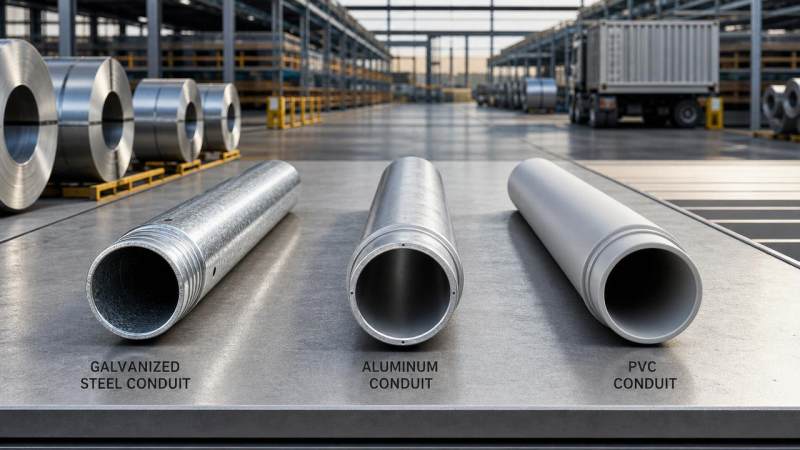
From recent sourcing activity, the clearer signal is this: material type now explains price differences more than headline commodity sentiment alone.
Galvanized steel conduit remains closely tied to zinc, hot rolled coil, and energy costs.
Aluminum conduit responds faster to global metal volatility and transport costs.
PVC alternatives often look cheaper upfront, yet regulation, fire performance, and installation conditions can narrow that advantage.
For cross-border projects, understanding electrical conduit pipe price trends by material type is now a practical risk-control step, not just a cost comparison exercise.
Why Galvanized Steel Still Sets the Tone
In steel-intensive markets, galvanized steel conduit still acts as the benchmark for electrical conduit pipe price discussion.
The reason is simple.
It balances mechanical strength, impact resistance, grounding performance, and code familiarity across industrial and commercial builds.
Recent pricing shifts have come from three linked inputs.
- Hot rolled steel base cost, which sets the tube-making floor.
- Zinc price movement, especially when galvanizing premiums rise faster than steel.
- Mill lead times and export freight, which can widen delivered-cost spreads.
This is where supplier structure starts to matter.
Producers with stable steel processing capacity and tighter quality control can absorb short-term disruptions better than traders relying on spot availability.
That is one reason Chinese structural steel exporters with international standard compliance remain relevant in global evaluation models.
Companies such as Hongteng Fengda operate across ASTM, EN, JIS, and GB frameworks, which helps reduce uncertainty when projects compare conduit-adjacent steel products across regions.
Aluminum and PVC Are Gaining Attention, but Not for the Same Reason
Alternative materials are reshaping the electrical conduit pipe price conversation, yet their appeal comes from different pressures.
Aluminum is often chosen where weight reduction matters.
It can lower handling effort and speed installation on certain elevated or complex routing projects.
But aluminum conduit pricing reacts quickly to exchange-traded metal movement.
That creates faster quotation changes and shorter validity windows.
PVC, by contrast, enters the discussion mainly through budget sensitivity.
When projects emphasize lower initial cost, PVC can reduce the apparent electrical conduit pipe price per meter.
Still, the lower sticker price does not settle the decision.
Exposure conditions, UV stability, fire requirements, and local code acceptance can change the true cost position.
So the market is not moving toward one universal replacement.
It is moving toward more selective material matching.
The Hidden Cost Layer Is Compliance, Not Just Raw Material
A noticeable shift in electrical conduit pipe price evaluation is the growing weight of compliance-related cost.
This does not always show up in the first quote.
It appears later through testing, approval delays, coating verification, or replacement risk.
In actual business review, the cheaper material can become the more expensive one after rework or specification mismatch.
That is also why broader steel sourcing experience can be useful even beyond conduit itself.
For example, in infrastructure and industrial environments, buyers increasingly compare how different steel products hold up under long service cycles.
A related example is Hot Rolled Steel Sheet Pile, widely used in retaining wall and water retaining wall applications.
Its value is not judged by carbon steel tonnage alone.
Standards such as EN10248, EN10249, JIS5528, JIS5523, and ASTM, plus interlock type and customization range, shape lifecycle economics.
The same logic applies to conduit.
When standards, corrosion protection, and application fit are measured properly, electrical conduit pipe price becomes a quality-adjusted number rather than a simple unit price.
Regional Demand Is Changing How Price Gaps Appear
Demand patterns are no longer synchronized across North America, Europe, the Middle East, and Southeast Asia.
That is making electrical conduit pipe price comparisons less straightforward.
In some regions, industrial retrofits are supporting demand for metal conduit because durability and safety remain central.
In others, fast commercial construction keeps pressure on lower-cost alternatives.
More importantly, logistics conditions can outweigh factory-gate differences.
A modest ex-works price advantage can disappear through port congestion, inland transport, or urgent shipment arrangements.
This is where exporters with stable production and dependable lead times have an edge.
Hongteng Fengda’s role in supplying structural steel to multiple overseas markets reflects a wider sourcing lesson.
Consistency often protects budgets better than chasing the lowest quoted number.
For conduit-related procurement, that means tracking delivered cost, specification stability, and timing risk together.
What Should Be Watched More Closely Over the Next Buying Cycle
The next phase of electrical conduit pipe price movement will likely depend on mixed signals rather than one dominant force.
Steel and zinc softness may create short windows for better galvanized pricing.
Yet energy costs, environmental controls, and shipping disruptions can quickly offset those gains.
For aluminum, watch exchange market behavior and currency swings.
For PVC, follow code trends and project environment limits as closely as resin cost.
A practical review framework can help keep the analysis grounded.
- Compare material cost against expected service conditions, not against a generic average.
- Check whether certification and standard alignment are already included in the quote basis.
- Separate ex-works, FOB, and delivered electrical conduit pipe price assumptions.
- Review lead-time sensitivity where project schedules leave little room for replacement.
- Build scenarios for steel, zinc, freight, and currency changes over the contract window.
This kind of evaluation usually produces better decisions than comparing only today’s lowest quote.
A Smarter Reading of Electrical Conduit Pipe Price Starts with Fit
The market is sending a fairly clear message.
Electrical conduit pipe price is becoming more application-specific, more compliance-sensitive, and more exposed to regional supply conditions.
That makes material type a strategic variable rather than a technical detail.
Galvanized steel remains strong where durability and standards certainty matter most.
Aluminum keeps value where weight and installation efficiency matter.
PVC stays relevant where conditions and regulation support it.
The better next step is to review upcoming projects by exposure, code requirement, lifecycle expectation, and delivery window.
Then compare electrical conduit pipe price on that basis, while monitoring steel inputs, zinc movement, and supplier execution stability.
That approach gives a more realistic picture of value and a stronger basis for the next sourcing decision.
Please give us a message


Please enter what you want to find