Choosing between a concrete h beam and steel alternatives is becoming a critical decision in 2026 construction planning.
The choice now shapes budget stability, structural safety, installation speed, and long-term maintenance exposure.
For industrial and commercial projects, the debate is no longer theoretical.
It is tied to supply chain pressure, labor efficiency, sustainability goals, and design flexibility.
This article compares concrete h beam solutions with steel options through a practical 2026 lens.
The focus is on cost, performance, procurement risk, and future-ready project execution.
Why the concrete h beam decision looks different in 2026
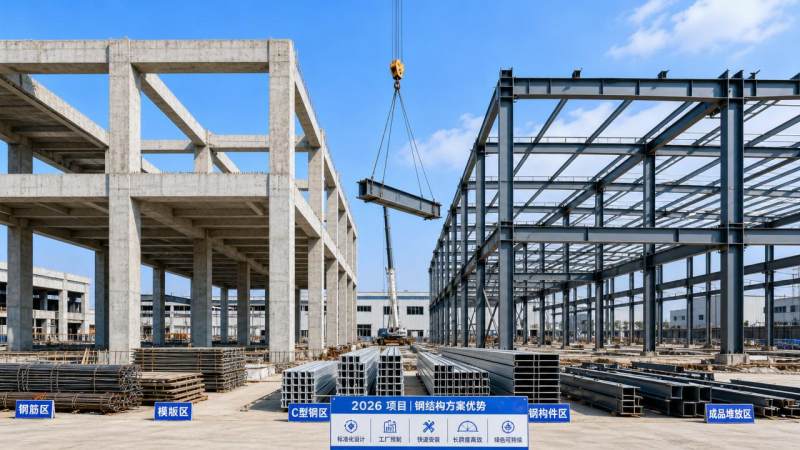
In earlier years, a concrete h beam was often selected by habit, local availability, or traditional engineering preference.
In 2026, those assumptions are changing quickly.
Project schedules are tighter, financing is more sensitive to delays, and material decisions face stronger lifecycle scrutiny.
At the same time, structural steel systems have improved in precision, standardization, and export reliability.
As a result, the concrete h beam versus steel comparison now depends on application-specific economics.
Warehouse developments, factories, logistics parks, workshops, and mixed-use commercial structures increasingly favor faster structural methods.
That does not mean concrete h beam systems are obsolete.
It means they must now justify their place against stronger steel alternatives.
The main signals driving the shift toward steel options
Several market and engineering signals explain why the concrete h beam question matters more today.
Where a concrete h beam still performs well
A concrete h beam remains relevant in projects that prioritize mass, stiffness, and certain fire performance advantages.
It can suit low-rise structures, heavy static loads, and environments where concrete supply is stable and economical.
In some regions, local contractor familiarity still reduces execution risk.
Concrete can also support acoustic control and perceived solidity in selected building types.
However, the concrete h beam approach usually carries tradeoffs.
- Higher structural weight can increase foundation demand.
- On-site curing slows schedule certainty.
- Wet work raises weather sensitivity.
- Design changes after casting are less flexible.
- Transport and lifting for precast units can become complex.
These limits matter most when project value depends on speed and modular coordination.
Why steel alternatives are winning more industrial projects
Steel systems are gaining share because they match how modern projects are delivered.
Fabrication can be standardized, dimensions can be tightly controlled, and installation is usually faster than concrete h beam construction.
For factories, logistics centers, workshops, and equipment platforms, lighter structural weight is another major advantage.
It often reduces foundation cost and enables longer spans with fewer intermediate supports.
Steel also supports phased expansion more effectively.
That is important in 2026, when many projects are built with future capacity changes in mind.
Beyond main beams, secondary framing choices also affect overall efficiency.
For purlins, wall beams, roof members, and light structural parts, Metal C Beam solutions are widely used.
They can be produced in Q195, Q235, Q345, A36, SS400, and s235jr.
Common standards include ASTM, EN, JIS, and GB related specifications.
Galvanized surfaces, perforated options, and processing services such as punching, cutting, and bending add flexibility to steel projects.
Steel advantages that directly challenge the concrete h beam option
- Shorter construction time through prefabrication.
- Better span-to-weight performance.
- Simpler integration with industrial enclosures and equipment supports.
- Easier quality verification before shipment and before erection.
- Higher adaptability for retrofits and future layout changes.
A practical comparison of concrete h beam and steel options
This comparison shows why concrete h beam systems are increasingly questioned in fast-track developments.
The answer depends on full project cost, not unit material price alone.
How the choice affects sourcing, engineering, and site execution
Material selection influences more than structural performance.
It changes procurement timing, shipping planning, labor dependency, and quality documentation requirements.
When concrete h beam components are used, site readiness becomes more critical.
Weather, formwork coordination, and curing discipline can affect milestone certainty.
With steel systems, much of the quality work happens before delivery.
That supports predictable erection planning and easier document control for export projects.
In secondary structures, perforated galvanized C sections can further simplify assembly and future maintenance access.
Lengths such as 6m, 9m, and 12m are common, while large quantity customization is often available.
Key checkpoints before finalizing the structure
- Confirm required span, load path, and future modification needs.
- Calculate total installed cost, not only material price.
- Review transport limits and lifting equipment capacity.
- Check compliance with ASTM, EN, JIS, or GB project standards.
- Assess lead time reliability and fabrication consistency.
What deserves the closest attention in 2026 planning
The strongest 2026 projects evaluate structure through lifecycle efficiency.
That means balancing initial budget with speed, risk, durability, and adaptability.
A concrete h beam may still fit projects with stable timelines and specific heavy-duty conditions.
But for many industrial buildings, steel now offers better value density.
- Prioritize structural systems that reduce schedule risk.
- Favor standardized steel components for global sourcing control.
- Use corrosion protection suited to climate and service life goals.
- Select suppliers with proven manufacturing capacity and inspection discipline.
- Plan primary and secondary steel members together for better cost efficiency.
A grounded way to decide between concrete h beam and steel
Start with the building function, not the default material.
If the project needs speed, long spans, lighter foundations, and future flexibility, steel should be examined first.
If mass, local casting economics, or certain fixed-load conditions dominate, a concrete h beam can still be justified.
The most effective decision comes from comparing installed cost, timeline risk, and structural adaptability side by side.
For projects requiring reliable structural steel supply, customized sections, and international standard compliance, working with an experienced Chinese structural steel exporter can reduce uncertainty.
Hongteng Fengda supports global construction and industrial buyers with stable production, strict quality control, and tailored steel solutions.
A clear technical review now can prevent expensive structural compromises later.
Please give us a message


Please enter what you want to find