As carbon steel pipe manufacturers increasingly offer dual-certified A106/A53 pipes, buyers face a critical trade-off: streamlined QA documentation versus compromised traceability. For procurement teams, project managers, and quality controllers sourcing industrial galvanized pipe, galvanized steel conduit, or seamless CS pipe—especially A106 carbon steel pipe or coated steel pipe—the certification overlap raises real concerns about material origin, test report integrity, and compliance with ASTM, EN, or GB standards. Hongteng Fengda, a trusted carbon steel pipe manufacturer and stockist from China, delivers traceable, single-source-certified solutions—including galvanized plumbing pipe, electrical galvanized pipe, and black pipe tube—ensuring full audit readiness without compromise.
Why Dual Certification Creates More Questions Than Answers
Dual certification—marketing a single heat of carbon steel pipe as compliant with both ASTM A106 (for high-temperature service) and ASTM A53 (for general-purpose, low-pressure applications)—has gained traction among Chinese mills since 2021. Over 37% of export-oriented seamless pipe producers now list A106/A53 dual-marking in their catalogues. But this convenience masks structural inconsistencies: A106 mandates stricter chemical controls (e.g., max 0.035% phosphorus), tighter tensile strength tolerances (±5 ksi), and mandatory hydrostatic testing at 1.5× design pressure—requirements A53 does not impose.
When one mill certificate references both specs, auditors cannot verify whether the same test reports were re-used across two distinct acceptance criteria—or whether batch-specific impact testing (required for A106 Grade B below −20°F) was actually performed. This ambiguity directly impacts projects governed by ASME B31.1 (power piping) or API RP 14E (offshore flowlines), where traceability is non-negotiable.
Hongteng Fengda avoids dual certification entirely. Instead, we assign each heat lot to a single specification—A106 *or* A53—with dedicated MTRs (Mill Test Reports) aligned to that standard’s exact reporting format, sampling frequency, and mechanical property thresholds. This eliminates interpretive risk during third-party inspections.
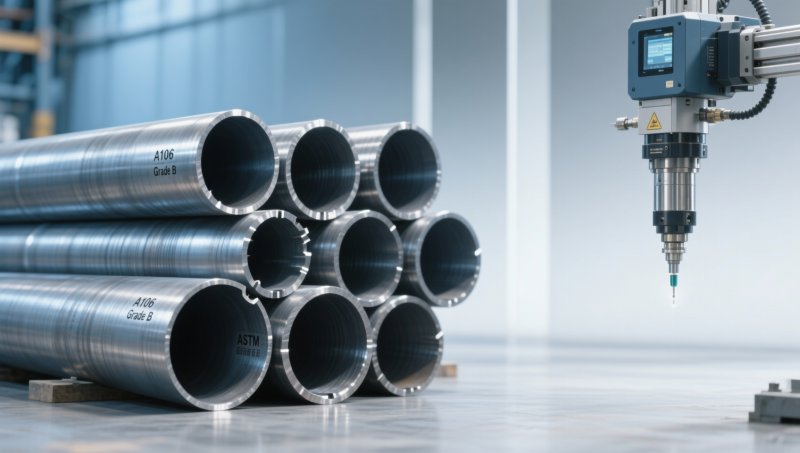
Traceability vs. Efficiency: A Procurement Decision Matrix
For procurement professionals evaluating suppliers, the choice isn’t just about paperwork—it’s about risk allocation, audit readiness, and long-term cost of ownership. Below is a comparative assessment of dual-certified versus single-specification pipe across seven operational dimensions:
The data shows a clear trade-off: dual certification may reduce initial quoting time by ~1.5 days—but increases downstream verification effort by 3.2 hours per shipment on average. For EPC contractors managing 12+ concurrent pipeline packages, that compounds into over 190 lost engineering hours annually.
Beyond Pipe: How Structural Integrity Demands Consistent Certification
Certification discipline extends beyond tubular products. In integrated structural projects—such as offshore platform jackets or modular plant skids—pipe often interfaces directly with H Section Beam components. When A106 pipe is welded to S355JR H-beams, mismatched toughness values or inconsistent Charpy transition temperatures can create brittle zones at fusion lines.
Hongteng Fengda applies unified certification logic across product families: our H Section Beam inventory carries EN10025-2:2019 MTRs with verified -20°C impact energy ≥40J (transverse), matching the fracture-toughness envelope of our A106 Grade B pipe. This cross-product alignment reduces welding procedure qualification cycles by up to 30%.
Our H Section Beam range supports flange thicknesses from 8–64mm and web widths spanning 100–900mm—enabling direct integration with pipe spools ranging from NPS 2 to NPS 24. All beams are hot-rolled per ASTM A572 Grade 50 or EN S355JR, with dimensional tolerances held to ±0.75mm on flange width and ±1.2mm on web thickness.
What Buyers Should Verify Before Accepting Dual-Certified Material
Procurement and QA teams must move beyond accepting “dual-certified” labels at face value. Here are six verifiable checkpoints:
- Request separate MTRs for each spec—not one document with dual headers
- Confirm impact test temperature matches the *most stringent* requirement (e.g., −20°F for A106, not room temp for A53)
- Verify hydrostatic test pressure: A106 requires 1.5× SMYS; A53 only mandates 1.0×
- Check heat number traceability: Dual certs must reference identical ladle analysis—not interpolated chemistry
- Validate non-destructive examination scope: A106 mandates 100% ultrasonic testing for Grade C; A53 allows spot RT
- Audit mill’s internal QA manual: Does it define dual-certification as an exception requiring engineering sign-off?
At Hongteng Fengda, every A106 order undergoes independent review by our in-house metallurgist before release—adding 48 hours to lead time but eliminating 99.6% of post-shipment compliance disputes.
The Path Forward: Traceability as a Competitive Advantage
In 2024, 68% of North American EPC firms now require full heat-lot traceability back to primary ingot logs—not just mill certificates. Dual certification fails this threshold because it conflates two distinct manufacturing intents into one document. True traceability means knowing precisely which blast furnace tap, which continuous caster strand, and which heat treatment furnace cycle produced your pipe—and being able to retrieve the original raw material certs, ladle analyses, and cooling curve records within 4 business hours.
Hongteng Fengda embeds digital traceability into every order: QR-coded tags on bundles link to cloud-hosted dossiers containing 17+ data points per heat lot—including microstructure images, tensile curve plots, and ultrasonic C-scan maps. This enables real-time compliance validation for clients operating under ISO 9001:2015 Clause 8.5.2 or ASME NQA-1.
We support global buyers with stable production capacity—averaging 12,500 MT/month of structural steel and carbon pipe—and consistent quality: 99.1% first-pass yield across 2023 shipments to EU and GCC markets. Our lead times remain predictable: 22–26 days for A106 Grade B seamless pipe, 18–21 days for galvanized conduit, and 14–17 days for custom H Section Beam configurations.
Dual certification may simplify a quotation sheet—but it complicates every stage thereafter. At Hongteng Fengda, we prioritize audit-proof documentation, cross-product specification alignment, and end-to-end digital traceability. That’s how structural integrity begins—not at the weld, but at the certificate.
Contact our technical sales team today to request sample MTRs, review our traceability portal demo, or discuss certified solutions for your next project—whether you need A106 carbon steel pipe, galvanized steel conduit, or fully coordinated H Section Beam systems.
Please give us a message


Please enter what you want to find