Carbon steel price expectations for 2026 are becoming a key concern for buyers, contractors, and project planners as raw material costs, energy pressure, trade policies, and demand cycles continue to reshape the market. From steel rebar cost and galvanized steel price to sourcing from a reliable h beam manufacturer or steel rebar supplier, understanding these drivers helps businesses control budgets, reduce procurement risks, and make smarter construction and manufacturing decisions.
For procurement teams, engineers, distributors, and project owners, carbon steel pricing is no longer just a purchasing issue. It affects tender accuracy, inventory planning, fabrication scheduling, and total project cost. In 2026, even a price move of 3%–8% in key steel categories can materially change budgets for structural frames, industrial equipment, and infrastructure packages.
As a structural steel manufacturer and exporter from China, Hongteng Fengda serves buyers across North America, Europe, the Middle East, and Southeast Asia with angle steel, channel steel, beams, cold formed profiles, and customized steel components. That market exposure makes one point clear: price trends must be read together with supply reliability, standard compliance, lead time stability, and quality consistency.
This article breaks down the main carbon steel price drivers for 2026, explains how different steel products may respond, and offers practical sourcing guidance for businesses that need both cost control and dependable delivery.
What the 2026 Carbon Steel Market Is Likely to Look Like
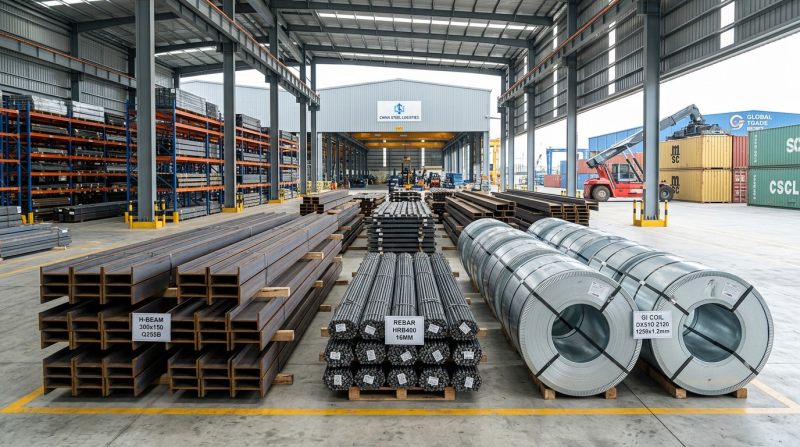
Carbon steel prices in 2026 are expected to remain range-bound but volatile. The market is unlikely to move in a straight line. Instead, buyers should expect quarter-to-quarter shifts driven by iron ore, coking coal, scrap, power tariffs, freight rates, and regional construction demand. In practical terms, many steel categories may trade within a 5%–12% fluctuation band over the year rather than showing a single clear uptrend or downtrend.
Construction-grade products such as rebar, H beams, channels, and galvanized sheet often react differently. Rebar is usually more sensitive to domestic construction cycles and infrastructure releases. Structural sections respond more directly to fabrication demand, heavy industry, and export orders. Galvanized carbon steel products add another cost layer because zinc coating weight, such as Z60, Z120, or Z275, directly affects pricing.
For many buyers, the key issue in 2026 will not be whether prices are “high” or “low,” but whether they are predictable enough to support project planning. A contractor managing a 2,000-ton to 10,000-ton structural package needs visibility on delivery windows, not just spot quotes. Late repricing can create contract risk, especially when payment schedules and installation milestones are fixed.
Another important feature of the 2026 market is regional divergence. China, Southeast Asia, the Gulf region, Europe, and North America may not move in sync. Anti-dumping rules, local capacity utilization, and logistics constraints can create price gaps large enough to change the economics of importing versus local sourcing.
Typical market conditions buyers should watch
- Monthly raw material shifts of 2%–6% in ore, coke, or scrap that quickly pass into mill offers.
- Lead time changes from 2–4 weeks to 6–10 weeks during high-demand periods.
- Freight volatility that can alter landed cost more than mill price cuts in some export markets.
- Policy-led production controls that tighten supply for standard beams, coils, and galvanized sheet.
For companies that buy on a project basis, these conditions mean price intelligence should be updated every 30–45 days. For stock-based distributors, the review cycle may need to be even shorter, especially when import transit times run 25–45 days.
The Main Factors Driving Carbon Steel Prices in 2026
The first and most visible driver is raw material cost. Iron ore and coking coal remain central for blast furnace production, while scrap is more important for electric arc furnace output. When ore or scrap rises by even USD 20–40 per ton over a short cycle, mills often adjust offer prices quickly. For carbon steel buyers, the impact is most visible in commodity products with thinner margins.
Energy is the second major factor. Electricity, natural gas, and industrial fuel costs affect rolling, coating, cutting, and heat processing. In galvanized products, energy and zinc both matter. If zinc prices rise while power rates stay elevated, galvanized steel price pressure can outpace that of plain hot rolled carbon steel. This is especially relevant for roofing sheet, cladding material, ducting, and light industrial fabrication.
Trade policy is the third driver. Duties, quota systems, customs review, and origin rules can add significant cost or delay. In some markets, the direct tariff is only part of the problem. Documentation reviews, port inspection, and uncertainty around classification can extend delivery by 1–3 weeks, which may be more expensive than the duty itself for time-sensitive projects.
The fourth driver is downstream demand. Carbon steel consumption in 2026 will be shaped by infrastructure programs, industrial upgrades, logistics facilities, energy projects, machinery output, and private construction confidence. Demand recovery does not need to be broad-based to move prices. Sometimes a strong rebound in only 2 or 3 sectors is enough to tighten availability of sections, coils, or galvanized sheet.
How these drivers translate into purchase risk
The table below shows how common price drivers affect purchasing decisions for structural steel and related carbon steel products in 2026.
The key takeaway is that price movement usually comes from several inputs at once. Buyers who track only the mill’s final quote often react too late. A better approach is to monitor cost inputs, freight, and demand signals together before committing tonnage.
Which Steel Products May See the Most Pricing Pressure
Not all carbon steel products will experience the same price pattern in 2026. Commodity rebar and merchant bar usually react quickly to local building activity. Structural sections such as H beams, I beams, channels, and angles often depend more on fabrication workloads, industrial plants, warehouses, and public infrastructure. Products with extra processing, coating, punching, or custom cutting usually show less price transparency but more service value.
Galvanized materials deserve special attention because they combine base steel pricing with coating cost. For buyers in construction, appliances, agricultural structures, transport equipment, and light industry, this category can be highly sensitive to zinc layer requirements and end-use standards. A sheet with heavier coating can cost more upfront but reduce replacement and maintenance frequency over a 5–15 year exposure cycle.
In many projects, product substitution is also part of cost control. For example, choosing a standard section size with easier mill availability can sometimes save more than negotiating a lower unit rate on a non-standard profile. That is why procurement, engineering, and production teams should review specification flexibility together before tender close.
For buyers looking at coated sheet and fabricated carbon steel components, one practical option is Galv Sheeting. This product range covers common grades such as DX51D+Z, DX52D+Z, SGCC, S250GD+Z, and S350GD+Z, with thickness from 0.12mm to 6.00mm, width from 600mm to 1500mm, and customizable lengths from 1m to 12m. Zinc coating options such as 60–275g/m² can support applications across construction, agriculture, transportation, energy, home appliances, and industrial fabrication.
Product categories and their likely sensitivity
The comparison below helps buyers estimate where cost pressure is more likely to appear in 2026.
The main conclusion is simple: the more processing, coating, and customization involved, the more important it becomes to assess total delivered value rather than base steel price alone. International standard compliance such as ASTM, EN, JIS, and GB also matters when comparing offers.
Specification points that can change the quote
- Coating class, especially when moving from lower zinc layers to Z275-level protection.
- Thickness range, because thin-gauge and heavy-gauge products may come from different processing lines.
- Tolerance requirements, flatness, and surface quality expectations for visible or industrial end uses.
- Packaging method, export protection, and whether custom length reduces installation waste enough to justify the premium.
How Buyers Can Manage Steel Price Risk in 2026
Price risk management in steel procurement starts with timing, but it should not stop there. Many companies focus only on getting the lowest quote on a given day. A stronger approach is to manage four linked variables: price, specification, delivery window, and supplier capability. If one of these is overlooked, short-term savings can turn into project delay, rework, or non-compliance costs.
For medium and large orders, staged purchasing is often effective. Instead of placing 100% of the volume at once, buyers may lock 30%–50% for critical path items, keep 20%–30% flexible for demand changes, and release the balance when fabrication drawings are final. This can reduce exposure to sudden market spikes while preserving planning freedom.
Supplier selection is equally important. A mill or exporter with stable production capacity, standard-compliant quality control, and consistent lead times can help offset pricing volatility. If a supplier misses a shipment by 2 weeks on a project with crane schedules, site labor, and subcontractors already mobilized, the indirect cost may exceed any initial unit-price advantage.
Hongteng Fengda supports global structural steel buyers with standard products and OEM solutions, which is especially useful when projects need coordinated supply of beams, channels, angle steel, cold formed profiles, and customized components. For procurement teams, consolidation can simplify inspection, shorten communication cycles, and improve document consistency.
A practical 5-step procurement framework
- Define technical scope clearly, including grades, standards, tolerances, coating, and test requirements.
- Separate critical-path materials from non-critical items so urgent supply can be prioritized.
- Request quotation validity, production lead time, and shipping lead time as separate line items.
- Review landed cost, not just ex-works or FOB price, especially when freight is unstable.
- Use pre-shipment quality checks and document verification before dispatch.
This process is especially helpful for project managers, quality teams, and commercial evaluators who must balance cost, compliance, and installation timing in one decision chain.
Common mistakes that increase total steel cost
- Choosing based on lowest headline price without checking standard equivalency or coating weight.
- Approving non-standard sizes that create mill delays of 2–6 additional weeks.
- Ignoring packaging and corrosion protection for long-distance export shipments.
- Failing to align procurement timing with drawing approval, causing order changes after production starts.
In 2026, disciplined procurement will be more valuable than trying to guess the exact bottom of the steel market. Predictability, not only price, is what protects project margins.
What Engineers, Distributors, and Decision-Makers Should Ask Suppliers
A reliable supplier conversation should go beyond unit price. Technical teams need to confirm whether the product matches the required grade, coating, and dimensional tolerance. Procurement teams need clarity on lead time, MOQ, packing, and shipping terms. Quality and safety personnel should verify inspection procedures and document availability before loading.
For structural steel and galvanized carbon steel, documentation often determines whether the sourcing process runs smoothly. Mill test certificates, dimensional inspection reports, coating information, and standard references should be available at the quotation or order-confirmation stage, not only after production. This reduces customs issues and internal approval delays.
Distributors and resellers should also ask about stocking rhythm and repeatability. A one-time low-cost shipment is less useful than a supplier who can repeatedly deliver similar quality over 3, 6, or 12 months. End users and project owners, meanwhile, should focus on the supplier’s ability to support customized lengths, bundled deliveries, and mixed product orders.
When comparing offers from China and other supply origins, it is useful to evaluate not only current price but also supply-chain resilience. Production stability, export experience, and familiarity with ASTM, EN, JIS, and GB standards often reduce friction in cross-border projects.
Supplier evaluation checklist
The following checklist can help technical and commercial teams screen suppliers more efficiently before placing carbon steel orders.
A supplier that performs well across these four areas may not always offer the lowest day-one price, but it often delivers better project economics over the full order cycle.
FAQ for 2026 steel sourcing
How often should buyers review carbon steel prices in 2026?
For active projects, every 2–4 weeks is a practical review frequency. If freight, zinc, or raw material markets are unstable, weekly monitoring may be justified for high-volume orders.
Is galvanized steel likely to rise faster than plain carbon steel?
It can. When zinc prices and energy costs are both firm, galvanized products often show more price pressure than uncoated hot rolled material, especially at heavier coating levels like Z275.
What lead time should buyers expect for structural steel exports?
A common range is 3–8 weeks for production, depending on tonnage, section size, customization, and mill loading. Ocean transit can add another 2–6 weeks depending on destination.
What matters most besides the steel price itself?
Specification accuracy, quality consistency, standard compliance, and dependable delivery usually have the biggest effect on total cost once fabrication and project schedules are considered.
Carbon steel price trends in 2026 will be shaped by raw materials, energy, policy, freight, and demand cycles rather than by a single market factor. For buyers of rebar, structural sections, customized steel components, and galvanized carbon steel, the best results will come from combining market timing with disciplined technical review and supplier evaluation.
Hongteng Fengda supports global customers with reliable structural steel products, OEM solutions, international standard compliance, and stable export service. If you are planning procurement for 2026, now is the right time to review specifications, compare sourcing options, and secure dependable supply.
Contact us to discuss your project requirements, request product details, or get a customized structural steel and galvanized steel sourcing solution tailored to your market, budget, and delivery schedule.
Please give us a message


Please enter what you want to find