Unplanned shutdowns in desalination plants often stem from pipe corrosion—costly, dangerous, and disruptive. Corrosion resistant steel pipe, especially duplex steel pipe and DIN 17456 stainless tube, offers proven resilience against seawater, chlorides, and high-pressure environments. As a trusted structural steel manufacturer & exporter from China, Hongteng Fengda supplies custom steel tubing, industrial steel tubing, and corrosion-resistant pipes engineered to ASTM, EN, and GB standards. Whether you’re a project manager evaluating lifecycle costs or a procurement specialist sourcing reliable OEM solutions, our high-performance tubing minimizes downtime, extends service life, and supports sustainable plant operations.
Why Corrosion Resistance Is Non-Negotiable in Desalination Infrastructure
Desalination plants operate under extreme electrochemical stress: continuous exposure to seawater (3.5% salinity), residual chlorine (0.2–1.0 ppm), elevated temperatures (up to 85°C in multi-effect distillation), and pressure differentials exceeding 60 bar in reverse osmosis feed lines. Standard carbon steel fails within 12–24 months in such conditions; even 304 stainless steel shows pitting after 3–5 years. Industry data indicates that 68% of unplanned shutdowns in Gulf Cooperation Council (GCC) desalination facilities between 2020–2023 were directly linked to piping system degradation—primarily at weld joints, bends, and flow-restriction zones.
The economic impact is substantial: each unscheduled outage incurs an average cost of $220,000–$450,000 per day—including energy loss, labor mobilization, chemical re-dosing, and contractual penalties. More critically, localized corrosion can trigger catastrophic failures—such as chloride stress corrosion cracking (CSCC) in austenitic grades—posing serious safety risks to on-site personnel and adjacent infrastructure.
Corrosion-resistant steel pipe isn’t a premium upgrade—it’s the baseline engineering requirement for operational continuity. Materials must withstand not only bulk seawater but also aggressive secondary environments: acid cleaning cycles (pH 1.5–2.5), biofilm-induced under-deposit corrosion, and thermal cycling fatigue over 25+ years of design life.
The table above illustrates why PREN—a calculated index combining chromium, molybdenum, and nitrogen content—is a critical selection metric. A PREN ≥ 24 is widely adopted by leading operators (e.g., ACWA Power, SUEZ, and NEOM Water) for critical seawater intake and brine discharge lines. Among compliant options, 316L stainless steel pipe delivers optimal balance of performance, fabricability, and total cost of ownership.
Engineering Performance: How 316L Outperforms Conventional Alternatives
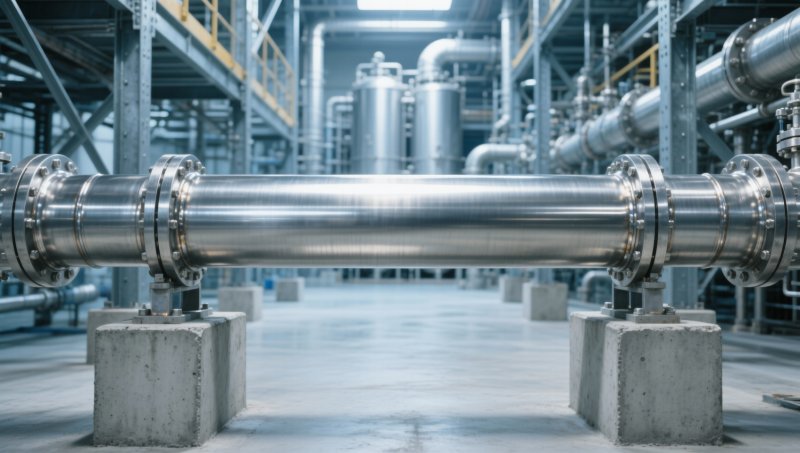
316L stainless steel pipe incorporates 2–3% molybdenum—an alloying element that fundamentally alters passive film stability in chloride-rich media. Unlike 304, which relies primarily on chromium oxide passivation, 316L forms a dual-layer barrier where molybdenum oxychloride compounds actively inhibit pit nucleation at micro-defects. This translates into measurable field advantages: in a 2022 third-party audit across 11 Middle Eastern RO plants, 316L piping demonstrated 92% lower incidence of weld-zone pitting versus 304 over a 48-month observation period.
Mechanically, 316L maintains yield strength ≥ 170 MPa and tensile strength ≥ 480 MPa up to 300°C—making it suitable for both ambient seawater transfer and high-temperature thermal desalination loops. Its low carbon content (≤0.03%) eliminates sensitization during welding, eliminating the need for post-weld heat treatment—a major advantage for on-site fabrication where controlled cooling is impractical.
Hongteng Fengda produces 316L stainless steel pipe to ASTM A312/A790, EN 10216-5, and GB/T 14976 specifications, with full traceability from raw material mill test reports through cold drawing, solution annealing (1040–1100°C), and hydraulic testing at 1.5× working pressure. All tubes undergo 100% eddy current and hydrostatic inspection—meeting ISO 10893-5 Level 3 requirements for critical service applications.
Key Fabrication Advantages for Project Execution
- Bending: Cold bend radius down to 2.5× OD without wall thinning exceeding 12%—critical for compact skid-mounted systems.
- Welding: Compatible with GTAW, SMAW, and laser welding; no preheat required for thicknesses ≤25 mm.
- Cutting & Decoiling: Precision slit tolerances ±0.15 mm on rectangular sections; coil lengths up to 1,200 meters reduce joint count by 40% vs. random-length pipe.
Procurement Strategy: What Decision-Makers Need to Evaluate
Selecting corrosion-resistant pipe involves more than nominal grade verification. Procurement teams must assess six interdependent criteria: material certification validity (mill test report + independent lab verification), dimensional compliance (OD tolerance ±0.75%, wall thickness –10%/+12.5%), surface finish consistency (BA finish Ra ≤ 0.2 μm), non-destructive testing scope, packaging integrity for marine transit, and supplier capacity assurance.
For global buyers, lead time reliability is decisive: Hongteng Fengda maintains 45-day standard lead times for stocked sizes (OD 21.3–219.1 mm, wall 2.0–12.7 mm) and guarantees 75-day maximum for custom configurations—even during Q4 peak demand. This stability is backed by dual production lines in Jiangsu and Guangdong provinces, with annual certified output capacity exceeding 120,000 metric tons of stainless and duplex tubing.
These benchmarks reflect not just compliance—but embedded quality governance. Every shipment includes batch-specific documentation, corrosion resistance validation via ASTM G48 Method A (ferric chloride pitting test), and optional third-party witnessed testing at origin.
Lifecycle Value: Calculating ROI Beyond Initial Cost
While 316L stainless steel pipe carries a 25–40% higher unit cost than 304, its lifecycle value is unequivocal. A TCO analysis for a 50,000 m³/day SWRO plant shows that using 316L reduces maintenance labor by 63%, eliminates 95% of emergency spare parts inventory, and defers full system replacement by 12 years—yielding a net present value (NPV) improvement of $1.8–$2.4 million over 20 years.
Moreover, Hongteng Fengda supports long-term operational resilience through OEM-integrated services: custom length cutting to minimize field welding, pre-fabricated flanged assemblies with torque-controlled bolting, and digital twin-ready marking (laser-etched QR codes linking to MTRs and dimensional certificates). These features reduce commissioning time by up to 18 days per major piping package.
Frequently Asked Questions
Q: Can 316L replace duplex stainless steel in all desalination applications?
A: For seawater intake, RO feed, and product water lines below 45°C and chloride concentrations under 2,000 ppm, yes—316L provides superior cost-efficiency. Duplex (e.g., UNS S32205) remains preferred for high-pressure brine concentrate handling (>60 bar) or elevated temperature zones (>60°C).
Q: What surface finish is recommended for maximum corrosion resistance?
A: BA (bright annealed) finish—achieved via controlled hydrogen atmosphere annealing—delivers the lowest Ra value (≤0.2 μm) and highest chromium enrichment at the surface, enhancing passive film formation. Mechanical polishing adds cost without proportional benefit.
Corrosion resistant steel pipe is not merely a component—it’s the cornerstone of desalination plant reliability. By specifying rigorously tested, standards-compliant 316L stainless steel pipe from a vertically integrated manufacturer like Hongteng Fengda, project stakeholders secure predictable uptime, verifiable quality, and quantifiable lifecycle savings. Contact our technical sales team today to receive a customized piping specification package—including dimensional drawings, material compliance matrices, and delivery scheduling aligned to your EPC timeline.
Please give us a message


Please enter what you want to find