For procurement planning in 2026, understanding 304 stainless steel price factors is critical for budget control and supply stability.
The price of 304 stainless steel is never shaped by one issue alone.
Raw materials, mill capacity, processing needs, certification demands, and freight conditions all influence final offers.
In steel sourcing, even small specification changes can create noticeable price differences.
This article explains the main drivers behind 304 stainless steel pricing in 2026 and outlines practical ways to evaluate quotations more accurately.
Basic Market Overview of 304 Stainless Steel
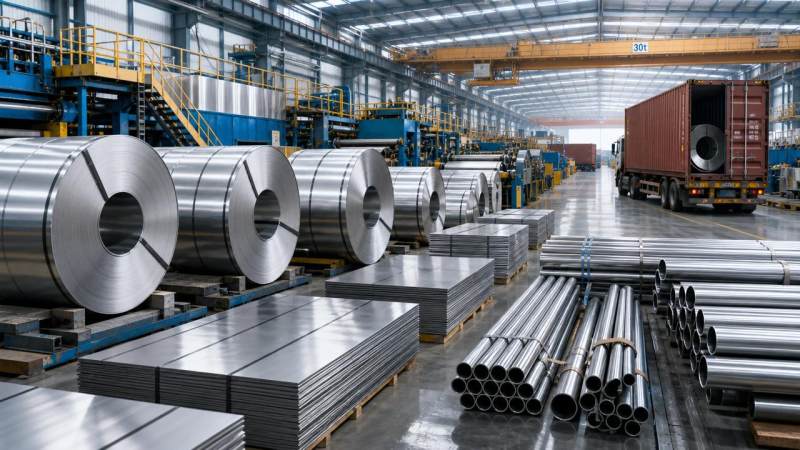
304 stainless steel is the most widely used austenitic stainless grade in construction, fabrication, transport, and industrial equipment.
It is valued for corrosion resistance, formability, weldability, and broad compliance with international standards.
Because of this versatility, 304 stainless steel appears in sheets, coils, pipes, tubes, bars, structural sections, and custom components.
Its market price often serves as a reference point for many stainless steel procurement decisions.
In 2026, 304 stainless steel price trends are expected to remain sensitive to both upstream materials and downstream project demand.
Nickel remains one of the most watched inputs, but chromium, energy, labor, and environmental compliance also matter.
Core Factors Affecting 304 Stainless Steel Price in 2026
The most important 304 stainless steel price factors can be grouped into supply-side and demand-side influences.
1. Raw Material Costs
304 stainless steel prices closely track nickel and chromium movements.
When alloy surcharges rise, mills usually adjust offers quickly.
Stainless scrap availability also affects production economics and can soften or tighten pricing.
2. Energy and Production Costs
Melting, rolling, annealing, pickling, and finishing consume significant power and gas.
Higher utility rates or environmental restrictions can increase 304 stainless steel production costs.
3. Global Demand Cycles
Construction, food equipment, water systems, transport, and light industry all influence buying volume.
When global projects recover, the price of 304 stainless steel usually strengthens.
When industrial output slows, mills may compete more aggressively on price.
4. Trade Policy and Regional Supply
Anti-dumping duties, safeguard measures, import licensing, and customs rules can reshape regional market pricing.
The same 304 stainless steel specification may carry different landed costs across Europe, North America, and Southeast Asia.
5. Freight and Delivery Conditions
Ocean freight, port congestion, container availability, inland transport, and packing requirements affect final purchasing cost.
For exported steel, logistics can become a major part of the delivered 304 stainless steel price.
Specification Details That Change Quotation Levels
Many buyers compare offers by ton, but specification details often explain why quotations differ.
This is especially true for 304 stainless steel in processed or customized formats.
For example, standard mill finish material may be priced much lower than polished or precision-cut components.
Small orders can also raise the unit price of 304 stainless steel due to setup and packaging inefficiencies.
Industry Signals Buyers Should Watch in 2026
A useful sourcing strategy starts with monitoring a few practical indicators instead of reacting to isolated quotes.
- Nickel and ferrochrome price direction
- Stainless steel mill lead times
- Export freight rates from major Asian ports
- Regional inventory levels at service centers
- Construction and industrial project activity
- Trade controls affecting stainless steel imports
These signals help explain whether 304 stainless steel prices are rising because of temporary pressure or deeper market shifts.
Reliable interpretation supports better timing for framework orders and shipment scheduling.
Business Value of Accurate Price Evaluation
Understanding 304 stainless steel price factors improves more than quote comparison.
It helps reduce total cost, avoid mismatched specifications, and lower disruption risk in engineering schedules.
Accurate price evaluation also supports negotiation on payment terms, shipment batches, and acceptable substitutes.
In many projects, the cheapest steel offer becomes expensive if tolerances, standards, or traceability are incomplete.
That is why landed cost and usable value should be reviewed together.
Some projects also combine stainless and carbon steel systems to optimize performance and budget.
For related pipeline and structural supply planning, Carbon Steel Pipe Supplier options may support broader package sourcing.
Available grades include Q345B, Q345e, and ASTM A106 Gr.B for construction, machinery, municipal works, and fluid transport systems.
Common forms include Round, API Pipe, EMT Pipe, and Thick Wall Pipe with thickness from 2.0mm to 80mm.
Certified to ASTM, API, JIS, GS, and ISO9001, such products can offer welding, punching, cutting, bending, and decoiling support.
Typical Purchasing Scenarios for 304 Stainless Steel
Different applications create different pricing priorities for 304 stainless steel.
This scenario-based review makes 304 stainless steel sourcing decisions more realistic and less dependent on headline market numbers.
Practical Recommendations for 2026 Sourcing
A disciplined quotation process can improve cost visibility and reduce later disputes.
- Define grade, dimensions, tolerance, finish, and standard before requesting offers.
- Ask whether the 304 stainless steel quote includes testing, packing, and export documentation.
- Compare EXW, FOB, CFR, and delivered terms instead of only mill price.
- Review lead time stability, not only current spot availability.
- Check whether processing services change yield loss or production schedule.
- Monitor alloy trends and secure batches when market direction becomes clearer.
It is also wise to confirm origin, standards, and inspection methods in writing.
Clear documentation helps align technical expectations with the agreed 304 stainless steel price.
Next-Step Planning for Better Cost Control
In 2026, 304 stainless steel prices will continue to reflect both commodity volatility and project-specific requirements.
The most effective sourcing approach is to combine market tracking with precise technical definition.
When quote evaluation includes raw materials, standards, fabrication, and logistics, price comparisons become more meaningful.
For global steel projects, working with a stable structural steel manufacturer and exporter can further reduce sourcing uncertainty.
Hongteng Fengda supports international projects with dependable steel supply, customized solutions, and compliance with ASTM, EN, JIS, and GB standards.
A structured review of 304 stainless steel requirements today can lead to stronger cost control and smoother delivery performance tomorrow.
Please give us a message


Please enter what you want to find