For technical evaluators specifying materials for desalination infrastructure, selecting the right 2 inch stainless steel pipe is critical to long-term system integrity. In aggressive chloride-rich seawater environments, standard grades often succumb to chloride pitting and crevice corrosion—leading to costly downtime and safety risks. This article examines how advanced austenitic and super duplex stainless steel pipes (e.g., ASTM A312 TP316L, UNS S32205) deliver superior resistance, backed by real-world performance data, material selection criteria, and proven mitigation strategies—from surface finish optimization to cathodic protection integration.
Why Standard Grades Fail in Desalination Service
Chloride concentrations in raw seawater typically exceed 19,000 ppm, with localized enrichment in crevices, under deposits, or at weld heat-affected zones (HAZ). At temperatures above 40°C—common in thermal desalination preheating loops or high-velocity brine discharge lines—standard 304 stainless steel exhibits rapid pit initiation within hours. Even 316 stainless steel, while more resistant, shows measurable pitting after 72 hours under stagnant, high-chloride, low-pH conditions simulating fouled pipe interiors. The failure mechanism is electrochemical: chloride ions disrupt the passive chromium oxide layer, enabling localized anodic dissolution while adjacent areas act as cathodes. Once initiated, pits propagate autocatalytically due to acidification and chloride accumulation in the pit cavity.
Material Selection: Beyond Nominal Grade
Grade designation alone is insufficient. For 2 inch stainless steel pipe used in critical desalination applications—such as high-pressure brine discharge headers, permeate transfer lines, or chemical dosing manifolds—three parameters must be jointly evaluated: PREN (Pitting Resistance Equivalent Number), microstructure homogeneity, and fabrication history. PREN = %Cr + 3.3 × %Mo + 16 × %N provides a comparative index but does not account for sigma phase formation in welded joints or cold-work-induced martensite in bent sections. Super duplex grades like UNS S32205 achieve PREN ≥ 34, significantly outperforming TP316L (PREN ≈ 25) in accelerated crevice corrosion tests per ASTM G48 Method A. However, this advantage assumes full solution annealing post-welding and absence of intermetallic precipitates—conditions often compromised during field welding without proper heat input control and post-weld cooling rate management.
Surface Finish and Joint Geometry as First-Line Defenses
Crevice corrosion initiates preferentially at geometric discontinuities where oxygen diffusion is restricted. Flanged connections with non-metallic gaskets, threaded fittings, and even improperly aligned butt welds create ideal crevices. A smooth, electropolished internal surface (Ra ≤ 0.4 µm) delays initiation by reducing sites for deposit adhesion and improving passive film stability. Conversely, mill-scale residue or grinding marks oriented perpendicular to flow direction act as nucleation points. For 2 inch stainless steel pipe, orbital TIG welding with back-purge argon and post-weld pickling using nitric-hydrofluoric acid mixtures is essential—not optional—to restore uniform chromium enrichment across the HAZ. Mechanical cleaning alone leaves embedded iron particles that initiate galvanic corrosion.
Environmental Control and Cathodic Integration
Passive corrosion resistance cannot be isolated from system hydraulics and chemistry. Turbulent flow (Re > 4,000) suppresses deposit buildup but increases erosion-corrosion risk if suspended solids are present. Laminar flow in low-velocity bypass lines promotes biofilm formation, lowering local pH and increasing chloride concentration via differential aeration cells. Integrating cathodic protection (CP) with stainless steel piping requires careful design: CP current density must remain below 10 µA/cm² to avoid hydrogen embrittlement in duplex grades, and reference electrode placement must account for resistivity gradients in seawater-injected concrete foundations. CP is most effective when combined with controlled biocide dosing to limit sulfate-reducing bacteria activity—particularly in buried or submerged 2 inch stainless steel pipe sections.
Material formability and processing behavior also influence final performance. While austenitic and duplex grades dominate high-integrity service, certain auxiliary components—such as support brackets, cladding substrates, or secondary instrumentation housings—may utilize leaner alloys where full corrosion resistance is not required. 201 Stainless Steel Coil, for example, offers higher formability than 300-series grades and sufficient strength for non-critical structural elements, though its lower nickel content limits suitability to ambient-temperature, low-chloride exposure zones. Its tensile strength (≥520 MPa), elongation (≥55%), and cold-work hardening capability make it viable for fabricating bolted flange reinforcements or vibration-dampening mounts—provided it remains outside direct seawater contact and thermal cycling paths.
Quality Assurance Beyond Certification
ASTM A312 compliance confirms dimensional tolerances and basic chemistry but does not verify microstructural soundness or passive film quality. Third-party verification should include ferrite content measurement (for duplex grades: 40–50% ferrite), intergranular corrosion testing per ASTM A262 Practice E, and ferroxyl testing for free iron contamination. Traceability is non-negotiable: each coil or pipe lot must carry heat numbers traceable to melt analysis, mechanical test reports, and NDE records—including 100% ultrasonic testing for seamless pipe and radiographic examination for welded pipe. Batch-level inconsistency in nitrogen addition during melting can shift PREN by ±2 units—enough to cross the threshold between acceptable and unacceptable performance in marginally aggressive conditions.
Installation and Commissioning Discipline
Corrosion failures rarely originate from material defects alone. During commissioning, flushing with chlorinated seawater before passivation creates aggressive conditions that accelerate initiation at microscopic flaws. Best practice mandates dechlorinated water flush followed by citric acid passivation (6–10% wt, 60°C, 2-hour dwell) prior to seawater introduction. Post-commissioning monitoring should include regular visual inspection of weld toes using borescopes, periodic measurement of potential gradients along pipe runs, and coupon-based weight loss assessment at representative locations—including upstream of control valves where cavitation-induced erosion may compromise passive layers.
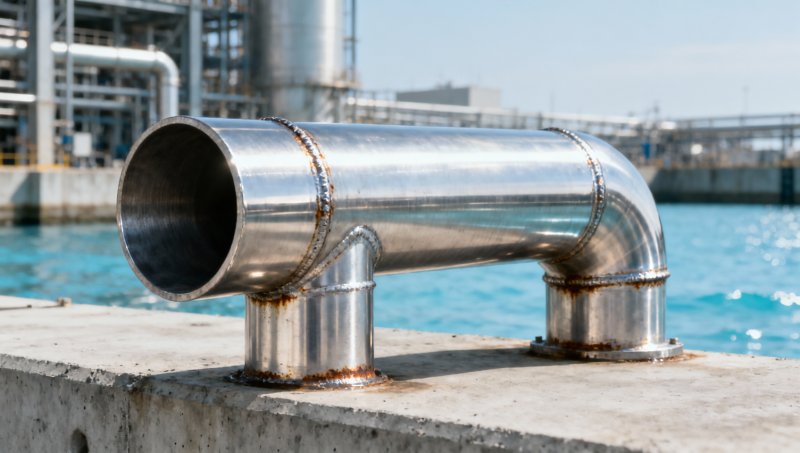
Ultimately, chloride pitting and crevice corrosion resistance in 2 inch stainless steel pipe is not a static property—it emerges from the interaction of alloy composition, thermal history, surface condition, environmental control, and operational discipline. Selecting a grade with high PREN is only the first step; sustained integrity depends on consistent execution across fabrication, installation, and maintenance phases. Where specification allows, specifying full-process documentation—including mill test reports, weld procedure qualifications, and post-fabrication NDE logs—provides the necessary evidence trail to confirm that theoretical resistance translates into field reliability.
Please give us a message


Please enter what you want to find