When galvanized steel is under review, the gap between Z275 steel coil and G90 is not just a naming issue. It shapes coating weight, corrosion behavior, expected service life, and whether a project aligns with the standard written into drawings or contracts.
That matters in structural and industrial work, where a small misunderstanding at specification stage can lead to overdesign, premature maintenance, or disputes during inspection. For projects exposed to humidity, condensation, or outdoor weathering, the coating system deserves closer attention than many buyers first expect.
In practice, the better choice depends less on marketing language and more on how zinc mass is defined, how the steel will be processed, and what environment the finished part will face over time.
Why the comparison creates confusion
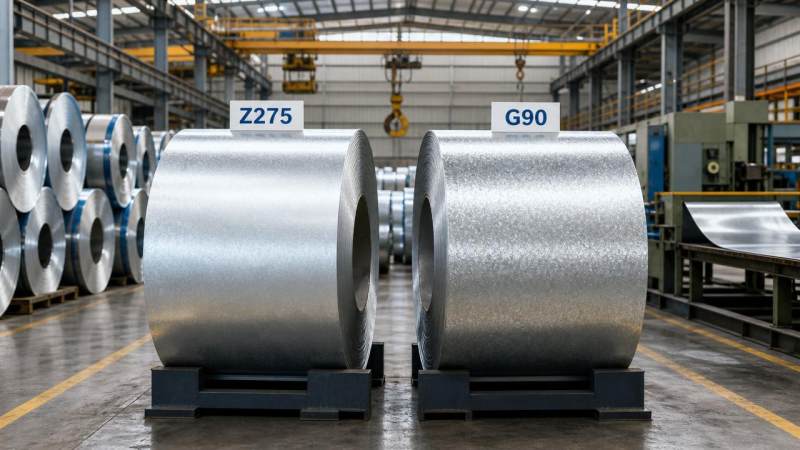
Z275 steel coil and G90 are often treated as direct equivalents. They are close, but not perfectly identical in how coating designation is expressed.
Z275 is commonly used in EN-related systems. The number refers to total zinc coating mass, measured in grams per square meter, on both sides together.
G90 comes from ASTM practice. It indicates a zinc coating weight of 0.90 ounces per square foot, again based on total coating on both surfaces.
After unit conversion, the two are very close. G90 is roughly 275 g/m², which is why many specifications compare Z275 steel coil with G90 in the same discussion.
The problem starts when people assume “close” means “always interchangeable.” It does not. The standard framework, base steel, coating tolerance, and end-use fabrication method still matter.
What actually determines how long the coating lasts
Zinc coating life is not judged by label alone. It is mainly tied to how much zinc is available to corrode before the base steel becomes exposed.
All else being equal, a heavier zinc layer usually lasts longer. That is the basic reason Z275 steel coil and G90 perform better than lighter coated material in the same environment.
Still, “all else being equal” is the key phrase. Real service life also depends on several field conditions.
- Outdoor or indoor exposure
- Marine salts or industrial pollutants
- Condensation frequency and drying cycles
- Cut edges, punched holes, and formed corners
- Whether the steel is painted, sealed, or left bare
In a mild indoor setting, both designations may deliver long and very similar results. In aggressive outdoor service, even a small difference in actual coating distribution can become more important.
Coating mass is only the starting point
A technical review should also examine coating uniformity, adhesion, spangle condition if relevant, and whether the coil will be roll formed, welded, bent, or profiled after supply.
Once the surface is cut or heavily worked, local protection can change. Zinc still offers sacrificial protection, but edge life may differ from flat surface life.
Z275 steel coil vs G90 in practical corrosion performance
From a corrosion standpoint, Z275 steel coil and G90 are generally expected to be in the same performance class when the actual coating mass is truly equivalent.
That means neither designation automatically lasts longer in every case. The longer-lasting option is usually the one with better verified coating control, more suitable substrate quality, and a closer fit to the service environment.
So, if the question is strictly which label lasts longer, the honest answer is that they should be very similar. If the question is which supplied material lasts longer on a real project, verification becomes more important than label conversion.
Where the decision matters most
This comparison becomes more critical in steel components exposed to weather, trapped moisture, or difficult maintenance access. Roofing members, wall girts, cable trays, purlins, ducts, enclosures, and light structural sections are common examples.
It also matters in downstream fabrication. A galvanized coil may later become a profile, bracket, panel, channel, or formed section. In those cases, corrosion performance depends on both incoming coating and production quality.
That broader system view is why experienced suppliers do not isolate one coil grade from the rest of the steel package. A project may combine galvanized coil, hot rolled sections, and related carbon steel products that must all fit the same durability target.
For example, some projects pairing coated sheet components with reinforcement or fabricated steel also review general-purpose carbon steel items such as Wire Rod. In that category, common grades include GB1499.2 HRB400, HRB500, ASTM A615 Grade 60, and BS4449 500B.
Those products serve auto manufacturing, shipbuilding, petrochemical plants, building material, and precision tools. Their value comes from dependable formability, weldability, and compliance with ASTM, GB, EN, DIN, and JIS requirements.
How to judge equivalence before approval
When a drawing calls for one system and a supplier offers the other, a quick unit conversion is not enough. A stronger review checks the full compliance path.
Points worth confirming
- Which product standard governs the steel substrate
- How the zinc coating is tested and certified
- Minimum and average coating values
- Whether forming, welding, or punching is expected
- Whether post-treatment, paint, or duplex coating is planned
- What the service environment looks like over the design life
This is where supplier capability begins to affect outcome. A manufacturer with stable process control can supply Z275 steel coil with more reliable coating consistency than a vendor focused only on nominal designation.
Hongteng Fengda works within that practical framework. As a structural steel manufacturer and exporter from China, the company supports global projects with standard and customized steel products built around ASTM, EN, JIS, and GB compliance.
That matters because technical selection is rarely about one isolated material line. It is about reducing sourcing risk, controlling lead time, and ensuring the supplied steel performs as specified after fabrication and installation.
When Z275 steel coil is the better fit
Z275 steel coil often makes more sense when the project documentation follows EN-style coating language, when cross-border sourcing needs metric consistency, or when downstream users compare materials primarily in g/m².
It can also simplify internal review for projects spanning Europe, the Middle East, and Southeast Asia, where metric-based specifications are often easier to align across design, procurement, and inspection records.
If the application involves formed profiles, structural accessories, or custom components, the best route is to confirm not only Z275 steel coil as a designation, but also mechanical properties, tolerances, and intended processing steps.
A practical way to answer the service-life question
If two materials are genuinely equivalent in coating mass and made under controlled standards, the service-life difference between Z275 steel coil and G90 is usually small.
If one material only appears equivalent on paper, the difference can become significant. That is why inspection documents, coating certificates, and end-use conditions should carry more weight than shorthand designation alone.
A reliable next step is to map the environment, expected fabrication, and governing standard in one comparison sheet. Then check whether the offered Z275 steel coil or G90 material meets those points without hidden assumptions.
That approach usually leads to better decisions than asking which label is stronger in the abstract. In steel selection, long-term durability is earned through matching coating, standard, process control, and application details from the start.
Please give us a message


Please enter what you want to find