When buyers compare a steel purlin quotation, the price difference often starts long before dimensions, weight, or freight are discussed—it starts with the coating.
Galvanizing thickness, surface treatment, corrosion resistance, and compliance standards can all change the real cost and long-term value of a purlin.
For procurement teams sourcing from China, understanding how coatings affect durability, project risk, and total ownership cost is essential to making fair supplier comparisons.
Why the Cheapest Steel Purlin Quote Is Often Not the Lowest-Cost Choice
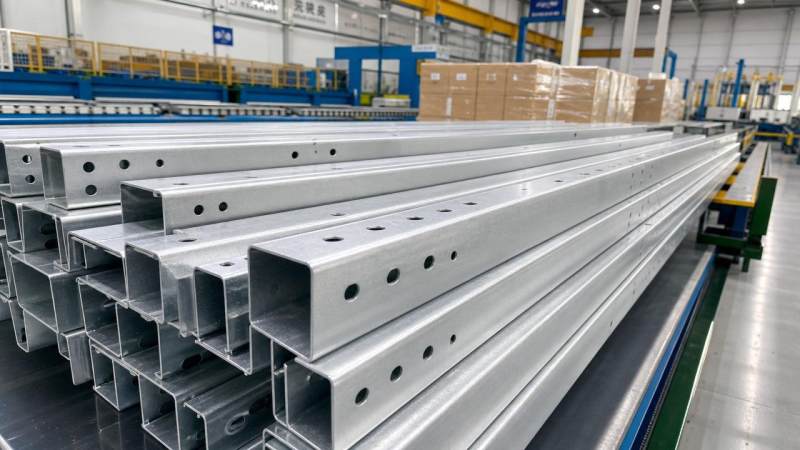
For purchasing teams, a steel purlin is rarely judged by unit price alone. It must perform reliably within a roof or wall system.
The coating determines how well the purlin resists corrosion during storage, installation, and long-term service in different environmental conditions.
Two suppliers may quote the same size, steel grade, and weight, yet provide very different coating thicknesses and surface protection levels.
That difference can explain a visible price gap, even when the specification sheet looks similar at first reading.
A lower coating mass can reduce the initial purchase cost, but it may increase replacement risk, maintenance needs, and project liability.
For this reason, procurement teams should treat coating details as a cost driver, not as a small technical note.
What Coating Factors Actually Change the Steel Purlin Price?
The first factor is zinc coating mass, often expressed in grams per square meter or equivalent coating designation.
Higher zinc coating generally means better corrosion resistance, but it also increases material consumption and production cost.
The second factor is whether the purlin is made from pre-galvanized coil or processed through another protective route.
Pre-galvanized material is common for cold formed purlins because it supports efficient production and stable surface quality.
The third factor is passivation, oiling, chromate-free treatment, or other surface finishing designed to protect the coating after forming.
These treatments can improve storage performance, reduce white rust risk, and support cleaner handling at the jobsite.
The fourth factor is coating uniformity, especially at edges, bends, punched holes, and formed corners of C or Z purlins.
A quotation that mentions only “galvanized” without coating mass, standard, and inspection criteria leaves too much room for interpretation.
How Galvanizing Thickness Affects Service Life and Project Risk
Galvanizing does not simply make steel look brighter. It provides sacrificial protection that slows corrosion of the underlying steel.
In dry inland environments, a moderate coating may be adequate for many agricultural, warehouse, or light industrial buildings.
In coastal, humid, chemical, or high-condensation environments, a light coating can degrade much faster than buyers expect.
That is why coating selection should be matched to the service environment, not selected only by lowest landed cost.
Project risk increases when the specified coating does not reflect humidity, salt exposure, ventilation, roof insulation, or condensation patterns.
A purlin hidden behind panels may be difficult to inspect and expensive to replace after installation is complete.
For procurement managers, the real question is not whether a thicker coating costs more, but whether it prevents avoidable failure.
A fair comparison should estimate expected service life, maintenance exposure, warranty obligations, and consequences of premature corrosion.
Why Similar Specifications Can Still Produce Different Supplier Prices
Steel purlin quotations often appear simple, but small specification gaps can produce significant commercial differences between suppliers.
One supplier may quote a nominal coating level, while another includes verified coating inspection and documented compliance testing.
One may include proper packaging for ocean freight, while another offers basic bundling that exposes material to moisture.
Another supplier may use a tighter tolerance for thickness, straightness, hole position, or length accuracy during cold forming.
These details influence production loss, inspection cost, packaging cost, and the probability of claims after arrival.
Procurement teams should also check whether the quoted coating applies before forming, after forming, or only to base coil data.
Because forming can affect coating appearance at bends, buyers need realistic acceptance criteria rather than vague surface descriptions.
The supplier willing to define these conditions clearly may not be the cheapest, but usually reduces dispute risk.
Questions Buyers Should Ask Before Accepting a Steel Purlin Quotation
Before comparing prices, buyers should ask every supplier to confirm the coating standard, coating mass, base steel grade, and forming method.
They should request information about thickness tolerance, yield strength, punching accuracy, bundle weight, marking, and export packaging.
It is also important to ask whether the supplier can provide mill test certificates or third-party inspection support when required.
For large projects, buyers should request sample approval or pre-production confirmation before full manufacturing begins.
A useful quotation should state whether prices include anti-rust storage measures, edge protection, moisture-resistant wrapping, and shipping marks.
If the project has a corrosion category or design standard, the buyer should share it before requesting final pricing.
Without this information, suppliers may quote based on assumptions, creating price gaps that are difficult to explain later.
The best procurement practice is to standardize the enquiry format, then compare suppliers against the same technical and commercial baseline.
How Coating Choices Affect Freight, Storage, and Installation
Coating quality matters even before the purlins are installed. Export shipments may face humidity, temperature changes, and long transit times.
White rust can appear when galvanized surfaces remain wet without enough airflow, especially during sea transportation or outdoor storage.
Good packaging reduces this risk, but packaging cannot fully compensate for an unsuitable coating or careless storage conditions.
Buyers should define whether bundles require waterproof wrapping, steel straps, wooden supports, or ventilation gaps for long-distance shipping.
At the jobsite, workers may drag, stack, cut, or drill purlins, creating damaged areas that need proper handling.
If the coating is thin or poorly bonded, installation damage may accelerate corrosion around cuts, holes, and contact points.
For projects with demanding exposure, procurement teams should discuss repair procedures for cut edges and minor coating damage.
These operational details may seem small, but they strongly influence whether the delivered steel purlin performs as specified.
Where Structural Steel Procurement Requires a Broader View
Many construction buyers source purlins together with beams, channels, angles, rebars, and customized structural components.
In these projects, coating decisions must align with the entire structural package, not only one product line.
For reinforced concrete elements, strength and seismic performance may be the main concern rather than surface coating.
For example, HRB500 Rebar is used in heavy-load structures, super high-rise buildings, bridges, and industrial plants.
It is a hot ribbed steel rebar available in specifications from 6 mm to 50 mm and lengths such as 6 m or 12 m.
Models include HPB300, HRB400, HRB500, and seismic-resistant E grades, with standards including ASTM, BS, DIN, GB, JIS, and AiSi.
This example shows why procurement teams must evaluate each steel product according to its own performance role and compliance requirements.
For purlins, coatings may dominate service value; for reinforcement, strength grade, ductility, and seismic behavior may be more decisive.
How to Compare Chinese Steel Purlin Suppliers More Fairly
When sourcing from China, buyers should separate the quotation into material, coating, processing, packaging, inspection, and logistics components.
This structure helps procurement teams understand whether a lower price reflects efficiency, specification differences, or missing quality requirements.
A reliable supplier should be able to explain coating choices clearly and recommend suitable options for the project environment.
They should also provide stable production capacity, predictable lead times, and quality control across repeated orders.
Buyers serving North America, Europe, the Middle East, or Southeast Asia may face different standards and climate conditions.
Therefore, export experience matters because documentation, packing, tolerance control, and communication all affect final project success.
Hongteng Fengda supports global buyers with structural steel products, customized profiles, and production aligned with ASTM, EN, JIS, and GB standards.
For procurement teams, the ideal supplier is not only a factory, but a partner that helps reduce sourcing uncertainty.
Red Flags That Suggest the Coating Specification Is Too Weak
A quotation that says only “galvanized steel purlin” without coating mass or standard should be reviewed carefully.
Another warning sign is a supplier refusing to confirm whether coating inspection can be provided before shipment.
Unusually low prices may indicate lighter coating, wider tolerances, lower-grade raw material, or simplified packaging.
Buyers should also be cautious when suppliers avoid discussing storage conditions, white rust prevention, or edge corrosion concerns.
If a supplier cannot explain the difference between indoor, rural, coastal, and industrial environments, technical support may be limited.
Inconsistent answers between sales documents, technical sheets, and invoices can also create problems during inspection or customs clearance.
The strongest protection is a written purchase specification that defines coating, steel grade, dimensions, tolerance, packaging, and documentation.
Clear requirements reduce misunderstanding and make supplier comparison more transparent from the first quotation stage.
Building a Practical Steel Purlin Buying Checklist
A practical checklist begins with the project location, building use, exposure condition, and expected service life.
Next, buyers should define purlin type, section size, thickness, steel grade, hole pattern, length, and allowable tolerance.
The coating requirement should include coating standard, minimum coating mass, surface treatment, inspection method, and acceptance criteria.
Packaging should specify bundle size, moisture protection, lifting method, shipping marks, and handling instructions for the destination site.
Documentation should include test certificates, packing list, commercial invoice, certificate of origin, and any required inspection reports.
Buyers should also confirm production lead time, loading schedule, container plan, and procedures for handling nonconforming material.
This checklist allows procurement teams to compare quotations based on total delivered value, not only the first price.
It also helps suppliers quote accurately, reducing later revisions that can delay purchasing decisions and project timelines.
Conclusion: Coatings Explain More Than the Price Gap
Steel purlin price gaps often begin with coatings because coatings affect material cost, corrosion resistance, service life, and project risk.
A fair quotation comparison must include coating mass, standard compliance, surface treatment, packaging, inspection, and expected environment.
The cheapest offer may be suitable for some projects, but only when its coating matches the building’s real exposure conditions.
For procurement teams, the best decision is based on clear specifications, supplier transparency, and total ownership cost.
When coating requirements are defined early, buyers can control costs more effectively and avoid hidden quality gaps after delivery.
That is how a steel purlin purchase becomes more than a price negotiation—it becomes a risk-managed sourcing decision.
Please give us a message


Please enter what you want to find