Why are some buyers paying up to 22% more for galvanized iron angle—yet receiving zero additional corrosion protection? This paradox confuses procurement teams, engineers, and project managers alike. Whether you're specifying l shaped metal bars for bracing angle in steel structure, sourcing A36 angle or galv angle for industrial frameworks, or evaluating steel ka angle vs. galvanized alternatives, understanding the real value—and hidden risks—of surface treatment is critical. As a trusted structural steel manufacturer & exporter from China, Hongteng Fengda clarifies the metallurgical truth behind galvanized angle, l shape steel, and galvanized iron angle—helping technical evaluators, cost-conscious buyers, and safety-focused QA teams make smarter, standards-compliant decisions.
Why “Galvanized Iron Angle” Is a Misleading Term—And Why It Costs You More
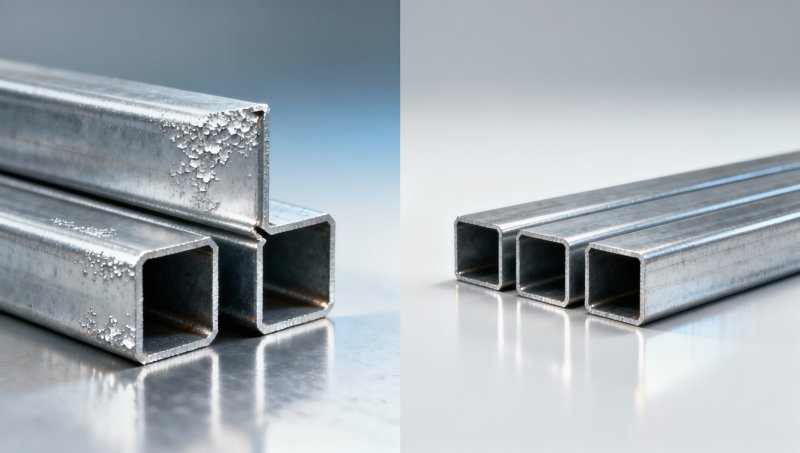
“Galvanized iron angle” is not a standardized product category—it’s a colloquial misnomer often used to describe hot-dip galvanized carbon steel angle (e.g., ASTM A36 or EN S235JR) with a zinc coating applied *after* rolling. Crucially, the base material remains unalloyed carbon steel—not “iron” in any metallurgical sense. The term “iron angle” falsely implies inferior composition, while the “galvanized” prefix suggests enhanced durability—neither of which holds true under rigorous inspection.
Zinc coatings on standard angle steel provide only marginal corrosion resistance in mild environments (e.g., indoor storage, short-term outdoor exposure). In aggressive conditions—coastal salt spray, industrial SO₂ zones, or high-humidity interiors—the coating degrades within 3–5 years, exposing bare steel. Worse: many suppliers apply substandard galvanizing (zinc thickness < 45 µm), failing ASTM A123 or ISO 1461 requirements—rendering the premium price entirely unjustified.
A 22% price markup over bare structural angle typically reflects only process overhead—not performance uplift. Buyers who specify “galvanized iron angle” without verifying coating mass, adhesion, or base steel grade risk overspending while gaining no meaningful service-life extension. That’s why leading infrastructure projects in North America and the EU now mandate certified hot-dip galvanizing reports—not just visual inspection—for all exposed structural angles.
What Real Corrosion Protection Requires
- Minimum 610 g/m² zinc coating mass (ASTM A123 Class B) for outdoor structural use
- Base steel meeting minimum tensile strength (≥ 400 MPa) and elongation (≥ 20%) to prevent brittle fracture at cut edges
- Post-galvanizing verification: coating adhesion (tape test per ASTM D3359), uniformity (no bare spots > 0.5 mm²), and thickness mapping across flanges and heel
- Third-party certification: SGS or BV audit reports confirming compliance with EN ISO 1461 or ASTM A123
Galvanized Angle vs. True Corrosion-Resistant Alternatives: A Technical Comparison
When long-term integrity matters—especially for bridges, transmission towers, or chemical plant supports—substituting galvanized carbon angle with inherently corrosion-resistant materials delivers measurable ROI. Below is a side-by-side comparison of performance, lifecycle cost, and application suitability:
The data shows a clear trade-off: galvanized carbon angle offers minimal durability uplift for high cost. Weathering steel delivers 3–5× longer life with no maintenance—making it cost-effective over 15+ years. For critical safety components, Rebar in HRB400 or HRB500 grades—often used alongside structural angles in foundations and columns—also benefits from similar lifecycle thinking: corrosion resistance must be engineered into the material, not added as a surface layer.
How to Specify Structural Angle Without Overpaying—or Underperforming
Procurement and engineering teams can eliminate the “galvanized iron angle” trap by adopting three disciplined practices:
- Require certified zinc coating data: Demand mill test reports showing average coating mass (g/m²), measured per ASTM A123 Annex A1—not just “galvanized per specification.” Reject shipments with thickness variation > ±15% across sections.
- Match base steel to environment: For interior dry locations: A36 or Q235 is sufficient. For coastal or industrial sites: specify weathering steel (Q355NH or ASTM A588) or duplex stainless alternatives—bypassing galvanizing entirely.
- Verify fabrication compatibility: Confirm that cutting, drilling, or welding won’t compromise coating integrity beyond allowable limits (EN ISO 1461 allows ≤5% bare area per component, max 0.5 cm² per spot).
Hongteng Fengda supports this precision approach with full traceability: every batch of angle steel carries dual certification—base material (ASTM/EN/GB) and galvanizing (ISO 1461 or ASTM A123). We also offer pre-fabricated, galvanized-to-specification assemblies—reducing on-site rework and ensuring compliance before shipment.
Why Global Buyers Trust Hongteng Fengda for Structural Steel Integrity
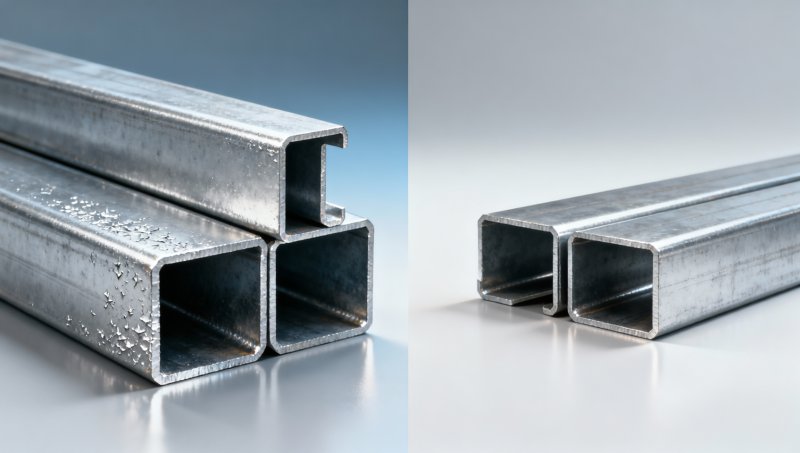
As a professional structural steel manufacturer & exporter from China, Hongteng Fengda eliminates ambiguity in material selection. We don’t sell “galvanized iron angle”—we deliver precisely specified, fully documented structural angles built for your exact environmental, load-bearing, and compliance needs.
Our capabilities include: hot-rolled and cold-formed angle steel (HRB335 to HRB500 grades), custom galvanizing with third-party verified thickness (50–80 µm), and integrated solutions combining Rebar, beams, and bracing components—all aligned to ASTM, EN, JIS, and GB standards. With production capacity covering 5–12m lengths, tolerances held to ±1%, and lead times consistently delivered within 25–35 days, we help procurement teams reduce sourcing risk while maintaining full technical control.
Ready to replace assumptions with data-driven specifications? Contact Hongteng Fengda today for: • Zinc coating verification protocols for your next tender • Weathering steel angle samples (ASTM A588 / Q355NH) • Custom OEM angle designs with EN 1090-2 execution class certification • Cross-referenced compliance reports for ASTM A6/A6M, EN 10025, and ISO 9001
Please give us a message


Please enter what you want to find