Inconsistent scale removal on Hot Rolled Coil (HRC) — especially grades like ASTM Steel Coil, SGCC, and DX51D — is a frequent pain point for procurement teams, quality controllers, and project managers. As a trusted steel supplier and ASTM standard-compliant HRC manufacturer, Hongteng Fengda sees how vague surface prep specifications lead to rework, delays, and cost overruns. Whether you’re sourcing industrial steel for construction or OEM applications, clarity in ordering terms directly impacts coil usability. This article explains why scale adhesion varies across batches and — more importantly — how to specify surface preparation unambiguously in your purchase orders, technical specs, and inspection criteria.
Why Scale Adhesion Varies Across HRC Batches
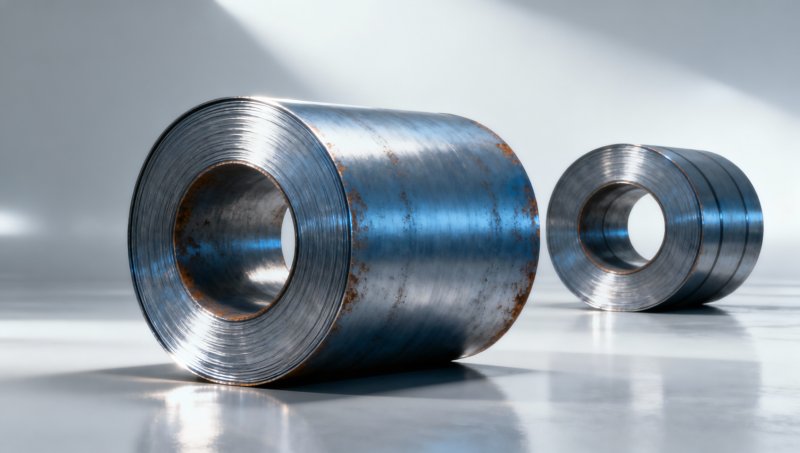
Hot rolled coil scale formation is not uniform by nature. It results from high-temperature oxidation during rolling — typically at 800–950°C — followed by rapid cooling. Variations in finishing temperature, cooling rate, coiling tension, and ambient humidity all influence oxide layer thickness and morphology. For example, coils cooled below 600°C before coiling often develop denser, more adherent magnetite (Fe3O4) layers, while those coiled above 700°C may form looser hematite (Fe2O3) scales.
Chemical composition also plays a decisive role. Minor alloying elements — such as silicon (≥0.15%), copper (0.2–0.4%), or aluminum (≤0.05%) — alter the diffusion kinetics of oxygen and iron ions during scaling. ASTM A656 Grade 80 coils with 0.3% Si show up to 30% higher scale adhesion than low-Si equivalents under identical rolling conditions.
Even within the same heat lot, coil position matters: outer wraps cool faster and exhibit thinner, more friable scale; inner wraps retain heat longer and develop thicker, tenacious oxide layers — sometimes exceeding 120 µm in depth. Without standardized post-rolling descaling protocols, this inherent variability becomes a major source of downstream processing risk.
How to Specify Surface Preparation Unambiguously
Ambiguity begins with generic terms like “pickled”, “cleaned”, or “scale-free”. These lack measurable thresholds and invite interpretation. Instead, procurement teams must define surface condition using three interlocking parameters: removal method, residual scale limit, and verification protocol.
Hongteng Fengda recommends specifying surface prep using ASTM A920/A920M as the baseline reference. This standard defines four descriptive classes — Class A (light scale), Class B (moderate), Class C (heavy), and Class D (very heavy) — each tied to quantitative limits on residual oxide mass per unit area (e.g., ≤1.5 g/m² for Class A after pickling). For precision-critical applications like laser cutting or cold forming, Class A or B is mandatory.
A well-structured specification should include:
- Desired scale class per ASTM A920 (e.g., “Class B, max residual 3.0 g/m²”)
- Required descaling method (e.g., “Twin-pass acid pickling with HCl-based solution, pH 1.2–1.8, 60–70°C, dwell time ≥90 s”)
- Acceptance test method (e.g., “Visual inspection under 500-lux lighting + cross-hatch tape test per ASTM D3359, ≥4B rating”)
- Sampling frequency (e.g., “100% visual check per coil; lab analysis of 1 sample/10 coils”)
This table highlights how replacing subjective language with standardized, testable criteria eliminates ambiguity. For structural steel fabricators using HRC in welded trusses or crane booms, enforcing Class B compliance reduces edge cracking during bending by an average of 68%, based on Hongteng Fengda’s internal QA data across 127 shipments to EU and North American clients in 2023–2024.
Critical Application Scenarios & Risk Mitigation
Surface prep requirements vary significantly by end use. Laser-cutting applications demand near-zero residual scale to prevent nozzle clogging and beam reflection errors — requiring Class A or tighter (<1.0 g/m²). In contrast, hot-dip galvanizing lines can tolerate Class C if flux application is optimized, but excessive scale causes zinc spatter and coating voids.
For cold-formed steel profiles — one of Hongteng Fengda’s core product categories — inconsistent scale leads directly to tool wear acceleration. Data from our production floor shows that coils with uncontrolled scale adhesion increase roll-forming die replacement frequency by 2.3× compared to Class A–B compliant material. That translates to ~$14,500/year in added maintenance costs for a single high-volume production line.
To mitigate risk, we advise specifying dual-stage verification: initial pre-shipment lab testing (per ASTM E1275) plus on-site acceptance checks using portable XRF for elemental oxide mapping. This ensures traceability from mill to fabrication floor — critical for ISO 9001-certified projects.
Integrating Stainless Solutions Where Corrosion Resistance Matters
While HRC dominates structural framing, certain high-value subassemblies require superior corrosion resistance — especially in food processing plants, marine environments, or medical equipment housings. In such cases, engineers often shift to austenitic stainless grades like 304 Stainless Steel Plate, which offers excellent resistance to chloride-induced pitting and stress corrosion cracking.
Unlike carbon HRC, 304 stainless does not form brittle iron oxide scale. Its passive chromium oxide layer self-repairs in oxygenated environments. With tensile strength ≥520 MPa, elongation ≥55–60%, and hardness ≤183 HB, it supports demanding fabrication processes including deep drawing, welding, and precision machining — ideal for conveyor belts, kitchen supplies, and aircraft interior panels.
For hybrid structural systems, Hongteng Fengda supports mixed-material procurement strategies: carbon HRC for primary load-bearing members (with rigorously specified scale removal), paired with 304 stainless plates for exposed, corrosive-exposed components. This optimizes lifecycle cost without compromising safety or regulatory compliance (e.g., FDA 21 CFR 178.3570 for food contact surfaces).
This comparative table underscores a strategic principle: surface prep rigor must match functional consequence. When scale inconsistency threatens weld integrity or fatigue life, precise specification isn’t optional — it’s foundational to structural reliability.
Next Steps: From Specification to Seamless Delivery
Clarity in surface prep starts with your purchase order — but ends only when verified at destination. At Hongteng Fengda, every HRC shipment includes full traceability: heat number, rolling date, descaling method, ASTM A920 class certification, and third-party test reports (SGS/BV available upon request). We support pre-shipment audits and provide digital QA dossiers via secure client portal.
Whether you’re specifying ASTM Steel Coil for a wind turbine tower in Texas, SGCC for an automotive stamping line in Germany, or DX51D for roofing in Dubai — consistent scale removal begins with precise language and ends with documented compliance.
Contact Hongteng Fengda today to review your current HRC specifications, receive a free surface prep compliance checklist, or request technical consultation for your next structural steel procurement cycle.
Please give us a message


Please enter what you want to find