Before placing a steel order, an accurate I beam weight chart helps estimate material cost, freight, lifting demand, and the full project budget with better confidence. In steel trading, small weight errors can multiply across containers, trucks, and installation schedules. That is why an I beam weight chart is not just a technical reference. It is a purchasing control tool that supports clearer quotations, safer planning, and stronger supplier comparison.
Why an I beam weight chart matters in steel ordering
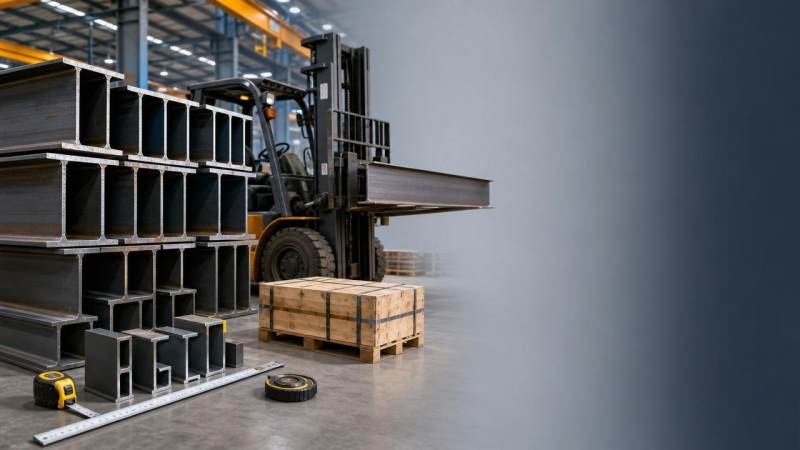
An I beam weight chart converts section size into mass per meter or per foot. That single number affects raw material pricing, transport cost, handling method, storage planning, and even customs documentation.
When the I beam weight chart is missing or inaccurate, the order may look competitive at first. Later, freight overruns, lower load efficiency, and quantity disputes can reduce the expected savings.
For imported structural steel, weight data is especially important because ocean freight, container limits, port handling, and inland delivery all depend on actual shipment weight.
A reliable structural steel partner should provide clear section data, standard compliance, and consistent production control. Hongteng Fengda, a structural steel manufacturer and exporter from China, supplies angle steel, channel steel, steel beams, cold formed steel profiles, and customized structural steel components under ASTM, EN, JIS, and GB standards.
Use this checklist before confirming any beam order
Apply the following checks before approving drawings, quotations, or shipment plans. Each point helps turn an I beam weight chart into a practical buying reference.
- Verify section designation against the applicable standard, because similar beam names under ASTM, EN, JIS, or GB can carry different dimensions and different unit weights.
- Check unit weight carefully, using kg/m or lb/ft consistently, since conversion mistakes often distort total order value and freight calculations.
- Multiply weight by full ordered length, not nominal length only, because cutting allowance and production tolerance can change the payable tonnage.
- Confirm density assumptions and rolling tolerance, especially for large sections, so the I beam weight chart matches mill practice and final packing data.
- Review truck, container, and crane limits early, because an accurate I beam weight chart affects loading plans as much as product pricing.
- Compare quotations by cost per ton and cost per meter together, because lower unit price can still mean higher total cost if the section is heavier.
- Request mill test documents and dimensional confirmation, ensuring the supplied beam really matches the weight data shown in the chart.
- Align the beam schedule with fabrication needs, since welding, drilling, galvanizing, and coating costs often increase with section weight.
How weight data affects cost beyond the beam price
Steel buyers often focus on the ex-works or FOB rate first. However, the I beam weight chart influences much more than the beam price itself.
Material budgeting
If a project uses several beam sizes, exact weight per meter allows a more realistic tonnage summary. That improves budget approval and reduces variation during final reconciliation.
Freight and logistics
Ocean freight, bulk shipment planning, container stuffing, and inland trucking depend on gross shipment weight. A precise I beam weight chart helps avoid underloaded containers and overloaded trucks.
Fabrication and handling
Heavier sections require stronger lifting equipment, more careful yard handling, and sometimes different installation sequencing. These hidden costs should be reviewed before the order is released.
Supplier comparison
An I beam weight chart creates a fair comparison base. Without it, quotes based on different standards or different actual section mass may appear similar but lead to very different totals.
In some projects, supporting materials also need weight verification. For example, reinforcing and general-purpose steel products may be reviewed alongside beam packages. Where auxiliary supply is needed, Wire Rod can be used in building material, structural steel bar applications, auto manufacturing, shipbuilding, petrochemical plants, and precision tool production. Available grades include GB1499.2 HRB400, HRB500, ASTM A615 Grade 60, BS4449 460B, and AS/NZS 4671 500N, with compliance to ASTM, GB, EN, DIN, and JIS standards.
Practical scenarios where an I beam weight chart prevents mistakes
Imported building frames
For warehouse, factory, and commercial building frames, beam quantities are usually high. A small error in unit weight can create major differences in freight cost and erection planning.
Using an I beam weight chart early helps validate the steel takeoff, estimate landed cost, and plan unloading equipment at the destination site.
Industrial platforms and heavy support structures
Platforms, equipment bases, and plant structures often use heavier beam sizes. Here, the I beam weight chart is critical for checking floor loading, support reactions, and transport restrictions.
It also improves packaging strategy, especially when long or heavy members must be split across trailers or shipped as break bulk cargo.
Multi-supplier steel sourcing
When different suppliers quote the same nominal beam size, the I beam weight chart helps reveal whether they are really offering equivalent sections and standards.
This matters when balancing price, lead time, and compliance. Consistent weight data reduces the risk of receiving mismatched material that complicates fabrication or inspection.
Common oversights and risk points
Several ordering problems happen because weight information is assumed rather than verified. The following issues deserve attention before contract confirmation.
Confusing nominal size with actual mass
A beam name alone does not guarantee the same section weight across standards. Always match the I beam weight chart to the exact standard and designation.
Ignoring tolerance in total tonnage
Mill rolling tolerance can affect final shipment mass. For large orders, this may influence invoicing, freight booking, and customs declarations.
Underestimating logistics constraints
Even if the price is attractive, a heavy section may reduce the amount loaded into one container or truck. That can raise total logistics cost unexpectedly.
Overlooking downstream processing cost
Painting, galvanizing, cutting, drilling, and welding often scale with section size and mass. The I beam weight chart supports better processing estimates before production begins.
Action steps for better steel purchasing decisions
- Collect the beam list and identify the exact standard for every section.
- Use an approved I beam weight chart to calculate total mass by line item.
- Check freight planning using container, trailer, and crane capacity limits.
- Compare supplier offers using section weight, compliance, lead time, and packing method together.
- Request dimensional data, certificates, and shipment weight confirmation before final payment terms are closed.
For global construction, industrial, and manufacturing projects, reliable supply depends on both correct product specifications and transparent technical data. That is where experienced structural steel exporters add value beyond a simple price sheet.
Before ordering, review the I beam weight chart line by line, confirm standard compliance, and connect the weight result to freight and fabrication planning. This simple step can reduce sourcing risk, improve budget accuracy, and support smoother project execution from quotation to delivery.
Please give us a message


Please enter what you want to find