For quality control and safety managers, choosing a stainless steel wire rope supplier is not just a purchasing decision—it is a risk management responsibility.
A proper supplier audit helps verify material traceability, production consistency, testing capability, and compliance with project standards before problems reach the jobsite or assembly line.
In steel-related applications where load performance, corrosion resistance, and long-term reliability matter, auditing the supplier can prevent costly failures, delays, and safety incidents.
What buyers are really trying to confirm during a supplier audit
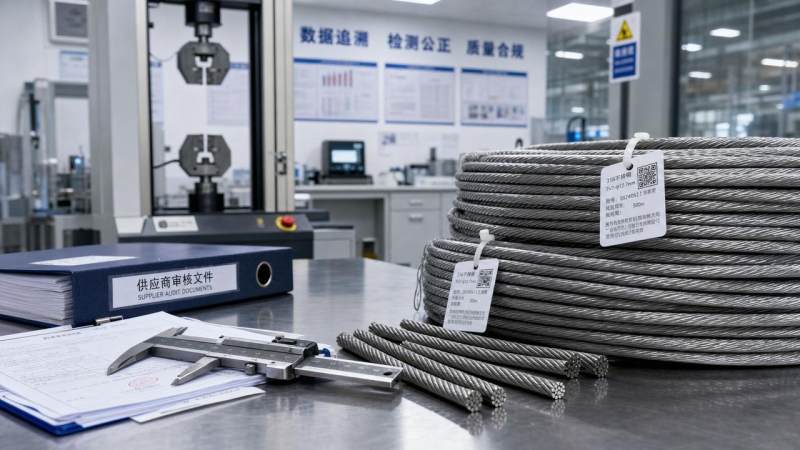
When buyers search this topic, they usually want more than a checklist. They need confidence that the supplier can repeatedly deliver safe material.
For a quality control manager, the main question is whether every coil, strand, fitting, or package can be traced and verified.
For a safety manager, the main concern is whether hidden material defects, poor lubrication, incorrect construction, or weak documentation could create operational risk.
A stainless steel wire rope supplier audit therefore focuses on evidence. Claims about experience, capacity, and quality are useful only when supported by records.
The audit should show how the supplier controls raw material, production parameters, inspection frequency, nonconforming products, packaging, storage, and shipment documents.
It should also clarify whether the supplier understands the end-use environment, including lifting, marine exposure, architectural tensioning, guardrail systems, or industrial equipment.
Why an audit matters before the first shipment
Wire rope failures are rarely simple. They may involve material chemistry, strand geometry, tensile performance, fatigue behavior, corrosion, incorrect handling, or installation conditions.
If the supplier is not audited early, buyers may discover problems only after cutting, installation, load testing, or field operation.
At that stage, the cost is no longer limited to replacement material. It may include project delay, rework, liability exposure, or shutdown.
An audit helps identify whether the supplier has a controlled process or only relies on final inspection after production is complete.
Final inspection can catch obvious defects, but it cannot fully compensate for unstable wire drawing, inconsistent heat treatment, or poor strand closing control.
Early auditing is especially important for international sourcing, where distance, shipping time, customs procedures, and communication gaps increase correction costs.
Material traceability is the first line of defense
Traceability is one of the most important audit items for any stainless steel wire rope supplier serving safety-sensitive applications.
The auditor should confirm how raw stainless steel wire rod or drawn wire is identified, separated, recorded, and linked to finished rope batches.
Material certificates should be checked against purchase orders, production lots, heat numbers, chemical composition, mechanical properties, and applicable standards.
If the supplier cannot clearly connect finished rope to raw material records, later investigation becomes difficult when defects or failures occur.
Traceability should also cover internal processing records, including drawing, annealing if applicable, stranding, closing, lubrication, cutting, spooling, and packaging.
Good suppliers maintain batch control throughout production, not only in the final warehouse or export documentation stage.
Production consistency is more important than one perfect sample
Many buyers approve a supplier after receiving one acceptable sample. However, a sample does not prove long-term production stability.
During an audit, quality teams should review whether process parameters are defined, monitored, recorded, and corrected when they move outside limits.
For wire rope, important controls may include wire diameter, tensile strength, lay length, strand tension, surface condition, lubrication quality, and rope diameter.
Auditors should ask how operators are trained, how machines are maintained, and how tooling wear is monitored during repeated production.
A supplier with stable production control can reduce variation between orders, which is critical for buyers managing multiple sites or long-term projects.
Consistency also supports easier incoming inspection, fewer disputes, and more predictable performance in assembled systems or field installations.
Testing capability should match the application risk
Not every order requires the same inspection level, but the supplier’s testing capability should match the rope’s expected duty and safety requirements.
An audit should verify available equipment for tensile testing, diameter measurement, visual inspection, coating or surface checks, and material identification.
For demanding projects, buyers may also require fatigue testing, salt spray evaluation, breaking load verification, or third-party laboratory support.
The key issue is not only whether equipment exists. Auditors must confirm calibration status, operator competence, test frequency, and record integrity.
Testing reports should be consistent with the applicable standard, purchase specification, drawing requirement, and actual production batch information.
If reports are generic, incomplete, or repeatedly copied without batch-specific data, the buyer should treat that as a serious warning sign.
Compliance is not only about certificates
Certificates are necessary, but they are not a substitute for process control. A supplier may present certificates while still having weak daily management.
Quality control teams should verify whether the supplier truly understands standards such as ASTM, EN, JIS, GB, or customer-specific project requirements.
They should also confirm whether the supplier can manage different acceptance criteria for construction, marine, machinery, architectural, or industrial applications.
Compliance should be reflected in drawings, inspection plans, production instructions, packing marks, certificates, and shipment documents.
Where export markets are involved, documentation accuracy matters because incorrect grades, dimensions, or standards can delay customs clearance or site approval.
A reliable stainless steel wire rope supplier should be able to explain how each standard requirement is converted into controllable production and inspection steps.
What quality and safety teams should check on site
A practical supplier audit should start with management responsibility. The team should identify who owns quality decisions and who approves shipment release.
Next, auditors should review incoming material control, including supplier qualification, material certificate verification, storage conditions, and segregation of different grades.
Production flow should be observed directly. The goal is to see whether written procedures match actual operator behavior on the workshop floor.
Inspection points should be checked at each stage where defects may appear, not only after the finished rope reaches packaging.
Auditors should also inspect warehouse conditions, because contamination, moisture, poor stacking, or unclear labels can damage otherwise qualified products.
Finally, the team should review complaint handling, corrective actions, and how lessons from previous problems are implemented into process improvements.
Red flags that deserve immediate attention
Some audit findings are minor and can be corrected through training or documentation updates. Others indicate deeper risk in supplier management.
Major red flags include missing heat numbers, uncalibrated testing equipment, mixed material storage, unclear inspection criteria, and inconsistent production records.
Another warning sign is overdependence on verbal explanations. In safety-related sourcing, important controls must be documented and repeatable.
Auditors should also be cautious when a supplier cannot explain the difference between similar grades, constructions, or performance requirements.
Unrealistically short lead times can be another concern, especially if the product requires controlled production, testing, documentation, and proper export preparation.
If the supplier resists reasonable audit questions, blocks workshop access, or avoids showing records, buyers should reassess the sourcing decision.
How audits reduce total sourcing cost
Supplier audits are sometimes viewed as an extra expense, but they often reduce total cost by preventing failures before shipment.
A strong audit can reduce incoming inspection burden, emergency replacement purchases, air freight costs, site downtime, and dispute management workload.
For safety managers, the value is even clearer. Preventing one critical failure can outweigh the cost of multiple supplier audits.
For quality teams, audits create a shared baseline for specifications, inspection requirements, documentation formats, and acceptable corrective action timelines.
They also support supplier development. A capable supplier can improve after clear feedback, measurable requirements, and regular performance review.
The result is not only lower risk, but also a more stable relationship between buyer, supplier, project owner, and end user.
Why related steel supply capability can matter
Many buyers source wire rope together with structural steel, rods, fasteners, profiles, or fabricated components for the same project environment.
In these cases, auditing a supplier’s broader steel management system can provide useful insight into quality culture and production discipline.
For example, Hongteng Fengda supplies structural steel products and customized solutions for global construction, industrial, and manufacturing projects.
Its steel portfolio includes products such as Galvanized Round Steel, which is used across power, railway, highway, marine, and building applications.
When reviewing related steel products, buyers can compare how suppliers control corrosion protection, dimensional tolerance, surface quality, testing, and international standards.
This broader view helps quality and safety teams judge whether a supplier can support complex projects beyond a single product category.
How to prepare before conducting the audit
A successful audit begins before the visit. Buyers should define the application, load requirements, environment, standards, inspection level, and documentation needs.
The audit team should prepare a checklist, but it should not be used mechanically. The checklist must reflect real project risks.
Before the audit, request company documents, process flow charts, sample certificates, calibration records, and previous inspection reports for review.
During preparation, clarify whether the audit is for first approval, annual evaluation, problem investigation, or expansion into higher-risk applications.
The team should also align internally on critical requirements, because purchasing, engineering, quality, and safety departments may emphasize different concerns.
Clear preparation allows the audit to focus on evidence and judgment, instead of spending time only on general factory introductions.
Questions that reveal supplier maturity
Good audit questions should encourage the supplier to explain how quality is controlled, not only whether a requirement is accepted.
Ask how the supplier prevents material mixing, how nonconforming products are isolated, and who has authority to release finished goods.
Ask what happens when a test result fails, whether retesting is allowed, and how root cause analysis is documented.
Ask how customer-specific requirements are transferred from sales to production, inspection, packaging, and shipping teams.
Ask whether the supplier tracks performance indicators such as rejection rate, customer complaints, on-time delivery, and corrective action closure.
The answers will show whether the supplier operates through a mature quality system or depends mainly on individual experience.
Remote audits and third-party inspections
When travel is difficult, remote audits can still provide value if they are structured carefully and supported by live evidence.
Video walkthroughs, live document review, photo records, and real-time demonstrations can help verify conditions, although they cannot replace every site observation.
Third-party inspection may also be useful, especially for pre-shipment verification, loading supervision, or independent laboratory testing.
However, third-party inspection should complement supplier auditing, not replace supplier qualification. Inspection checks products, while audits evaluate systems.
For high-risk applications, buyers should combine supplier audits, batch testing, third-party checks, and clear contractual quality requirements.
This layered approach reduces reliance on any single control point and improves confidence in international sourcing decisions.
Turning audit findings into practical decisions
After the audit, findings should be classified by risk level. Not every issue should block approval, but critical risks need firm action.
Critical findings may include traceability failure, false documentation, missing testing capability, uncontrolled subcontracting, or unsafe storage and handling practices.
Moderate findings may require corrective action before mass production, while minor findings can be tracked through routine supplier improvement.
The buyer should define deadlines, evidence requirements, responsible persons, and follow-up methods for each corrective action.
Approval should be conditional when necessary, especially for first orders, new specifications, or applications involving lifting or public safety.
A supplier audit becomes valuable only when findings lead to clear purchasing decisions, improved controls, and measurable risk reduction.
Final takeaway for quality and safety managers
Auditing a stainless steel wire rope supplier is not administrative formality. It is a practical method for preventing quality failures and safety incidents.
The most valuable audit areas are traceability, production consistency, testing capability, compliance understanding, storage control, and corrective action management.
Quality control teams should look for evidence, not promises. Safety managers should focus on how supplier weaknesses could affect real operating conditions.
A capable supplier will welcome clear requirements, provide transparent records, and show how its process controls support reliable product performance.
For global buyers, a disciplined audit process supports better sourcing decisions, fewer surprises, and stronger long-term supplier partnerships.
When load performance, corrosion resistance, and project reliability matter, supplier auditing is one of the most effective tools for reducing preventable risk.
Please give us a message


Please enter what you want to find