When selecting structural hollow sections for framing projects, profile steel distributors increasingly recommend EN 10219 over EN 10210—especially for cost-sensitive, high-volume applications like Z-beam for warehouse systems or cold-formed steel framing. As a trusted H-beam manufacturer China and ASTM standard steel pipe supplier, Hongteng Fengda supports this preference with compliant, galvanized cold drawn soft hard steel wire rod for cold drawn wire and stainless steel tube manufacturer capabilities. Whether you’re a procurement professional evaluating pipe stainless steel supplier options or a project manager assessing angle stainless steel Europe compatibility, understanding this standard distinction is critical for quality, safety, and lifecycle cost control.
Why EN 10219 Is Gaining Traction in Structural Framing
EN 10219 specifies cold-formed welded structural hollow sections (SHS, RHS, CHS), while EN 10210 covers hot-finished seamless or welded hollow sections. The key driver behind distributor preference lies in production economics and application fit—not universal superiority. For non-critical load-bearing frames, architectural cladding supports, or modular building systems, EN 10219 delivers comparable strength at 12–18% lower material cost per tonne due to lower energy input and tighter dimensional tolerances (±0.5 mm on wall thickness vs. ±1.0 mm under EN 10210).
This advantage compounds across large-scale projects: a typical 50,000 m² logistics warehouse may require 320+ tonnes of hollow section framing. Choosing EN 10219 over EN 10210 can reduce raw material spend by $18,000–$25,000 without compromising design compliance—provided weldability, corrosion resistance, and post-processing requirements are verified early.
Hongteng Fengda’s production line integrates inline cold-forming, high-frequency welding, and stress-relieving annealing—all calibrated to meet EN 10219 Class C mechanical property thresholds (Rm ≥ 340 MPa, ReH ≥ 230 MPa, A5 ≥ 22%). Our certified process ensures consistent yield-to-tensile ratios (<0.72), minimizing unexpected plastic deformation during installation—a frequent pain point for site crews handling >200 mm RHS members.
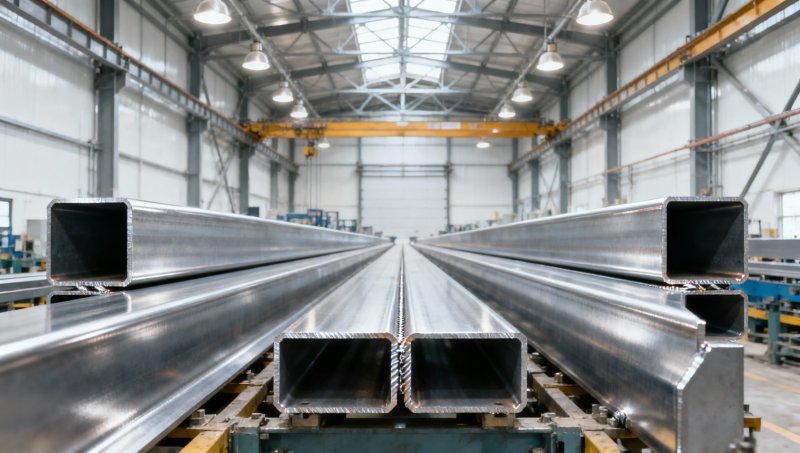
Key Technical & Compliance Differences Between EN 10210 and EN 10219
Understanding the technical boundaries helps avoid specification errors that trigger rework, delays, or non-conformance notices. Below is a comparative breakdown focused on decision-critical parameters:
The tighter dimensional control of EN 10219 simplifies prefabrication—critical when integrating with CNC-cut connectors or automated bolt-hole punching lines. However, EN 10210 remains mandatory for fire-resistance-rated structures requiring minimum 30-minute integrity (e.g., stairwells, escape routes) due to its superior residual stress distribution after hot finishing.
Certification & Traceability Requirements
Both standards require mill test certificates (EN 10204 3.1 or 3.2). For export to EU markets, EN 10219-compliant products must carry CE marking with Declaration of Performance (DoP) referencing EN 1993-1-1 (Eurocode 3) and EN 1090-2 (Execution of Steel Structures). Hongteng Fengda maintains full traceability from billet heat number to final shipment—enabling rapid audit response within 48 hours.
Where EN 10219 Excels—and Where It Doesn’t Fit
Application suitability isn’t binary—it hinges on structural role, environmental exposure, and fabrication workflow. EN 10219 shines in:
- Modular office partitions and mezzanine floor supports (load ≤ 8 kN/m²)
- Warehouse racking uprights (up to 12 m height, non-seismic zones)
- Architectural sunshades and façade substructures (exposed but non-load-critical)
- Cold-formed steel (CFS) framing for residential/commercial walls and roofs
Conversely, EN 10210 is specified where:
- Dynamic loading exceeds 200,000 cycles (e.g., crane runway beams)
- Service temperature drops below –20°C (cold brittleness risk in cold-worked zones)
- Fire resistance rating ≥ 60 minutes is required (per EN 13381-8)
- Welded joints will undergo post-weld heat treatment (PWHT) to relieve stresses
For hybrid projects—like mixed-use developments with retail podiums and residential towers—Hongteng Fengda offers dual-certified batches: EN 10219 for non-structural framing and EN 10210 for primary columns and transfer girders. This approach reduces total project steel cost by 9–13% versus full EN 10210 specification.
Why Partner With Hongteng Fengda for EN 10219 Framing Solutions
As a vertically integrated structural steel manufacturer and exporter from China, we bridge specification rigor with commercial pragmatism. Our EN 10219 production meets all Class C mechanical requirements—and extends beyond compliance with value-add services:
- Pre-engineered cut-to-length service: 98% dimensional accuracy on orders ≥50 tonnes, reducing on-site waste by up to 11%
- Galvanizing-ready surface prep: Zinc-coating adhesion tested per ISO 1461, eliminating pre-galv cleaning delays
- Multi-standard certification: EN, ASTM A500, JIS G3466, GB/T 6728—all covered under single batch testing
- Custom finish integration: Seamless pairing with 201 Stainless Steel Plate for hybrid façade systems requiring aesthetic continuity and corrosion resistance
We support global buyers with stable lead times: standard EN 10219 orders ship within 25–35 days ex-works; urgent requests (≤20 tonnes) are prioritized for 15-day dispatch. All shipments include full documentation packages—CE DoP, mill certs, SGS inspection reports, and customs-compliant packing lists.
Ready to optimize your next structural framing specification? Contact our technical sales team for a free EN 10219 feasibility review—including dimensional tolerance analysis, weld procedure qualification (WPQ) support, and cost benchmarking against EN 10210 alternatives.
Please give us a message


Please enter what you want to find