Why ‘Buy Stainless Steel Pipe’ Searches Often Lead to Substandard Imports — Red Flags in Mill Certificates and Dimensional Tolerances
If you're trying to buy stainless steel pipe for critical structural or industrial applications, generic online searches often land you with substandard imports—hidden flaws in mill certificates and out-of-spec dimensional tolerances can compromise safety, compliance, and project timelines. At Hongteng Fengda, a China-based structural steel manufacturer and exporter, we help global procurement professionals avoid these pitfalls through certified ASTM/EN-compliant stainless steel pipes, full traceability, and rigorous dimensional verification—ensuring every order meets engineering-grade reliability.
What Procurement Teams *Really* Search For (and Why They Get Disappointed)
When you type “buy stainless steel pipe” into Google or Alibaba, your intent isn’t theoretical—it’s operational: You need pipes that weld cleanly, pass pressure tests, align with drawings, and won’t trigger rework or rejection at site inspection. Yet most search results deliver generic listings with stock photos, vague “ISO-certified” claims, and mill certificates that look official—but lack enforceable traceability or third-party validation.
Procurement professionals don’t lose sleep over metallurgy theory. They lose sleep over delayed shipments, failed bend tests, and the 3 a.m. call from a site engineer holding a pipe that’s 0.8 mm undersized on OD—and no recourse because the supplier vanished after payment.
The Two Silent Dealbreakers: Mill Certificates That Don’t Prove Anything
A mill certificate is not a stamp of approval—it’s a legal document. But many imported stainless steel pipes ship with certificates that fail basic forensic scrutiny:
- Missing heat numbers: No unique identifier means no batch traceability. If corrosion appears in field, you can’t isolate affected lots—or hold anyone accountable.
- Generic chemical composition tables: Real certs list actual lab results per heat—not just “meets ASTM A312” boilerplate. Deviations of 0.05% in chromium or nickel impact pitting resistance in chloride environments.
- No mechanical test data: Yield strength, tensile strength, and elongation must be reported per test piece—not estimated or interpolated. Substandard mills often omit this or backfill values post-production.
At Hongteng Fengda, every stainless steel pipe shipment includes a fully auditable mill certificate signed by our in-house metallurgist and verified against raw material heats. We cross-reference each certificate with furnace logs, hot-rolling records, and final cold-drawing reports—so your QA team can audit down to the ton.
Dimensional Tolerances: Where “Close Enough” Becomes Costly
ASTM A312 allows ±1% OD tolerance for seamless stainless pipe. That sounds narrow—until you realize a 6-inch nominal pipe (168.3 mm OD) can legally measure 166.6 mm to 170.0 mm. In tight-fitting flange assemblies or multi-pipe support frames, that variance causes misalignment, gasket stress, and welding distortion.
Worse: Many exporters quote “ASTM-compliant” pipes but ship to Chinese GB/T 14976 tolerances—which permit up to ±1.5% OD and ±12.5% wall thickness deviation. That’s not compliance—it’s misrepresentation.
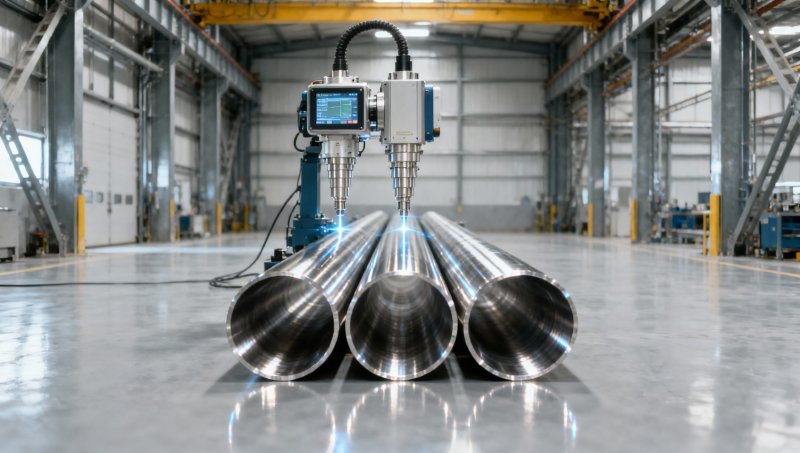
We test every coil and every pipe run with laser micrometers and ultrasonic wall-thickness gauges. Our dimensional reports include min/max OD, wall thickness distribution across circumference, and ovality—all plotted and archived. If your spec calls for ±0.5% OD, we guarantee it—not just promise it.
How to Vet Suppliers *Before* You Commit (A Procurement Checklist)
Don’t wait for the first shipment to discover gaps. Use this field-tested checklist during supplier evaluation:
- Ask for a sample mill certificate *before* quoting: Does it show real heat numbers? Are tensile/yield values handwritten or auto-filled? Is the testing lab accredited (e.g., CNAS, ISO/IEC 17025)?
- Request dimensional test reports for *your specific size*: Not “typical values”—actual measurements from the last three production runs of your exact OD/wall/thickness grade.
- Verify factory capability—not just certifications: Can they produce ASTM A312 Grade 316L *in-house*, or do they subcontract cold drawing? Subcontracting introduces uncontrolled variables in surface finish and residual stress.
- Confirm packaging & marking protocols: Heat numbers must be legibly stamped *on every pipe*, not just on tags. Missing or faded stamps mean traceability breaks before it leaves the yard.
This isn’t about perfectionism—it’s about eliminating preventable failure points. One rejected pipe lot can cost more than six months of sourcing diligence.
Beyond Stainless Pipe: When Material Integrity Demands Consistency
Stainless steel pipe isn’t isolated in your supply chain. Its performance depends on compatibility with other structural elements—especially cladding, roofing, and enclosure systems exposed to the same environmental loads.
For example, if your project uses stainless piping in food-grade processing lines but relies on conventional galvanized roofing, differential corrosion rates can accelerate degradation at interfaces. That’s why we integrate material specifications across product families—ensuring long-term synergy, not just individual compliance.
Our PPGL Steel Sheet exemplifies this systems-thinking approach: pre-painted galvalume steel with 55% aluminum, 43.4% zinc, and 1.6% silicon delivers >25-year service life, high thermal reflectivity, and proven adhesion—even under coastal salt spray or industrial fumes. It’s not just “roofing material.” It’s a corrosion-resistant envelope engineered to match the longevity and integrity expectations set by your stainless infrastructure.
Why Structural Steel Manufacturers Outperform General Exporters
Many “stainless pipe suppliers” are trading companies—not manufacturers. They source from multiple mills, blend heats, and prioritize margin over metallurgical consistency. As a structural steel manufacturer, Hongteng Fengda controls the full value chain: from billet selection and hot rolling to cold drawing, heat treatment, and non-destructive testing.
This vertical integration lets us enforce what traders cannot: material pedigree, process discipline, and accountability. When you buy stainless steel pipe from us, you’re not buying a commodity—you’re engaging a partner who shares your risk in structural integrity, regulatory compliance, and project delivery.
Final Takeaway: Trust Is Verified—Not Declared
“Buy stainless steel pipe” is a transactional phrase. What you actually need is assurance—verified through evidence, not marketing. Red flags in mill certificates and dimensional tolerances aren’t quirks; they’re systemic indicators of weak quality governance.
Procurement teams succeed not by finding the lowest quote—but by identifying the supplier whose documentation stands up to engineering scrutiny, whose tolerances match your drawings—not their catalog—and whose commitment to traceability starts at the furnace and ends at your job site.
Hongteng Fengda doesn’t ask you to trust us. We give you the data—heat numbers, dimensional plots, third-party lab reports—to verify everything yourself. Because in structural steel, confidence isn’t built on promises. It’s built on proof.
Please give us a message


Please enter what you want to find