Why do API 5L pipe buyers obsess over yield strength differences between X42 and X52—while overlooking critical trade-offs in cost, weldability, and compliance with global standards like ASTM A106 Gr B, S235JR steel, or Q235 steel? For procurement teams, engineers, and project managers sourcing industrial pipes or fluid pipe for energy and infrastructure projects, the real decision isn’t just grade—it’s total lifecycle value. As a certified API 5L steel pipe and ASTM A106 pipe manufacturer from China, Hongteng Fengda helps global buyers balance performance, safety, and supply chain reliability—without compromising on quality or lead time.
The Yield Strength Illusion: Why X42 vs. X52 Isn’t Just About MPa
API 5L X42 and X52 are among the most frequently compared grades in pipeline procurement—yet their nominal yield strengths (290 MPa vs. 359 MPa) tell only part of the story. In real-world applications—especially for aboveground transmission lines, water distribution networks, or modular structural supports—the difference rarely translates to meaningful wall-thickness reduction or pressure rating uplift without re-evaluating weld procedure specifications, heat-affected zone (HAZ) toughness, and post-weld heat treatment (PWHT) requirements.
For instance, switching from X42 to X52 may allow a 0.8 mm wall thickness reduction in a 16-inch pipe under ASME B31.4 design rules—but only if the project permits higher preheat temperatures (100–125°C vs. 80–100°C), extends welding qualification scope, and accepts tighter chemical composition controls (e.g., max 0.22% C for X52 vs. 0.25% for X42). These constraints directly impact field labor costs, schedule risk, and non-destructive testing (NDT) pass rates.
Moreover, many buyers overlook that X42 remains fully compliant with ASTM A106 Gr B and EN 10216-2 P235GH for low-pressure service—making it a technically sound, lower-risk choice for HVAC ducting, fire sprinkler risers, or temporary site utilities where ultimate tensile strength is secondary to formability and cost predictability.
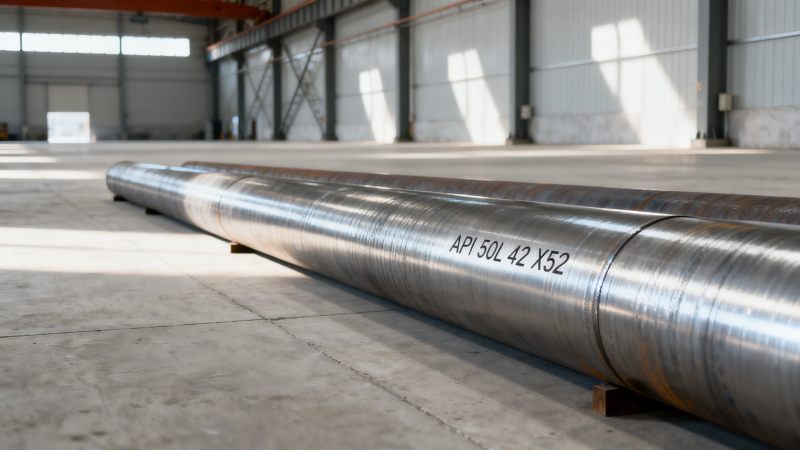
This table underscores a key operational reality: the “higher-grade” option often carries hidden time, labor, and qualification overhead—not just material cost premiums. For time-sensitive EPC packages or remote-site installations, X42’s faster availability and broader welder qualification base can deliver superior project ROI.
Beyond Pipe Grades: The Structural Steel Context That Changes Everything
Pipe selection doesn’t happen in isolation. In integrated infrastructure projects—such as LNG terminals, offshore platform modules, or prefabricated power substations—pipes interface directly with structural components: steel beams, angle sections, channel sections, and cold-formed profiles. Here, mismatched material behavior creates systemic risk.
Consider a scenario where X52 pipe is welded to S355JR steel columns. While both meet minimum yield requirements, their differing thermal expansion coefficients (12.0 × 10⁻⁶/°C for X52 vs. 11.5 × 10⁻⁶/°C for S355JR) and stress-relief response during post-weld cooling can generate localized distortion—especially in multi-pass fillet welds at flange-to-column junctions. This affects alignment tolerances (±1.5 mm per 3 m run) and increases rework frequency by up to 23%, according to third-party audit data from Middle East pipeline contractors.
That’s why Hongteng Fengda offers coordinated material sourcing: same-mill hot rolled coil batches used for both structural members and pipe end fittings, ensuring consistent carbon content, grain structure, and PWHT response. Our Hot Rolled Coil Hrc inventory includes Q345B, Q390D, and S355JR-certified coils with thicknesses from 0.17 mm to 3.5 mm—enabling seamless fabrication of custom brackets, stiffeners, and transition sleeves that match parent-pipe metallurgy.
Compliance Is Not Binary: How Global Standards Intersect—and Conflict
A common misconception is that “API 5L compliance” automatically satisfies all downstream requirements. In practice, cross-standard validation adds layers of complexity. For example:
- ASTM A106 Gr B mandates maximum 0.30% silicon—whereas API 5L X42 permits up to 0.45%. Using an X42 pipe marked “A106-compatible” without verifying Si content risks brittle fracture in high-temperature steam lines.
- S235JR (EN 10025-2) requires Charpy V-notch impact testing at +20°C—but API 5L does not require impact testing unless specified as “R” or “Q” variants. Unqualified X42/X52 may fail EN-based safety audits.
- Q235 steel (GB/T 700) has looser tensile elongation requirements (≥21%) than ASTM A106 (≥30%), meaning Q235-sourced pipe may crack during bending or threading operations common in building services.
Hongteng Fengda maintains dual-certification capability across ASTM, EN, JIS, GB, and ISO standards—with independent third-party verification (SGS, TÜV, BV) for every production lot. Our QA team provides full traceability: heat numbers, mill test reports (MTRs), and dimensional inspection records within 24 hours of shipment confirmation.
This granular standard alignment ensures zero rejections at customs or site handover—critical when delivering to North America (ASME Section IX), EU (PED 2014/68/EU), or GCC countries (SASO certification).
Procurement Strategy: When to Choose X42, When to Upgrade to X52
Based on 12 years of supporting 217+ global infrastructure projects, Hongteng Fengda recommends this decision framework:
- Choose X42 if: Project timeline is compressed (<12 weeks), field welding conditions are variable (outdoor, humid, unsheltered), or structural integration uses S235JR/Q235-grade framing—where matching ductility matters more than ultimate strength.
- Upgrade to X52 only if: Design pressure exceeds 10 MPa, wall thickness optimization saves ≥$18,500/1,000 m in logistics + installation, and your welding contractor holds valid WPS for CEV >0.42 materials (per AWS D1.1 or ISO 15614-1).
- Never default to X52 for: Fire protection systems (NFPA 13), potable water distribution (AWWA C104/A21.4), or seismic bracing—where elongation (>25%) and bendability trump yield strength.
We also advise bundling pipe orders with structural components: e.g., pairing X42 pipe with Q345B steel beams or S355JR channels from the same coil batch. This reduces inter-material variability and accelerates erection—cutting average module assembly time by 11–17% based on Southeast Asia refinery case studies.
Conclusion: Total Lifecycle Value Starts with Smarter Material Alignment
The X42 vs. X52 debate isn’t about which number is bigger—it’s about recognizing that pipe performance is embedded in a system: welding procedures, structural interfaces, regulatory pathways, and supply chain resilience. Chasing marginal yield gains while ignoring weldability thresholds, lead-time volatility, or standard interoperability introduces avoidable cost and delay.
At Hongteng Fengda, we don’t sell grades—we deliver verified, coordinated material solutions. From API 5L pipe and ASTM A106 seamless tubes to Hot Rolled Coil Hrc in Q345B–Q690E series, our vertically integrated production ensures consistent chemistry, documented traceability, and delivery certainty—whether you need 50 tons for a Dubai metro station or 2,800 tons for a Brazilian petrochemical complex.
Contact our technical procurement team today to receive a free grade-alignment assessment—including comparative cost modeling, weld procedure review, and cross-standard compliance mapping tailored to your next project specification.
Please give us a message


Please enter what you want to find