For a long-span building frame, the “best” structural steel grade is rarely the grade with the highest nominal yield strength. The governing choice depends on whether the critical limit state is member strength, global or local buckling, deflection, vibration, connection capacity, fracture resistance, or fabrication performance. In many roof and floor frames, serviceability and stability control the design before yield strength does.
A practical starting point is to use a well-established, readily available grade with predictable welding and connection behavior—such as ASTM A992 for wide-flange members in North American practice or S355-class steel under EN standards—and move to higher-strength material only where calculations show a meaningful reduction in member weight, depth, or connection demand. Grade selection must be made together with section geometry, bracing layout, loading pattern, joint type, and the governing design code.
Why long spans change the grade-selection logic
Long spans amplify the effect of stiffness, instability, and connection deformation. A beam that is adequate in bending strength may still exceed allowable deflection under roof dead load, snow, suspended services, façade loads, or occupancy-related live load. Raising yield strength from 355 MPa to 460 MPa does not materially increase the elastic modulus of steel. Carbon structural steels used in building frames generally have an elastic modulus close to 200 GPa, regardless of grade.
This distinction is fundamental. If deflection governs, substituting a higher-strength grade without changing the section profile will provide little benefit. The effective remedies may instead include a deeper beam, a built-up plate girder, a truss, cellular beam geometry, composite action with a concrete slab, additional secondary members, or a revised support arrangement.
Long-span members are also more sensitive to lateral-torsional buckling, web buckling, local flange buckling, and erection-stage instability. A high-strength grade can permit a thinner plate or smaller section, but reduced thickness may lower local buckling resistance and complicate fabrication. The design advantage of higher yield strength is therefore conditional, not automatic.
Common grade families and where they fit
Specifications from different regions should not be treated as direct equivalents merely because their nominal yield strengths are similar. Yield strength, tensile strength, impact toughness, chemical composition, delivery condition, dimensional tolerances, and permitted product forms all matter.
ASTM A992 is often a sound default for rolled wide-flange framing designed under U.S. practice because it was developed specifically for structural shapes. ASTM A572 Grade 50 can be suitable for plates, angles, channels, selected shapes, and fabricated members, but the evaluator should confirm that the specified grade is available in the required product form and thickness.
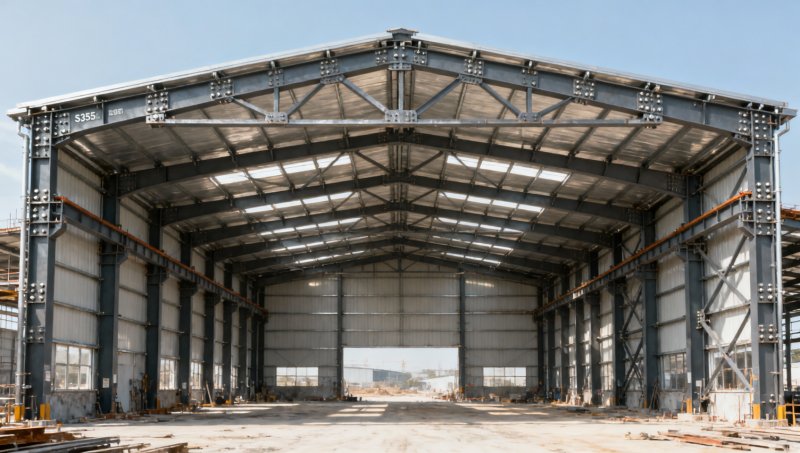
Under EN practice, S355 is frequently a practical baseline for long-span building structures. It offers a favorable balance between yield strength, ductility, weldability, and broad market availability. However, “S355” alone is incomplete as a specification. S355JR, S355J0, and S355J2 identify different Charpy impact-test conditions. The choice among them should reflect the minimum service temperature, member thickness, loading rate, restraint level, and fracture consequences.
Higher-strength EN grades such as S420 and S460 can be appropriate for major plate girders, transfer structures, highly loaded truss chords, and members where self-weight reduction has a demonstrable structural benefit. They are not automatically economical for an entire frame. Material savings may be offset by stricter fabrication controls, reduced availability in certain dimensions, more demanding welding qualification, or sections that remain governed by deflection and buckling.
Start with the governing design condition, not the grade name
A reliable evaluation separates the frame into structural functions. Primary roof girders, long-span floor beams, truss chords, columns, braces, secondary purlins, and connection components do not necessarily need the same steel grade. Applying one premium grade across every member can add cost and procurement complexity without improving the controlling performance of the system.
For primary flexural members, the central question is whether bending resistance or serviceability governs. If the bending utilization is high while deflection remains acceptable, a higher-yield grade may permit a smaller section or lower steel tonnage. If deflection is already close to the limit, a deeper section or a different structural system will usually be more effective than a grade upgrade.
For compression members and truss chords, slenderness is often the limiting issue. Higher yield strength improves squash-load capacity, but its benefit diminishes when elastic buckling controls. A slender compression member does not gain proportionally from a higher-strength material because Euler buckling depends principally on elastic modulus, effective length, and moment of inertia.
For portal frames and frames with significant unbraced lengths, lateral stability must be assessed at the system level. The grade decision should follow checks for lateral-torsional buckling, frame sway, second-order effects, flange restraint, diaphragm action, and erection bracing. A stronger steel beam with insufficient lateral restraint can still be an inefficient or unsafe solution.
Deflection and vibration can override the apparent value of high-strength steel
Long-span roofs are commonly affected by accumulated deflection from permanent loads: roofing, insulation, photovoltaic systems, mechanical equipment, suspended ceilings, fire protection, and future service installations. The design load model should distinguish permanent loads from variable loads and identify any concentrated hanging loads that may be added after the primary frame is erected.
For floor structures, vibration may be as important as static deflection. Reduced beam depth can lower stiffness and alter floor response, even when the member satisfies strength checks. Where human comfort, sensitive equipment, or repetitive machinery loads are relevant, the assessment needs a dynamic review rather than a simple grade comparison.
This is why a specification such as “use the strongest available structural steel grades to reduce beam size” is incomplete. The required beam depth may be driven by deflection limits, vibration criteria, service integration, fire protection geometry, or connection detailing. In such cases, material grade has less influence than section stiffness and structural configuration.
Toughness, ductility, and fracture performance need explicit requirements
Yield strength is only one element of reliable long-span design. Toughness becomes more important where structures operate in low ambient temperatures, where members have substantial thickness, where welded details create restraint, or where failure consequences are high. Charpy V-notch test requirements provide a way to specify impact toughness at a defined temperature, but the required level must align with the governing structural standard and project conditions.
In EN designations, JR, J0, and J2 suffixes are directly relevant to impact-test temperature conditions. Comparable ASTM or other regional specifications may require separate supplementary requirements or project-specific toughness provisions. A mill certificate that confirms yield and tensile strength does not necessarily demonstrate that the required fracture-toughness condition has been met.
Ductility is particularly important in seismic systems, moment-resisting frames, and heavily restrained connection zones. The required grade must be compatible with the ductility and connection provisions of the applicable building code. Material substitution based only on a nominally equivalent yield strength can undermine assumptions embedded in the connection design.
Weldability is a frame-level issue, not a workshop detail
Long-span frames frequently rely on welded plate girders, trusses, haunches, stiffeners, and moment connections. Weldability should therefore be assessed before a higher-grade steel is selected. Relevant factors include chemical composition, carbon equivalent, plate thickness, hydrogen control, preheat requirements, heat input limits, joint restraint, and the approved welding procedure specification.
As plate thickness increases, through-thickness properties can also become relevant. Highly restrained welded connections may impose through-thickness strain that raises the risk of lamellar tearing in susceptible plate. Where the joint geometry and load path create this condition, a through-thickness quality requirement may be needed; EN 10164 is one recognized framework for specifying such properties.
The evaluation should also consider whether the fabricator can qualify and consistently execute the required welding procedures for the chosen grade and thickness range. A high-strength plate that is technically acceptable in analysis but poorly matched to available fabrication controls can introduce schedule and quality risk.
Connections may determine the usable grade
Long-span members develop large reactions and moments at their supports. The strength of the beam or truss chord may increase with grade, while bolts, welds, end plates, column panels, base plates, anchors, and supporting concrete elements do not automatically gain capacity. A grade upgrade can shift the governing weakness into the connection.
For bolted connections, checks should include bearing, net-section rupture, block shear, slip where relevant, bolt shear and tension interaction, prying action, and connection rotation. For welded connections, the evaluator should review weld access, weld size, fatigue-sensitive details, and the effect of thick flanges or highly restrained joints.
In moment frames, the selected steel grade must also be consistent with the connection qualification route required by the design code. It is not sufficient for the beam flange to meet a specified yield strength if the expected connection behavior depends on material ductility, weld access-hole geometry, continuity plates, or panel-zone capacity.
Product form, thickness, and certification should be locked into the specification
A grade designation without product form is not a complete procurement requirement. Rolled beams, hot-rolled plate, welded sections, angles, channels, cold-formed sections, and hollow sections can be governed by different material standards even within the same regional system. Minimum yield strength can also vary with thickness under many specifications.
For each critical member category, the material schedule should identify the governing standard, grade, toughness class where required, product form, thickness range, dimensional tolerances, coating or fire-protection interface requirements, and inspection documentation. Mill test certificates should be reviewed against the purchase order and applicable code requirements rather than treated as generic proof of quality.
Where steel is sourced internationally, equivalency should be established through a documented comparison of the full specification. Comparing “S355” with “Grade 50” or “Q355” by yield strength alone is not a sufficient basis for substitution. The comparison must include mechanical-property limits, chemical restrictions, impact requirements, weldability implications, permitted thickness range, testing basis, and the project’s contractual standard.
A defensible selection path
For many conventional long-span building frames, a 355 MPa or 50 ksi-class structural steel provides the most balanced starting point. ASTM A992 is a natural choice for applicable rolled W-shapes; ASTM A572 Grade 50 may suit other specified structural products; S355 grades are commonly suitable in EN-based designs when the required toughness suffix is selected. Hollow-section trusses require HSS-specific material specifications rather than a beam-grade assumption.
A move to S420, S460, or another higher-strength grade is justified when strength calculations show that reduced area or weight produces a real system-level benefit and when deflection, buckling, connections, welding, fire design, and supply conditions remain satisfactory. It is least compelling when the member depth is already fixed by serviceability, architectural clearance, vibration, or stability requirements.
The final specification should therefore state more than a grade name: it should capture the load path, member form, governing limit states, toughness condition, welding demands, connection assumptions, and certification requirements. That approach turns structural steel grade selection from a nominal material comparison into an engineering decision that supports the actual behavior of the long-span frame.
Please give us a message


Please enter what you want to find