Outdoor water lines fail at the interfaces between material, environment, and installation. A galvanized pipe that performs well above ground in a dry service corridor can deteriorate much faster when buried in wet, acidic, saline, or poorly drained soil. The relevant galvanized pipe specifications therefore extend beyond nominal size. They must define the pipe's base material, wall thickness, zinc coating, dimensional tolerances, end preparation, pressure suitability, and the standard governing manufacture and inspection.
For water distribution, the specification should begin with the actual duty: potable or non-potable water, irrigation, temporary construction supply, fire-water service, pump discharge, or gravity-fed drainage. These uses impose different demands. A low-pressure irrigation branch and a pressurized line connected to a pump may share the same nominal diameter while requiring very different wall thicknesses, joining methods, and corrosion protection.
Start with the governing pipe standard
A pipe description such as “galvanized steel pipe, 2 inch” is incomplete. Nominal pipe size identifies the approximate bore family, not the full mechanical or corrosion performance. The applicable product standard establishes how outside diameter, wall thickness, mass, steel composition, weld quality, zinc coating, testing, marking, and tolerances are controlled.
For projects crossing regional supply chains, the specification should name the required standard system and the exact grade or class within that system where the design documents require it. ASTM, EN, JIS, and GB standards use different terminology and test frameworks. A pipe described as equivalent in commercial language is not automatically interchangeable with one made to the project standard. The allowable dimensional variation, hydrostatic test requirement, thread requirements, and coating criteria need to be compared rather than assumed to match.
Certificates should identify the produced item, not merely the general capability of a mill. Useful documents normally connect the pipe size, thickness designation, production batch, coating process, test results, and referenced standard. When several pipe lengths or thickness classes are shipped together, traceability is especially important because they can look similar once bundled and galvanized.
Wall thickness controls more than pressure resistance
Wall thickness is often expressed through a schedule, a class designation, or an actual minimum thickness. These are not interchangeable labels unless the applicable standard says they are. The purchase description should state the accepted designation and, where appropriate, the required wall thickness in millimetres or inches. This avoids a frequent error: comparing two quotations by nominal diameter while overlooking a substantial difference in metal section.
A heavier wall provides greater resistance to internal pressure and external damage, but it also affects threading, handling weight, bending behavior, and joint geometry. Threaded pipe loses some wall section where threads are cut. If a threaded connection is specified, the pipe wall and thread form must work together; a light-wall tube that happens to have the right outside diameter is not a substitute for pipe designed for threaded joints.
Burial conditions change the thickness decision. Backfill containing sharp stone, construction debris, or compacted angular aggregate can damage a pipe locally, particularly where the line is shallow or crosses traffic areas. Settlement at a joint, unsupported spans inside valve pits, and impact during installation are mechanical concerns separate from internal water pressure. A pipe selected only from a pressure calculation may be inadequate for those installation loads.
The zinc coating needs to suit the exposure
Galvanizing protects steel primarily by forming a zinc layer that acts as a barrier and provides sacrificial protection at small discontinuities. Its useful life is influenced by coating mass or thickness, uniformity, adhesion, and the severity of the surrounding environment. A bright, even appearance does not by itself prove that the coating meets the required specification. Visual inspection can reveal bare spots, runs, ash inclusions, excessive roughness, or damage, but it cannot establish coating mass with confidence.
For outdoor water lines, distinguish between the exterior and interior surfaces. Soil, standing water, fertilizer contact, road salts, and wet insulation affect the outside. Water chemistry, flow pattern, temperature, and periods of stagnation affect the bore. Galvanized steel is not a universal answer for every water chemistry. Highly aggressive water or soil can consume the zinc coating faster than anticipated, while deposits inside a line can gradually reduce effective flow area. Where the environment is known to be aggressive, the specification should require an exposure review rather than simply increasing pipe diameter.
Hot-dip galvanizing is generally preferred when a robust zinc layer is required on steel pipe, but the wording still matters. The order should state whether the pipe is supplied galvanized as part of the pipe manufacturing standard or whether galvanizing is performed after fabrication. Field-cut, drilled, welded, or abraded areas require defined repair treatment. Leaving those areas to an unspecified site practice creates weak points exactly where moisture and disturbed coatings are most likely.
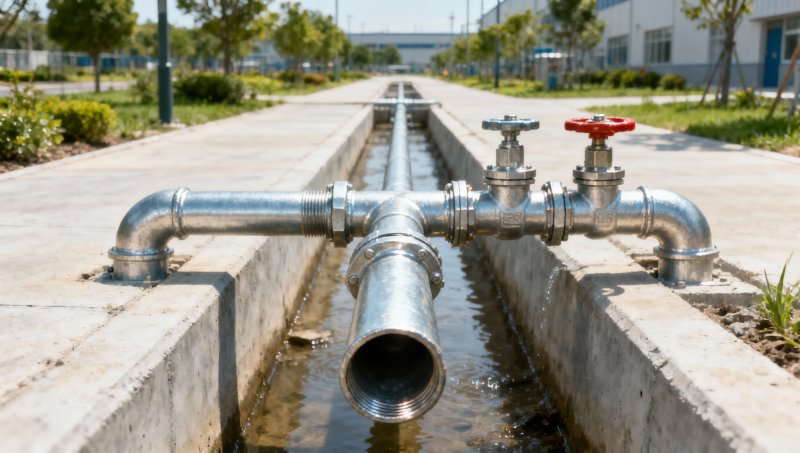
Coating continuity around pipe ends deserves attention. Threads, cut ends, and mating surfaces are frequently handled, sealed, and tightened during assembly. Excessive zinc on threads can make engagement difficult; insufficient protection leaves exposed steel. A compatible threaded galvanised fitting, approved sealant, and careful assembly torque are part of the corrosion system. For welded connections, welding destroys nearby zinc and produces fumes, so the connection design, ventilation, repair coating, and inspection sequence should be established before installation begins.
Diameter must be checked against flow, not just the existing connection
Nominal diameter is commonly selected by matching an existing valve, pump outlet, or manifold. That approach can overlook friction loss along a long run. Internal diameter is affected by wall thickness, and threaded joints, fittings, valves, meters, bends, and strainers add resistance. A line that is adequate at the pump connection may deliver inadequate pressure at distant outlets when the route is long or contains many changes of direction.
The design should use the expected flow rate, available pressure, elevation change, route length, and fitting count. It should also allow for service conditions that are different from the initial commissioning condition. Scale formation and deposits are particularly relevant to galvanized water lines because they can reduce the bore over time. Selecting a larger nominal diameter solely to compensate for possible future restriction is not always economical or practical, but the possibility should be considered where water quality suggests deposition.
Do not confuse outside diameter compatibility with hydraulic equivalence. Two products of the same outside diameter can have different wall thicknesses and therefore different bores. This matters when a transition is made between galvanized pipe and another piping material. The fitting must accommodate the relevant dimensional system, while the hydraulic calculation should use the actual internal diameter.
Joint design determines whether the coating remains effective
Outdoor piping systems often fail first at joints rather than in the middle of straight pipe. Threaded connections are familiar and useful for smaller sizes, accessible valve stations, and installations requiring disassembly. They become less attractive where there are many joints, significant vibration, or large diameters. Each threaded joint introduces a potential leak path and a location where zinc protection is interrupted by cutting.
Grooved, flanged, welded, or mechanical couplings each create different specification needs. Grooved ends must retain adequate wall thickness after preparation. Flanges require bolt, gasket, and coating choices that suit the service environment. Mechanical couplings need the correct outside diameter and surface condition to seal reliably. A buried joint that is difficult to access should not rely on a joining method selected only for installation speed.
Galvanic interaction also needs attention where galvanized steel connects to copper alloys, stainless steel, bare carbon steel, or aluminium components. Dissimilar metals do not automatically create a severe problem, but the risk rises when moisture or conductive water bridges the materials. The design may require dielectric separation, compatible transition fittings, or a defined grounding arrangement. Electrical bonding requirements should be coordinated with the project electrical design rather than altered casually at the piping installation stage.
Outdoor location changes the meaning of corrosion resistance
Above-ground pipe faces sunlight, rain, condensation, and mechanical exposure. Soil-buried pipe faces a less visible set of variables: moisture retention, drainage, resistivity, pH, chlorides, sulfates, organic content, and stray current. A line installed in well-drained neutral soil is a different proposition from one laid through reclaimed ground, coastal soil, manure storage areas, or a trench that regularly fills with water.
Backfill quality matters because a good galvanized coating cannot compensate for every trench condition. Large stones placed directly against the pipe can scratch the coating. Heterogeneous fill can create uneven support and movement. Persistent water around a joint encourages corrosion and makes leaks harder to detect. Bedding, compaction, drainage, and protection at road or equipment crossings belong in the installation specification because they preserve the performance assumed when the pipe was selected.
Above ground, contact points need similar care. Steel clamps, brackets, and supports should avoid trapping water against the pipe. Unsupported spans can sag and put stress on joints. Pipe that touches concrete or masonry in a wet area may need separation or local protective treatment, particularly where the contact remains damp. A protective topcoat over galvanized steel can be appropriate in severe atmospheric exposure, but it requires compatible surface preparation and a repair procedure for later damage.
Pressure rating should reflect transient conditions
Static operating pressure is only one part of the load on an outdoor water line. Pump start-up, rapid valve closure, emergency shutdown, and changes in flow direction can create transient pressure surges. The consequence is more serious in long lines, systems with fast-acting valves, or runs containing high points where air may accumulate. A specification that only states normal pressure leaves uncertainty about the required margin.
The pipe, fittings, valves, couplings, and joint seals must be rated as a system. A suitably heavy pipe cannot compensate for an underrated fitting or a gasket unsuitable for the water temperature and treatment chemicals. Test pressure should also be set by the governing standard and project design requirements; it should not be inferred from the pipe marking alone.
Before trench closure or insulation, visual inspection and pressure testing provide the best opportunity to identify damaged coating, incomplete thread engagement, misaligned supports, and leakage. Testing should not conceal a repair issue. A repaired welded zone, a damaged galvanized surface, or a joint disturbed during testing should be recorded and corrected while access is still available.
Specify inspection evidence that matches the actual risks
The final galvanized pipe specifications should make acceptance measurable. Pipe markings should remain legible enough to identify size, standard, grade or class, and production traceability. Inspection records should address the items that cannot be reliably judged from appearance, such as wall thickness, coating requirement, and pressure or weld testing where applicable.
Sampling should include pipes from different bundles and, when supplied, different heats or batches. Measuring only the first accessible length can miss a mixed shipment. Check that end caps have protected threads during transport, that bundles have not been dragged across abrasive surfaces, and that storage does not leave pipe sitting in standing water. White corrosion products on newly galvanized material can result from wet storage conditions; this should be assessed for coating condition rather than dismissed as a purely cosmetic issue.
A clear specification for an outdoor water line therefore ties pipe dimensions to hydraulic duty, steel section to pressure and installation loads, zinc protection to the actual exposure, and joints to the construction method. When those elements are written as connected requirements, the delivered pipe is far less likely to be correct in name but unsuitable in service.
Please give us a message


Please enter what you want to find