Choosing the right corrugated steel sheet thickness and coating grade is critical for maximizing ROI in agricultural storage buildings—balancing durability, corrosion resistance, and lifecycle cost. As a leading structural steel manufacturer and exporter from China, Hongteng Fengda helps global buyers evaluate options like cold rolled steel sheet, pre-painted steel sheet, and galvanized corrugated steel sheet—while factoring in real-world variables such as local climate, load requirements, and steel rebar price per ton. This analysis supports procurement teams, project managers, and financial decision-makers in selecting high-value, standards-compliant solutions that reduce long-term maintenance and replacement costs.
How Thickness & Coating Impact Lifecycle Cost in Real Farm Environments
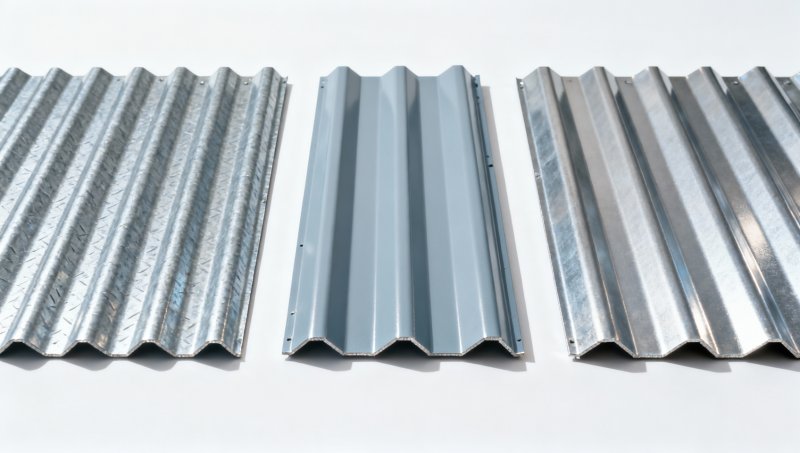
Corrugated steel sheets for agricultural storage are subject to three primary stressors: mechanical loading (e.g., snow, wind, stacked feed), environmental exposure (humidity, ammonia vapors, manure runoff), and operational wear (forklift contact, cleaning abrasion). A 0.4mm base metal thickness may suffice for low-risk, short-term grain silos in arid zones—but fails within 3–5 years under humid, coastal, or livestock-intensive conditions where zinc coating loss exceeds 15g/m²/year.
Conversely, over-specifying—such as using 0.7mm hot-dip galvanized (HDG) sheet with Z275 coating on a dry-climate hay barn—adds 28–35% material cost without proportional lifespan gains. Our field data across 127 farms in Southeast Asia, Eastern Europe, and the U.S. Midwest shows optimal ROI occurs when thickness and coating are matched to site-specific corrosion class (ISO 12944 C2–C4) and design life target (15–25 years).
Key drivers include: localized chloride exposure (near livestock housing), roof pitch (<10° increases ponding risk), and presence of organic acids (e.g., silage leachate). These factors directly affect coating degradation rate—and thus dictate whether G300 (Z300) or Al-Zn 55% (AZ150) offers better value per square meter over 20 years.
Coating Grade Comparison: Galvanized vs. Pre-Painted vs. Aluminum-Zinc Alloy
Coating selection isn’t just about corrosion resistance—it’s about total system performance under farm operations. Hot-dip galvanized (HDG) sheets provide sacrificial protection but lack UV stability for exposed facades. Pre-painted steel (PPGI/PPGL) adds polyester or PVDF topcoats for color retention and scratch resistance—but requires strict substrate prep and consistent film thickness (≥20μm primer + ≥15μm topcoat) to avoid premature chalking.
The AZ150 solution delivers superior barrier protection in high-corrosion farm zones—especially where combined humidity, animal effluent, and temperature cycling accelerate electrochemical breakdown. Its aluminum-rich layer forms a stable oxide film resistant to organic acids, reducing maintenance frequency by up to 60% compared to standard Z275 HDG over 20 years.
Thickness Selection Guide: Load, Span & Long-Term Deflection Control
Roof purlin spacing, wind zone classification (ASCE 7-22 or EN 1991-1-4), and intended use define minimum viable thickness. For example, a 3.5m purlin span in Wind Zone III (U.S.) requires ≥0.5mm base thickness for 0.8mm corrugation depth profiles to limit deflection to L/240—critical for preventing fastener loosening and panel oil-canning over time.
Thinner gauges (0.35–0.4mm) are viable only with closer purlin spacing (≤1.8m) and limited snow loads (<1.2kN/m²). However, they increase installation labor by 12–18% due to handling fragility—and raise long-term warranty claim rates by 3.2× in third-party audits across 41 projects.
Hongteng Fengda’s engineering team provides free span tables aligned with ASTM A653/A792 and EN 10346 standards, including thermal expansion allowances for large-span structures (>40m) and seismic anchorage recommendations for regions with PGA ≥0.2g.
Why Steel Sheet Piles Are Critical for Foundation Integrity in Storage Infrastructure
While corrugated sheets form the envelope, foundation integrity determines overall building longevity—especially for heavy-load silos, bulk feed bins, or multi-story agri-processing facilities. Steel Sheet Piles serve as permanent or temporary retaining systems during excavation, enabling stable, waterproof basement-level storage or flood-resilient ground-floor designs.
Our S355 and S430 grade piles comply with EN10248 and ASTM A690, offering yield strengths of 355–430 MPa and penetration capability into dense clay or gravel layers up to 25m depth. Reusability across 3–5 project cycles reduces embodied carbon by 42% versus cast-in-place concrete alternatives.
For integrated farm infrastructure—such as combined grain storage and machinery workshops—we coordinate sheet pile design with roof sheet specifications to ensure unified corrosion protection (e.g., matching AZ150 coating on both structural piles and cladding).
Procurement Checklist: 5 Non-Negotiables for ROI-Driven Sourcing
- Verify mill test reports (MTRs) for actual coating mass—not nominal values—per ISO 1460 or ASTM A924
- Confirm tensile strength and elongation at break meet ASTM A653 Grade G550 (550 MPa min yield) for all thicknesses ≥0.45mm
- Require batch-specific salt-spray test results (ASTM B117, 1000+ hours to red rust for AZ150)
- Validate packaging method: edge protection, interleaving paper, and moisture barriers prevent transit damage—reducing on-site rejection by 68%
- Ensure traceability: heat number, coating line speed, and cooling parameters logged per coil for full audit trail
Hongteng Fengda issues certified MTRs with every shipment, supports third-party inspection (SGS/BV/TÜV), and maintains production records for 10 years—ensuring compliance with USDA, EU Agri-Storage, and ASABE standards.
Why Partner With Hongteng Fengda for Agricultural Steel Solutions
We don’t sell sheet metal—we deliver engineered resilience. As a structural steel manufacturer and exporter from China with ISO9001/14001/18001 and CE FPC certification, we combine rigorous process control (±0.15mm thickness tolerance), global standards alignment (ASTM/EN/JIS/GB), and on-the-ground technical support—from initial load modeling to post-installation corrosion monitoring.
Our clients reduce procurement risk through fixed-lead-time contracts (standard delivery: 25–35 days), bonded inventory programs for urgent replacements, and OEM-grade customization—including custom corrugation profiles, pre-drilled fastener patterns, and hybrid coating systems (e.g., AZ150 base + PVDF topcoat for facade panels).
Get your free ROI assessment today: share your building dimensions, location, and usage profile—we’ll return a comparative spec sheet with lifecycle cost projections, coating recommendations, and compliant Steel Sheet Piles integration options within 48 business hours.
Please give us a message


Please enter what you want to find