Choose ASTM A572 structural steel angle over A36 when higher yield strength improves the capacity of the member or allows a smaller section after all governing checks are completed. A572 Grade 50 is a strong candidate for tension members governed by gross-section yielding, relatively stocky compression members, and brackets whose capacity depends on yielding. Its advantage becomes less certain when slenderness, deflection, connection geometry, or fatigue controls the design.
For technical evaluation, the first question is therefore whether the proposed angle can use the additional strength. A grade change with unchanged dimensions can increase some resistance values, but it will not significantly increase elastic stiffness. Reducing the section to capture weight savings also changes buckling resistance, connection capacity, and fabrication requirements. The useful comparison is between two fully checked member designs, including their connections and delivered cost.
Start with the specified grade and the governing limit state
ASTM A572 covers multiple grades, so a drawing or quotation that says only “A572 angle” leaves an essential requirement undefined. For the common Grade 50 comparison, the specified minimum yield strength is 50 ksi, versus 36 ksi for A36 angles within the applicable specification limits. Specified minimum tensile strength is 65 ksi for A572 Grade 50; A36 has a specified tensile-strength range of 58–80 ksi. Product dimensions, specification edition, and applicable requirements must remain part of the material review.
These values explain both the opportunity and its limits. Grade 50 has a substantially higher specified yield strength, while its minimum tensile strength increases by a smaller proportion. A tension member governed by gross-section yielding may therefore benefit more than one governed by net-section rupture. Using the yield-strength ratio to predict every capacity improvement will overstate the benefit.
Consider an idealized tension member governed only by gross-section yielding. With the same design method and resistance factor, the required gross area scales inversely with yield strength. The ratio 36/50 is 0.72, suggesting a theoretical area reduction of about 28% when moving from A36 to Grade 50. That calculation is a screening tool. It excludes bolt holes, shear lag, connection requirements, available section sizes, and other limit states that can prevent the reduction.
An evaluator should first identify which check sets the A36 section size. If the calculation is governed by yielding, investigate Grade 50. If it is governed by stiffness or a geometric constraint, changing the grade may produce little usable value. If several checks are close, the governing condition may shift as soon as the section is reduced.
The same distinction applies when retaining the original section. Substituting Grade 50 may provide additional strength reserve, but that reserve should not automatically become permission to increase the applied load. The bolts, welds, gusset plates, supporting members, and load path must support the revised demand.
Where the strength advantage survives—and where it disappears
Tension angles: check the connected leg before reducing area
Tension bracing offers a clear starting point for comparing A36 and Grade 50, particularly when gross-section yielding governs. Angles connected through one leg, however, do not develop their entire cross-section uniformly at the connection. Shear lag can reduce the effective net area, and bolt holes further reduce the area available to resist rupture.
A smaller Grade 50 angle may consequently pass the yielding check and fail the rupture check. It may also have insufficient connected-leg width for the required bolt spacing and edge distances. Moving to a thinner angle can reduce bearing or tearout resistance at the holes, while a different leg width may require a revised gusset layout. The connection calculation belongs in the initial comparison, before a smaller section becomes the procurement basis.
Where paired angles are used, review the complete arrangement. Separation, packing plates, intermediate connectors, and load introduction affect member behavior. A material upgrade does not resolve eccentric loading or inadequate connection detailing.
Compression angles: higher yield strength has a slenderness cost
Compression members require more caution. For a relatively stocky angle, increasing yield strength can improve compressive resistance. As the member becomes more slender, elastic buckling has greater influence, and the benefit from higher yield strength diminishes. Structural carbon steels have essentially the same elastic modulus for ordinary design purposes, so Grade 50 does not materially improve elastic buckling resistance when the geometry and restraint remain unchanged.
Single angles also have unsymmetrical geometry. Their compression behavior can involve flexural buckling, torsional effects, and eccentricity from the connection. An assessment based only on cross-sectional area and yield strength can miss the controlling behavior.
Local slenderness matters as well. Under common steel design provisions, width-to-thickness limits depend on the relationship between elastic modulus and yield strength. Increasing the specified yield strength can make the same angle leg more slender relative to the applicable limit. Selecting a thinner section compounds that effect. The Grade 50 option must be checked using its own dimensions and material properties rather than carrying over the A36 classification.
For a long brace or lightly restrained compression member, greater section depth, a different angle arrangement, or improved restraint may contribute more than a material upgrade. Grade 50 can still be useful, but its value should emerge from the member calculation.
Brackets and supports: separate strength from movement
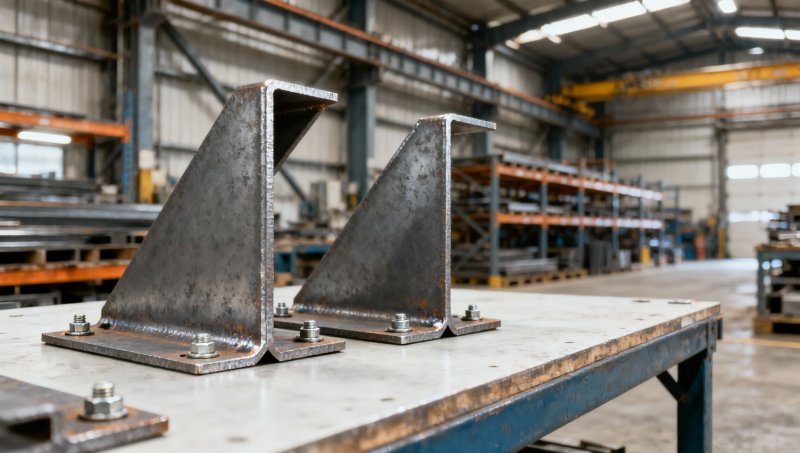
Short brackets, equipment supports, and connection angles can benefit from higher yield strength when yielding controls their resistance. Yet many such components are selected to limit movement, maintain alignment, or provide a minimum bearing surface. Those requirements can hold the dimensions constant even when the material has additional strength.
For the same angle geometry under the same load, elastic deflection will be approximately the same in A36 and A572 Grade 50. Reducing the section generally reduces stiffness and can increase movement. A support carrying sensitive equipment may therefore require the original dimensions even if a smaller Grade 50 section passes a strength calculation.
If stiffness remains the obstacle, compare section geometry. A channel can be worth evaluating for a bracket, wall beam, or equipment support because its section properties and connection arrangement differ from those of an angle. A product range such as Channel In Steel provides a starting point for that geometry comparison, but the chosen channel still needs its own material specification, dimensional requirements, and structural checks. It is not an automatic substitute for the specified angle.
Fatigue is another condition where a strength upgrade can disappoint. For welded details under repeated loading, fatigue resistance is strongly influenced by detail geometry and stress range. Increasing base-metal yield strength alone generally does not provide a corresponding increase in fatigue capacity. Where cyclic loading governs, evaluate the connection detail and load spectrum before paying for a higher grade.
Include fabrication and connections in the grade decision
A36 and A572 Grade 50 can both be welded using suitable procedures. Neither designation, by itself, establishes every fabrication requirement. Welding procedure suitability depends on the applicable code, material thickness, joint configuration, consumables, restraint, and other conditions. Preheat and interpass requirements should be determined from those conditions rather than inferred from a general statement that the steel has good weldability.
A grade substitution deserves particular attention when the design takes credit for the higher base-metal strength. Confirm that the welding procedure and filler-metal selection support the required connection performance. A stronger angle joined by an unchanged weld may leave the assembly governed by the weld. Conversely, simply increasing weld size can introduce additional heat, distortion, or detailing constraints without delivering an economical solution.
Bolted connections need a similar review. If the design load rises, bolt shear, plate bearing, tearout, block shear, and the connected supporting material may become limiting. If the load stays constant and the angle becomes smaller, reduced thickness or less space for bolts may erase the expected saving. The practical outcome can be a Grade 50 member that retains nearly the same dimensions because the connection sets the minimum size.
For formed or straightened components, review the proposed operations with the fabricator. Higher strength can affect forming forces and springback, while bend geometry, thickness, and material condition influence the risk of cracking. Heat straightening also needs controlled procedures. These issues are especially relevant when a standard rolled angle becomes part of a customized component.
Corrosion performance should be treated separately. A572 Grade 50 does not inherently provide the atmospheric corrosion resistance associated with weathering steel, and it does not remove the need for a suitable protective system. Where corrosion allowance or minimum remaining thickness determines the section, a thinner Grade 50 angle may offer less useful life margin despite its higher initial strength.
Cold service, impact loading, and fracture-critical applications can introduce toughness requirements beyond the basic grade designation. Do not assume that an A572 Grade 50 certificate establishes the impact performance required by a project. Specify any required testing, acceptance criteria, and supplementary requirements explicitly.
Approve the finished design and the material evidence together
The commercial comparison should use the proposed finished components. A higher price per tonne can be acceptable if reduced weight lowers the total material, handling, transportation, or installation cost. However, those savings depend on obtaining the redesigned section without offsetting costs from connection changes, additional fabrication, minimum order quantities, or delivery constraints. Request quotations for the actual sizes, quantities, lengths, and delivery schedule.
Availability can determine whether the theoretical saving is achievable. Confirm that the supplier can provide the required Grade 50 angle dimensions and thicknesses within the project schedule. If the closest available section is substantially larger than the calculated requirement, the expected weight advantage may disappear. Availability of one A572 product form does not establish availability of every angle size.
The purchase specification should give the supplier a clear acceptance basis:
- ASTM A572/A572M, the required grade, and the applicable edition or project specification basis.
- Angle dimensions, thickness, lengths, and applicable dimensional tolerances.
- Required inspection documents, heat identification, and traceability through cutting or fabrication.
- Any additional toughness, coating, testing, or project-specific requirements.
Review the mill test report against the ordered specification, including chemistry and mechanical results as applicable. Maintain a link between the certificate and the delivered material. A report for an unrelated heat or product does not establish conformity of the angles being accepted. General quality-system certificates or third-party inspection marks cannot replace product-specific evidence.
For international sourcing, treat proposed grade equivalence carefully. A GB, EN, or JIS designation with a similar yield strength does not automatically satisfy ASTM A572. Chemistry, tensile properties, test methods, delivery conditions, and dimensional requirements may differ. Accepting an alternative requires an engineering and contractual review; a supplier’s description of “equivalent strength” is insufficient.
The decision becomes straightforward when the comparison records four things: the governing check for the A36 design, the governing check for the Grade 50 design, the resulting connection and fabrication changes, and the delivered cost and schedule. Select Grade 50 when that comparison demonstrates useful capacity, weight, or dimensional benefits. Retain A36 when stiffness, slenderness, connection space, or minimum thickness already fixes the section and the higher grade provides no necessary performance improvement.
If Grade 50 wins only under the assumption that the angle can be made smaller, approval should identify the exact smaller section and its checked connections. Until those details are established, the upgrade remains a material option rather than a demonstrated design saving.
Please give us a message


Please enter what you want to find