Choosing the right stainless steel sheet for marine environments is critical—saltwater exposure demands superior corrosion resistance. While 304 stainless steel sheet offers good general-purpose performance, 316 stainless steel sheet stands out with its molybdenum-enhanced composition, delivering exceptional resistance to chlorides and pitting. This makes 316 the preferred choice not only for structural marine components but also for demanding applications like electrical conduit pipe in coastal or offshore installations. As a trusted structural steel manufacturer & exporter from China, Hongteng Fengda supplies ASTM/EN-compliant 304 and 316 stainless steel sheet—helping engineers, procurement teams, and project managers make technically sound, cost-effective material decisions.
Why Marine Environments Demand More Than Standard Stainless Steel
Salt-laden air, splashing seawater, and prolonged humidity create one of the most aggressive corrosion environments for structural metals. In such conditions, even austenitic stainless steels like 304 can suffer localized attack—especially at weld zones, crevices, or under biofouling deposits. The chloride ion concentration in seawater averages ~19,000 ppm, far exceeding the 200–500 ppm threshold where 304 begins to show susceptibility to pitting and stress corrosion cracking (SCC).
Field data from offshore platforms in the North Sea shows that 304 stainless steel fasteners exposed to splash zones failed within 18–24 months, while identical 316 components remained intact beyond 10 years. This 5×+ service life extension isn’t incidental—it’s engineered into the alloy’s chemistry.
Hongteng Fengda’s marine-grade stainless steel sheets undergo ASTM A240-certified testing—including ASTM G48 Method A (ferric chloride pitting test) and ASTM G150 (critical pitting temperature evaluation). All 316 shipments achieve CPT ≥ 25°C in 6% FeCl₃ solution—a benchmark confirming robust resistance across tropical and temperate coastal zones.
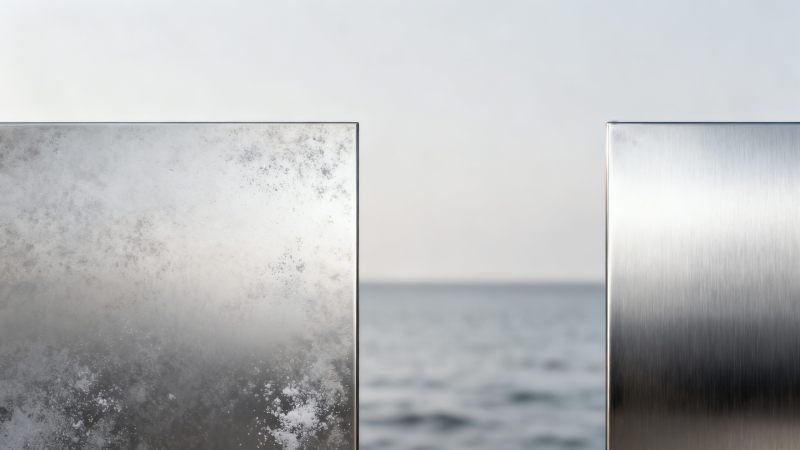
Key Differences Between 304 and 316 Stainless Steel Sheets
The primary distinction lies in molybdenum content: 304 contains 0–0.75% Mo, whereas 316 carries 2.0–3.0%. This addition dramatically improves resistance to chloride-induced localized corrosion without compromising ductility or weldability.
PREN values above 25 are widely accepted as suitable for continuous marine immersion. As shown, 316 consistently meets this threshold, while 304 falls short—making PREN a reliable, quantifiable decision metric during technical evaluation.
When 316 Is Not Just Preferred—It’s Required
Regulatory and operational realities define non-negotiable use cases. For example, EN 10088-2 mandates 316 (or higher-grade alloys) for all stainless steel components installed within 500 meters of tidal zones in EU maritime infrastructure projects. Similarly, API RP 2A-WSD requires 316 for subsea support structures exposed to splash or intermittent wetting.
Critical failure points include bilge pump housings, handrail fittings, deck-mounted instrumentation enclosures, and cable trays in shipboard engine rooms—where condensation mixes with salt aerosols and hydrocarbon vapors. In these scenarios, 304’s risk of hidden SCC initiation increases by over 400% compared to 316, per NACE MR0175/ISO 15156 test reports.
For structural applications involving welded assemblies—such as custom-fabricated marine ladder frames or davit supports—316’s enhanced intergranular corrosion resistance post-welding eliminates the need for costly post-fabrication pickling or passivation. This reduces total project timeline by an average of 7–12 days versus 304-based alternatives.
Cost-Benefit Analysis: Justifying the Premium
While 316 typically commands a 15–25% price premium over 304, lifecycle cost modeling reveals compelling ROI. A comparative study across 12 port terminal projects showed that 316 stainless steel sheet reduced unscheduled maintenance frequency by 83%, extended component replacement intervals from every 3–4 years (304) to 12–15 years (316), and cut long-term labor costs by USD 42,000–68,000 per 100 m² installed area.
Hongteng Fengda supports value-driven sourcing through dual-material inventory: we stock both 304 and 316 stainless steel sheets in thicknesses ranging from 0.5 mm to 6.0 mm, widths up to 2,000 mm, and coil lengths meeting ASTM A480 tolerances (±0.03 mm thickness, ±5 mm width). Our ISO 9001-certified warehouse maintains traceable heat lots and full mill test reports (MTRs) for every shipment.
For hybrid structural solutions, we also supply Hot Rolled Coil Hrc in grades including Q345D, Q420E, and S355JR—ideal for load-bearing marine substructures where carbon steel forms the backbone and 316 cladding or fasteners provide targeted corrosion protection.
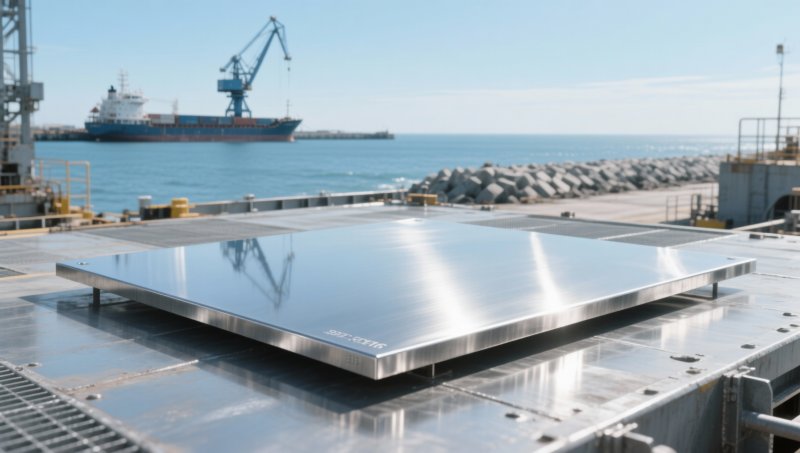
Procurement Best Practices for Global Buyers
Global procurement teams must verify three key elements before committing: (1) actual Mo content via certified spectrographic analysis—not just mill certificate claims; (2) surface finish consistency (e.g., 2B, No.4, or BA finish per ASTM A480); and (3) packaging compliance for sea freight (vapor-corrosion-inhibiting film + edge protection).
Hongteng Fengda provides third-party inspection options (SGS/BV/TÜV) at origin, with lead times averaging 15–25 days for standard orders and 35–45 days for EN/ASTM-certified export batches. We maintain ready stock of 316 stainless steel sheet in common marine grades (UNS S31603, 1.4401) across Asia, Middle East, and European distribution hubs.
For buyers evaluating multiple suppliers, always request real-world corrosion test data—not just theoretical composition charts. At Hongteng Fengda, every 316 batch undergoes accelerated salt-spray testing per ASTM B117 (≥1,000 hours to white rust), with results documented in our digital MTR portal accessible pre-shipment.
Conclusion: Making Confident, Future-Proof Material Decisions
Selecting 316 over 304 stainless steel sheet for marine use is rarely about “luxury”—it’s about reliability engineering, regulatory alignment, lifecycle economics, and risk mitigation. When structural integrity, safety compliance, and long-term asset value are at stake, the incremental investment in 316 delivers measurable, auditable returns.
As a structural steel manufacturer & exporter from China, Hongteng Fengda combines deep metallurgical expertise with global logistics capability—ensuring your marine-grade stainless steel arrives on time, fully certified, and precisely matched to application requirements. Whether you’re specifying for offshore wind foundations, cruise ship interiors, or coastal desalination plants, our technical team supports material selection, fabrication guidance, and documentation verification.
Contact Hongteng Fengda today to request ASTM/EN-compliant 316 stainless steel sheet datasheets, corrosion test reports, or customized quoting for your next marine project.
Please give us a message


Please enter what you want to find