When to Use Welded vs. Woven Steel Mesh in High-Traffic Flooring or Retaining Wall Applications
High-traffic flooring and retaining walls demand steel mesh solutions that perform under sustained mechanical stress, environmental exposure, and long-term load cycling. For project managers overseeing infrastructure, industrial facilities, or civil works, the choice between welded and woven steel mesh isn’t about preference—it’s about matching material behavior to structural function. Misalignment here leads to premature fatigue, localized deformation, or costly rework—especially when specifications are based on catalog data rather than application physics.
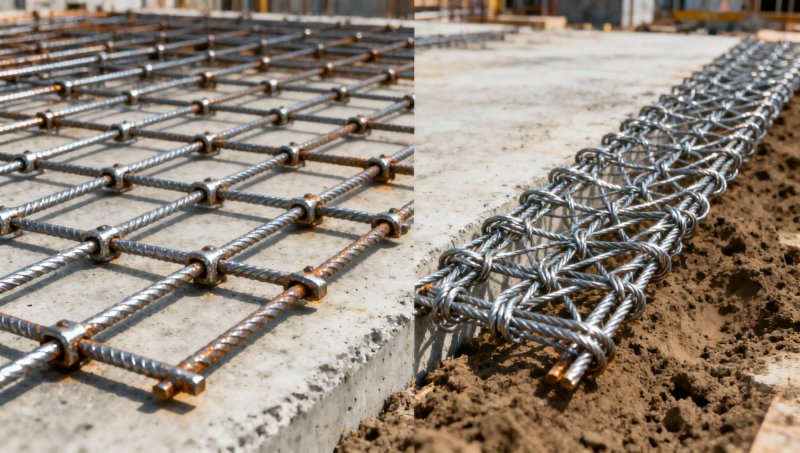
Welded steel mesh delivers predictable rigidity. Each intersection is fused under controlled heat and pressure, creating a monolithic grid with uniform tensile resistance across both longitudinal and transverse directions. This consistency matters where point loads dominate: pedestrian concourses, warehouse floors, or vehicular ramps subject to repeated wheel impact. ASTM A185 and EN 10237 define minimum yield strength (≥460 MPa for typical deformed bar welds) and bond integrity thresholds—requirements directly tied to crack propagation resistance in concrete overlays or grouted installations. If your design relies on moment transfer across the slab—or if deflection control is specified at ≤L/360—the welded configuration provides deterministic stiffness. Its limitation emerges where substrate movement exceeds ±1.5 mm/year: thermal expansion differentials or differential settlement can induce interfacial shear that the rigid node resists poorly, potentially fracturing adjacent concrete or compromising anchorage.
Woven steel mesh behaves differently—not as a stiff plate, but as a tension-distributed lattice. Wires are interlaced without fusion, allowing micro-slip at intersections under shear. This gives it superior energy absorption in dynamic soil conditions, particularly for retaining walls subjected to lateral earth pressure fluctuations or seismic loading. EN 10080 classifies such mesh by ultimate tensile strength and elongation at break—not just yield point—because ductility governs performance when backfill settles unevenly or hydrostatic pressure shifts seasonally. In practice, woven mesh accommodates up to 3–4% strain before failure, whereas welded variants typically fracture at 12–15% elongation *of individual wires*, but far less at nodes due to stress concentration. That distinction becomes decisive when designing gravity-retaining structures with granular backfill or mechanically stabilized earth (MSE) systems where mesh acts as a reinforcement layer rather than a primary load-bearing element.
The substrate condition determines which behavior you need—not the specification sheet. Welded mesh excels on stable, engineered foundations: reinforced concrete slabs cast on compacted subgrade, or pre-cast planks anchored to structural steel frames. Its advantage compounds when combined with high-strength concrete (≥C40/50), where bond strength between wire and matrix dominates overall system capacity. Woven mesh, conversely, gains relevance where foundation movement is anticipated: slope stabilization on clay-rich soils, waterfront retaining walls exposed to tidal cycles, or modular retaining systems built over reclaimed land. Here, its ability to redistribute localized stress through wire slippage prevents brittle failure cascades—a trait verified in pull-out tests per ASTM D6706, where woven configurations show 20–30% higher interface friction coefficients under cyclic loading.
Corrosion resistance must be evaluated separately from mechanical selection—but not in isolation. Both mesh types rely on base steel quality and coating integrity. Standard carbon steel wire (e.g., Q235 or ASTM A615) offers adequate strength but limited service life in chloride-laden environments. Galvalume-coated alternatives provide measurable improvement: the aluminum-zinc alloy layer inhibits undercutting corrosion more effectively than pure zinc, especially in humid or marine-exposed applications. DX53D Galvalume Steel Coil —with its 270–300 MPa yield strength and ≥24% elongation—demonstrates why upgraded substrate material matters beyond mere coating thickness. Its higher formability allows tighter weaving without wire fracture, and its enhanced ductility supports post-installation adjustments during field tensioning—critical for retaining wall facings where alignment tolerances are tight and rework is logistically prohibitive.
Installation methodology further narrows the choice. Welded mesh arrives in rigid sheets, requiring precise spacing and support during concrete pour to prevent sagging or displacement. It demands skilled labor for cutting and bending on-site—especially around penetrations or irregular edges—where thermal cutting risks embrittlement of adjacent welds. Woven mesh is supplied in rolls, enabling faster unrolling and draping over curved or stepped retaining structures. However, its flexibility introduces tensioning variables: insufficient pretension leads to “bagging” behind facing panels; excessive tension induces wire necking at clamps. Field verification requires calibrated torque wrenches and periodic load testing—not visual inspection alone.
Standards compliance doesn’t guarantee suitability. ASTM A185 covers welded mesh for concrete reinforcement but says nothing about long-term creep under sustained 80% yield loads—a real concern in elevated walkways or bridge decks. EN 10223-3 addresses woven mesh for erosion control but excludes performance thresholds for static earth retention above 6 meters. Project managers must cross-reference application-specific requirements: BS 8110 for floor slab deflection limits, Eurocode 7 for retaining wall partial safety factors, or local geotechnical reports specifying allowable lateral displacement. Relying solely on mesh certification without validating against actual boundary conditions invites non-conformance—even with full documentation.
Cost analysis often misleads. Welded mesh carries a 15–25% premium over woven equivalents per square meter, but this ignores labor savings in controlled environments (e.g., precast yards) and reduced risk of re-pouring due to mesh displacement. Conversely, woven mesh may lower initial material cost but increase site supervision hours for tensioning verification and post-installation monitoring. Lifecycle cost hinges less on unit price and more on whether the selected type reduces the probability of remediation—measured in man-days, delay penalties, or warranty claims—not just procurement line items.
There is no universal “better” option. The decision rests on three verifiable inputs: (1) the dominant load mode (bending vs. shear), (2) expected substrate movement magnitude and frequency, and (3) installation constraints (access, labor skill, tolerance for field modification). When those inputs align with welded mesh’s rigidity profile—stable subgrade, bending-dominated design, precision-controlled placement—it delivers repeatability and predictability. When they align with woven mesh’s ductile redistribution—variable soil pressure, cyclic loading, or complex geometry—it delivers resilience. Neither performs well outside its functional envelope—and substituting one for the other without recalculating system-level behavior risks compounding failure modes rather than mitigating them.

Previous page: Already the first one
Next page: Already the last one
Please give us a message


Please enter what you want to find