When it comes to municipal water distribution—especially for buried service lines, fire mains, or above-ground distribution risers—the choice between hot diped-galvanized pipe and black steel pipe isn’t about “better” or “worse” in absolute terms. It’s about where each material’s inherent behavior aligns—or misaligns—with real-world site conditions, water chemistry, installation practices, and long-term ownership expectations. For project managers overseeing infrastructure upgrades, retrofits, or new builds, the decision often hinges on a handful of decisive factors—not budget alone.
Corrosion resistance isn’t theoretical—it’s environmental
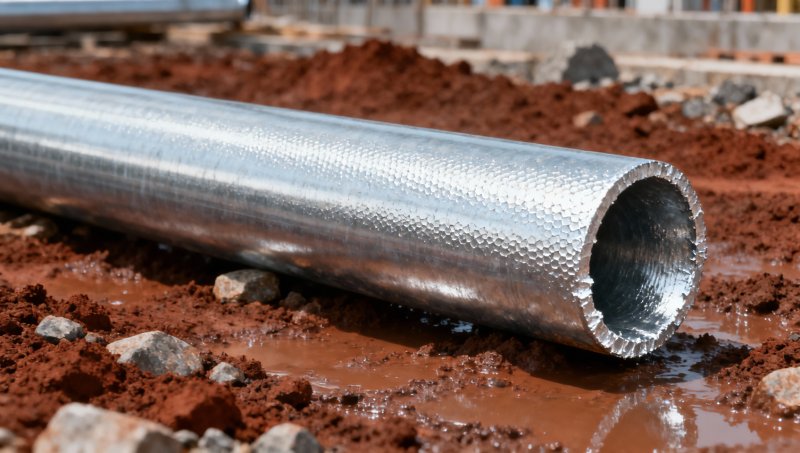
Black steel pipe (uncoated carbon steel) relies entirely on external protection: bituminous wraps, fusion-bonded epoxy, or polyethylene sleeves. That protection is vulnerable—during backfilling, from rock impingement, at field-cut joints, and over decades of soil movement. Once compromised, localized corrosion accelerates rapidly, especially in acidic, high-chloride, or poorly drained soils. Hot diped-galvanized pipe, by contrast, carries its corrosion defense *within the metal itself*: a metallurgically bonded zinc layer (typically 85–100 µm thick per ASTM A123/A123M) that sacrificially corrodes ahead of the base steel. Crucially, this layer self-heals at cut ends and minor scratches—a feature no external coating replicates.
This matters most in three common municipal scenarios:
- Unchlorinated or low-residual water systems—such as groundwater-fed rural networks or older city systems with intermittent disinfection. Without free chlorine to passivate steel surfaces, black pipe interiors corrode quickly, causing turbidity, iron staining, and flow restriction. Galvanized pipe resists internal pitting far longer—even in soft, low-pH water.
- High-conductivity soils—clay-rich, saline, or industrial-contaminated ground dramatically increases galvanic corrosion risk for bare steel. Zinc’s electrochemical potential provides a stable buffer, extending service life from ~10–15 years (black steel, unprotected) to 30+ years in many field installations.
- Shallow burial or exposed above-ground sections—where mechanical damage to external coatings is likely. Galvanized pipe tolerates abrasion, UV exposure, and incidental impact without immediate loss of protection.
Installation reality changes the math
Project managers often underestimate how much the *installation phase* reshapes long-term performance. Black steel pipe requires meticulous surface prep before coating—and every field weld, thread, or coupling introduces a discontinuity that must be meticulously touched up. Miss one joint, delay inspection, or allow moisture ingress during backfilling, and you’ve created a corrosion initiation point. Hot diped-galvanized pipe arrives ready to install: no priming, no curing time, no field-coating labor. Threads can be cut and sealed with standard pipe dope; flanged connections need no additional barrier. This reduces both schedule risk and quality variability—critical when managing subcontractor crews across multiple sites.
That said, hot diped-galvanized pipe isn’t universally ideal. In highly alkaline soils (pH > 9.5), zinc can form non-protective white rust or dissolve faster. In very dry, aerated sands, the zinc layer may deplete more slowly—but so does black steel’s corrosion, narrowing the performance gap. And if the system will carry aggressive chemicals (e.g., chloramines at elevated temperatures), stainless alternatives may be warranted instead.
Regulatory alignment—beyond minimum specs
Many municipal specifications still list “black steel pipe, coated per AWWA C203” as default—largely due to historical precedent and familiarity. But updated standards like AWWA C101 (for ductile iron) and ASTM A53/A123 increasingly recognize galvanized carbon steel as a qualified, code-compliant option for service lines up to 12 inches in diameter. More importantly, jurisdictions with aging infrastructure—particularly those tracking break rates, water loss, or customer complaints about discoloration—are quietly updating tender documents to favor materials with proven field longevity. When your O&M team spends less time locating leaks and flushing rusty mains, the lifecycle cost advantage becomes tangible—not just theoretical.
What about structural steel? Context matters
While piping selection focuses on fluid conveyance and corrosion control, project managers also coordinate supporting infrastructure—brackets, hangers, support frames, and structural sleeves. Here, material consistency simplifies procurement, welding compatibility, and galvanic compatibility. For example, using galvanized pipe alongside Hot Rolled H Beam in matching zinc-coated grades (e.g., ASTM A572 Grade 50 with ASTM A123 coating) eliminates bimetallic corrosion risk at contact points and streamlines QA/QC. Hongteng Fengda supplies both hot diped-galvanized pipe and structural sections—including Hot Rolled H Beam in Q345B, S355JR, and ASTM A572 variants—certified to EN10025, ASTM, and GB standards. This ensures dimensional accuracy, weldability, and coating integrity across integrated systems, reducing rework and interface coordination delays.
The maintenance trade-off: upfront cost vs. lifetime visibility
Yes—hot diped-galvanized pipe typically carries a 15–25% premium over black steel pipe (material only). But compare total cost of ownership:
- Black steel: Lower initial pipe cost, but higher labor for coating application, inspection, and repair; mandatory cathodic protection surveys every 3–5 years; frequent leak investigations; higher risk of unplanned shutdowns.
- Hot diped-galvanized: Higher pipe cost, but near-zero field coating labor; no routine cathodic protection needed; predictable degradation pattern (zinc depletion → uniform steel corrosion); easier visual assessment during inspections.
In practice, projects with tight timelines, limited QA resources, or historically high break rates see faster ROI on galvanized pipe—not because it’s “more expensive,” but because it shifts risk from operations back to procurement, where it’s easier to control and specify.
Three questions to ask before specifying
Before finalizing your spec sheet, confirm these with your design engineer and local utility authority:
- What’s the actual soil resistivity and pH at trench depth? (Not just surface reading.) If resistivity is < 2,000 ohm-cm or pH < 5.5, galvanized outperforms black steel decisively.
- Is internal water quality monitored—and how consistently? If residual chlorine drops below 0.2 ppm for extended periods, internal corrosion of black pipe accelerates exponentially.
- Who maintains the system post-handover—and what’s their capacity for coating repair and CP monitoring? If maintenance is outsourced or under-resourced, galvanized pipe reduces operational dependency on skilled coating technicians.
Bottom line
Hot diped-galvanized pipe outperforms black steel pipe in municipal water systems when corrosion control cannot be delegated to field-applied coatings—or when long-term reliability must outweigh short-term procurement savings. It’s not the right choice for every mile of pipeline. But for service connections, fire mains, pressure-reducing stations, and any section exposed to variable soil, moisture, or handling, it delivers measurable reductions in break frequency, water loss, and maintenance labor. As infrastructure ages and budgets tighten, the question isn’t whether you can afford galvanized pipe—it’s whether you can afford the recurring cost of managing its alternative.
Please give us a message


Please enter what you want to find