For procurement teams, choosing coil coated steel often comes down to balancing upfront price with long-term value. While the initial cost may be higher, its durability, corrosion resistance, and processing efficiency can reduce maintenance, waste, and project delays. Understanding when coil coated steel justifies the extra investment is essential for making smarter sourcing decisions in competitive steel projects.
When the extra cost of coil coated steel creates measurable project value
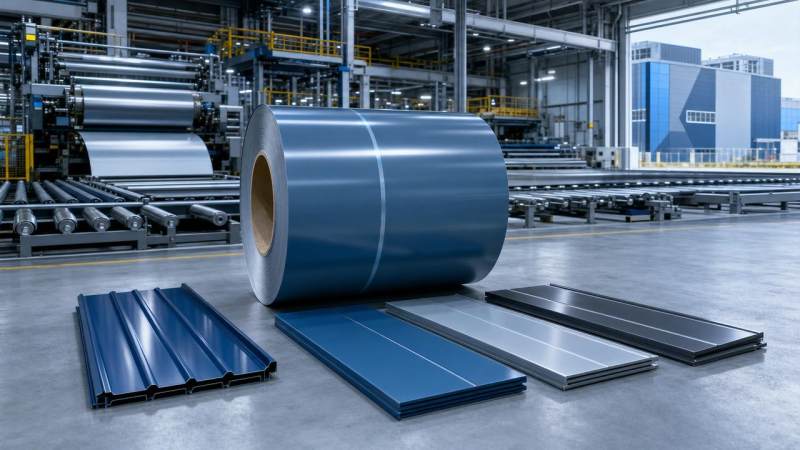
The price gap between bare steel and coil coated steel is visible at purchase. The value gap often appears later, during fabrication, transport, installation, and service life.
In steel supply decisions, the right question is not only “How much does it cost today?” It is “What costs can it prevent tomorrow?”
Coil coated steel combines substrate performance with a factory-applied coating system. This improves surface consistency, corrosion resistance, appearance, and processing stability.
For structural and industrial projects, that can mean fewer repaints, less on-site touch-up work, reduced scrap, and more predictable delivery schedules.
Hongteng Fengda, a structural steel manufacturer and exporter from China, supports global projects with reliable steel products, customized solutions, and production aligned with ASTM, EN, JIS, and GB.
Why project context matters before choosing coil coated steel
Not every steel application needs a pre-coated surface. In some projects, standard steel with later painting remains the practical choice.
However, some environments punish low-cost decisions. Moisture, salt, chemicals, abrasion, and high handling frequency can quickly erase initial savings.
Project context changes the economics of coil coated steel. The same material may be optional in one job and essential in another.
Useful evaluation points include service environment, target lifespan, appearance requirements, processing steps, installation conditions, and maintenance access after completion.
Key signals that the higher price may be justified
- Outdoor exposure with regular rain, humidity, or coastal air
- Projects requiring stable color and clean visual finish
- Fast-track production where rework causes schedule pressure
- Sites where future maintenance is difficult or expensive
- High-volume forming operations that benefit from uniform surface quality
Typical scenarios where coil coated steel is worth the extra cost
Outdoor building systems with long service expectations
Roofing, cladding, wall panels, and exterior components often face constant weather cycles. In these cases, coil coated steel can protect value beyond the initial purchase.
Factory-controlled coating quality supports better adhesion and consistency than many on-site painting conditions. That matters when appearance and durability both affect project outcomes.
Industrial facilities exposed to moisture or chemical risk
Warehouses, processing areas, utility buildings, and equipment enclosures often face demanding internal conditions. Bare steel may deteriorate faster than expected in these spaces.
Coil coated steel becomes more attractive when downtime, contamination, or maintenance shutdowns carry real cost. Surface protection then supports operational continuity.
Projects where speed and fabrication efficiency matter
Pre-coated material can reduce secondary finishing steps. That shortens production flow and lowers the risk of bottlenecks caused by painting, drying, or touch-up work.
For time-sensitive steel projects, faster throughput can offset a higher material cost. This is especially true when delays trigger penalties or site coordination problems.
Infrastructure and water-related works needing durable steel choices
In some heavy-duty applications, buyers also compare coated sheet products with other corrosion-conscious steel solutions used in marine and foundation works.
For example, Steel Sheet Piles are selected for deep water construction and cofferdams where strength, waterproof performance, and reusability matter.
Available grades include S275, S355, S390, S430, SY295, SY390, and ASTM A690. Standards include EN10248, EN10249, JIS5528, JIS5523, and ASTM.
This comparison highlights a useful sourcing principle. Material selection should follow service conditions, not only initial ton price.
How different project scenarios change the value of coil coated steel
The same steel budget can perform very differently depending on exposure, finish needs, and lifecycle expectations. A simple comparison helps clarify decision logic.
A practical checklist for deciding on coil coated steel
A reliable decision should compare total project impact, not only material quotation lines. Use these checkpoints before finalizing steel sourcing.
- Define the exposure level: indoor, outdoor, coastal, industrial, or wet environment.
- Estimate service life and acceptable maintenance frequency.
- Review whether visual consistency affects project acceptance or brand image.
- Measure process savings from reduced painting, drying, and handling.
- Check forming, bending, and fabrication compatibility with coating requirements.
- Calculate the cost of field repairs if bare steel is selected instead.
When coil coated steel is usually a strong fit
- Long-life building systems
- Steel parts shipped through humid or variable climates
- Projects with limited access for future repainting
- High-volume manufacturing requiring consistent finish quality
When the premium may be unnecessary
- Temporary structures with short service duration
- Hidden steel components without surface exposure
- Low-humidity indoor applications with simple maintenance access
Common mistakes when evaluating coil coated steel
One common mistake is comparing only per-ton prices. This ignores labor, scrap, coating inconsistency, repaint risk, and schedule disruption.
Another mistake is treating all coated steel the same. Coating systems, substrate grades, and processing requirements should match the actual use case.
Some projects also underestimate transport and storage exposure. Steel may face moisture and handling damage long before it reaches final installation.
A further oversight is ignoring downstream efficiency. If coil coated steel reduces touch-up work and speeds fabrication, that advantage belongs in the cost model.
How to turn coil coated steel selection into a better sourcing decision
The smartest way to buy coil coated steel is to align material choice with service conditions, production flow, and lifecycle cost targets.
Request clear data on base steel grade, coating system, processing suitability, standards compliance, and expected delivery consistency. This reduces sourcing uncertainty.
For global steel projects, stable supply capacity matters as much as specification. Reliable partners help control lead times, quality variation, and replacement risk.
Hongteng Fengda supplies structural steel products and customized solutions for construction, industrial, and manufacturing needs across North America, Europe, the Middle East, and Southeast Asia.
When the environment is demanding, the finish is visible, or maintenance is costly, coil coated steel is often worth the extra cost. In lower-risk settings, standard steel may remain the better-value option.
The next step is simple: compare total installed cost, maintenance exposure, and schedule impact side by side before confirming the steel specification.
Please give us a message


Please enter what you want to find