A galvanized sheet steel angle can replace a hot-rolled angle when its verified capacity, stiffness, connections, and durability satisfy the same project requirements. Matching the leg dimensions is not enough. A lighter angle may look interchangeable on a drawing while behaving very differently under compression, bending, or loads applied through one leg.
For technical evaluators sourcing angulo chapa galvanizada, the practical question is not whether cold-formed steel is “as good” as hot-rolled steel. It is whether a specific formed section can perform a specific job without introducing unacceptable movement, instability, connection failures, or maintenance demands. Some substitutions are straightforward; others require a redesigned section or connection rather than a purchasing change.
Start with the member’s job, not its product name
The term angulo chapa galvanizada generally describes an angle formed from galvanized sheet. It does not, by itself, establish a structural grade, coating mass, design thickness, or certified resistance. The material may be suitable for trim, equipment framing, secondary supports, or engineered load-bearing work—but those uses require different levels of verification.
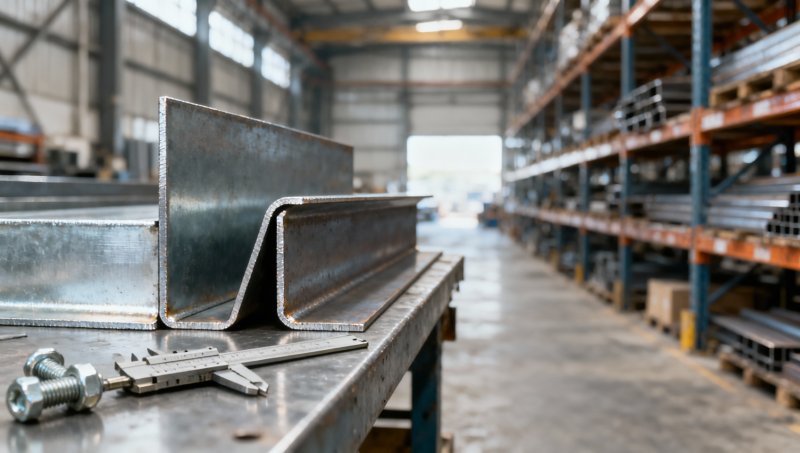
Hot-rolled angles are produced by rolling steel into an L-shaped section. Sheet angles are formed by bending or roll-forming flat material, often already zinc-coated. The distinction matters because cold-formed products commonly have thinner legs, different corner radii, and greater sensitivity to plate buckling.
“Secondary” does not mean unimportant. A small angle supporting façade panels may carry modest gravity loads but significant wind suction. An angle described as decorative may also restrain equipment or protect an occupied walkway. Establish the actual load path before classifying the substitution as low risk.
Why identical leg dimensions do not mean equivalent performance
Consider a proposed change from a hot-rolled angle to a formed angle with the same two leg widths but thinner steel. The external envelope remains similar, yet the steel area, centroid, principal-axis properties, torsional stiffness, and connection behavior change. Even when both materials have the same specified yield strength, their usable capacities may differ substantially.
A useful section drawing should show leg dimensions, base-metal thickness, inside bend radius, hole positions, and orientation in service—not just “L × L.” Rounded corners influence developed dimensions and section properties, while asymmetric loading can make principal-axis behavior more important than the familiar horizontal and vertical axes.
Separate strength from stiffness
Higher-strength sheet can improve some strength checks, but it does not provide a corresponding increase in elastic stiffness. Conventional structural steel grades have broadly similar elastic moduli. A thinner, higher-strength angle may resist yielding adequately yet deflect too much, rotate at its connection, or allow attached panels to move.
Check serviceability against the actual function: alignment of machinery, movement of cladding, door clearances, vibration, and drainage falls. Passing an ultimate-strength calculation does not guarantee satisfactory performance in use.
Account for slender legs and member instability
Thin angle legs can buckle locally before the gross section reaches yield. Depending on the governing design method, resistance calculations may require effective-section properties or another recognized cold-formed steel procedure. Gross area alone is therefore an unreliable basis for comparing compression or bending resistance.
At member level, unsupported length, restraint, end conditions, and load eccentricity affect flexural and flexural-torsional buckling. A connection through one leg introduces eccentricity relative to the section centroid. Do not assume attached sheeting provides restraint unless its stiffness, fasteners, and load path justify that assumption.
A substitution review that follows the load path
The most efficient assessment starts with the approved hot-rolled design and identifies what the replacement must deliver. Avoid beginning with a supplier’s available thickness and working backward toward an acceptable calculation.
- Recover the design basis. Confirm loads, combinations, span or unsupported length, restraint assumptions, environmental exposure, and serviceability limits. Include erection loads where relevant.
- Define the proposed section. Record the steel grade, minimum base-metal thickness, tolerances, bend radius, coating designation, hole layout, and actual formed geometry.
- Calculate member resistance. Check applicable tension, compression, bending, shear, and combined-action limit states using the appropriate design standard.
- Evaluate the attachments. Verify that bolts, screws, welds, anchors, and connected materials transfer the required forces without premature failure.
- Confirm durability and fabrication compatibility. Review cut edges, bends, coating repairs, drainage, and any contact with dissimilar metals.
- Approve the change formally. Update drawings, specifications, and inspection requirements through the responsible design authority.
Where project records do not establish the original loads or restraints, equivalence cannot be demonstrated merely by comparing catalogue capacities. Recover the missing information or redesign the affected assembly.
Connections frequently decide whether the change works
A formed angle may pass the member calculation and still fail at the attachment. Thin material around a bolt hole has less bearing area and can be more vulnerable to tear-out, net-section rupture, or local distortion. Fastener diameter, edge distance, pitch, washers, and connection length all deserve review.
For screw-fastened assemblies, check pull-out from the supporting material and pull-over through the angle separately. For brackets, account for prying and bending at the heel or fastener line. A bolt group that was adequate in a thicker hot-rolled leg is not automatically adequate in sheet steel.
Welding needs particular care. Thin galvanized material can distort or burn through, and zinc affects welding procedures and fume control. Welded areas also need appropriate corrosion-protection restoration. If welding is essential to the original design, determine whether a qualified fabrication procedure makes the substitution practical before committing to it.
Sometimes a revised connection makes a formed angle viable: a backing plate, additional fasteners, a shorter unsupported length, or a different load introduction point. These are engineered changes, however, and their fabrication cost belongs in the comparison.
Galvanizing addresses exposure—not missing structural capacity
The coating route should be explicit. An angle formed from continuously galvanized sheet is not necessarily equivalent in corrosion performance to an angle galvanized after fabrication. Cut ends, punched holes, welded areas, and damaged bends can expose steel or interrupt protection.
Zinc can provide sacrificial protection near exposed edges, but that does not eliminate the need to evaluate the environment. Persistent moisture, coastal salts, industrial pollutants, crevices, and water-trapping details can change the maintenance requirement substantially.
- Specify zinc or alloy coating designation and coating mass, rather than requesting “galvanized” alone.
- Distinguish base-metal thickness from thickness measured over metallic and organic coatings.
- Check the grade and coating supplier’s permitted bend radii and inspect formed corners for cracking or damage.
- Define protection for cuts, holes, welds, and handling damage under the applicable specification.
- Review drainage and compatibility with adjoining metals, fasteners, and treated materials.
A corrosion-resistant finish cannot compensate for insufficient section resistance. Conversely, a structurally adequate angle may be unsuitable if its coating and detailing cannot support the intended maintenance strategy.
Where prepainted sheet fits—and where it does not
In roofing, wall-panel, door-frame, and equipment-enclosure projects, the replacement discussion sometimes includes color-coated sheet. Hongteng Fengda’s PPGI Steel Sheet is relevant to these applications, with listed thicknesses of 0.2–1.2 mm, widths of 600–1250 mm, and finishes including PE, SMP, HDP, and PVDF.
Such material can be useful for formed trim and appearance-sensitive components. However, the paint system describes surface protection and appearance; it does not establish structural resistance. At these thicknesses, a plain angle may be governed by local buckling, deflection, or fastener behavior well before material strength becomes the deciding factor.
If prepainted material is proposed for a load-bearing angle, request the underlying steel grade, minimum base-metal thickness, metallic coating specification, and forming limitations. Confirm whether the substrate is zinc-coated or aluminum-zinc-coated, since procurement terminology sometimes blurs that distinction. Select the paint system for the actual exposure and forming process, not for an assumed structural benefit.
What technical evaluators should request from the supplier
A dependable quotation needs more than dimensions and a unit price. Hongteng Fengda supplies structural steel and customized cold-formed profiles for international projects; for substitution work, the useful discussion centers on the exact project specification and the evidence available for the proposed product.
Request a documentation package covering:
- Material traceability: mill certificates identifying the applicable steel standard, grade, chemical composition, and mechanical properties, with traceability to supplied batches.
- Dimensional control: nominal and minimum thickness, leg tolerances, bend radius, straightness, twist, and hole-position tolerances.
- Coating evidence: coating designation, mass or thickness as applicable, inspection method, and repair requirements.
- Engineering data: section properties and, where capacities are supplied, the calculation method, assumptions, restraint conditions, and design basis.
- Manufacturing details: forming method, hole-making method, welding requirements, and acceptance criteria for surface or bend damage.
Standards must be identified precisely. ASTM, EN, JIS, and GB are families of standards, not interchangeable assurances of performance. A sheet specification establishes material requirements; it does not automatically approve the formed angle as a replacement member. Depending on the project jurisdiction, cold-formed design may use provisions such as AISI S100 or EN 1993-1-3, with other applicable rules governing connections, durability, and execution.
Make the decision on installed value, not weight alone
Lower steel weight can reduce material use and handling effort, but added stiffeners, closer support spacing, extra fasteners, coating repairs, and engineering review can offset that saving. Compare the completed assembly—including inspection and maintenance—not simply the price per kilogram.
Accept the substitution when documented calculations and product evidence demonstrate adequate resistance, stiffness, connection capacity, durability, and compliance. Redesign before accepting when the formed angle needs altered geometry, restraint, or attachments. Retain the hot-rolled angle when the proposed alternative cannot meet the requirements reliably or when the evidence needed to verify it is unavailable.
The strongest procurement decision is a traceable one: defined loads, defined material, checked details, and approved drawings. Under those conditions, galvanized sheet steel angles can be practical alternatives. Without them, a matching outline is only a visual resemblance—not engineering equivalence.
Please give us a message


Please enter what you want to find