When an assembly crew must mark, clamp, drill, deburr, and check every steel angle before installing it, a low material price can hide a substantial labor bill. Angle iron with pre drilled holes cuts assembly labor costs when connections repeat, mating dimensions are settled, and factory hole accuracy allows parts to fit without field modification. The commercial advantage comes from removing preparation work at installation—not simply from buying steel with holes.
The strongest candidates are repeatable frames, equipment supports, and modular assemblies with approved connection details. Pre-drilled angles are less attractive where dimensions change during installation or existing structures must be measured individually. The purchasing decision should compare the added fabrication charge against avoidable labor, handling, equipment, and rework costs while allowing for drawing control and delivery risk.
Identify the work that actually disappears
A crew drilling plain angle steel does more than operate a drill. Someone interprets the drawing, establishes a datum, marks hole centers, positions the workpiece, selects tooling, removes burrs, and checks alignment. On site, moving material to a suitable work area and arranging safe access can take additional time. These activities may involve both an installer and a helper, so elapsed task time alone can understate the labor cost.
Factory-prepared holes can remove much of that sequence, but assembly still requires unpacking, identifying parts, positioning members, inserting fasteners, and tightening connections as specified. Procurement should therefore distinguish avoidable preparation hours from installation hours that remain under either option.
Use the current workflow as the baseline. Record preparation time across representative parts, including awkward locations and different hole patterns. Separate normal work from exceptional delays. A comparison based only on drilling an accessible loose angle at a bench will not represent a project where members are handled repeatedly or drilled after positioning.
- Marking and setup: Count repeated measurements, template positioning, and fixture adjustments.
- Hole production: Include tool changes, repositioning, and any pilot drilling required by the actual process.
- Finishing and verification: Include deburring, cleaning, and checking hole position.
- Correction: Track mislocated holes and rejected parts separately rather than assuming all rework will disappear.
Three assembly situations that change the economics
Repeated parts with a stable connection pattern
Production frames and standardized support assemblies offer a clear opportunity. The same approved pattern appears across many members, allowing fabrication setup and drawing preparation to be spread over the order. Installers receive identifiable components rather than raw sections requiring individual layout.
The relevant quantity is not just the total number of angles. It is the quantity per unique pattern. An order with many pieces but almost as many drawing variants can carry significant programming, setup, and inspection costs. Ask suppliers to quote by part number and pattern family so this distinction remains visible.
Installation locations where drilling is difficult
Work at height, restricted equipment access, or limited space for clamping can make site hole preparation disproportionately expensive. Bringing ready-to-fit members to the installation point may reduce tool movement and interruptions between positioning and fastening.
That benefit depends on reliable mating geometry. If the supporting structure varies from its drawings, an accurate factory hole may still be in the wrong place for the actual connection. Survey the interfaces before release, or retain an approved adjustment method where necessary. Do not assign a labor saving to holes that the crew will probably need to relocate.
Low-volume work with uncertain dimensions
Small batches, retrofit work, and changing layouts often favor plain angles or partial factory preparation. The buyer may pay for setup, then pay again for modifications after site measurements become available. A hybrid approach can be more economical: factory-produce the stable holes and leave location-dependent features for controlled field work.
Slotted holes are not an automatic remedy for uncertainty. Their orientation, dimensions, fasteners, and connection behavior require design approval. Adjustment must be intentional rather than a substitute for accurate drawings.
Compare installed cost, not the steel line item
Request comparable quotations for plain cut-to-length angles and factory-prepared angles using the same material grade, section dimensions, quantities, coating requirements, and delivery basis. Otherwise, a difference attributed to drilling may actually come from a different steel specification or freight arrangement.
A useful calculation is:
Net benefit = avoided preparation labor + avoided tooling and rework costs − fabrication premium − additional inspection, logistics, and drawing-control costs.
Apply a loaded labor rate consistent with the project estimate, including relevant employment burdens and subcontractor charges. For tasks involving several people, use combined person-hours. Do not multiply crew elapsed time by a rate for only one worker.
The break-even test is straightforward: the fabrication premium per component must be lower than its credible avoided cost. Treat schedule benefits separately unless they translate into identifiable charges, such as reduced equipment rental or fewer subcontractor hours. Faster work may create useful capacity without immediately reducing payroll.
Run a conservative comparison using lower labor savings and higher retained inspection costs. If the prepared option only wins when every part fits perfectly and every drilling minute becomes a cash saving, the commercial case is fragile.
Hole location matters more than the label “pre-drilled”
A purchase description stating only angle size, length, and hole diameter is incomplete. Successful assembly depends on the relationship between holes, member ends, the two legs of the angle, and the mating component. Specify datums clearly so the supplier does not interpret dimensions from a different edge or end.
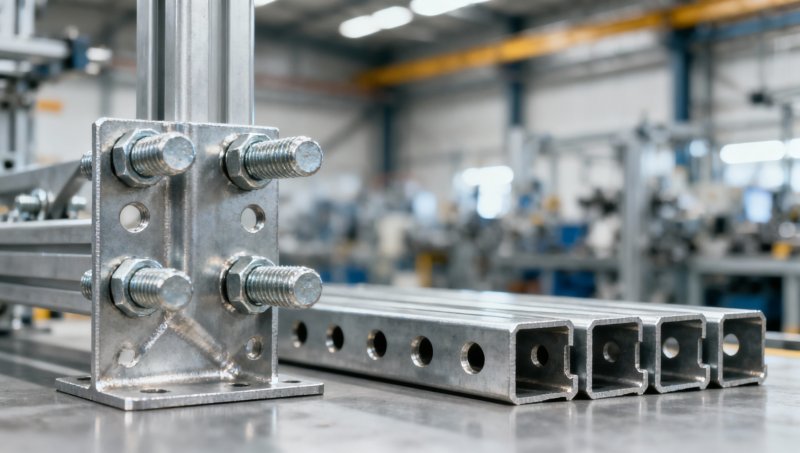
The fabrication drawing should define hole diameter or slot dimensions, center locations, pitch, end distances, leg identification, and orientation. Where mirrored parts exist, assign distinct part numbers or show the handedness unmistakably. Include acceptance tolerances for hole position and relevant section geometry rather than relying on an undefined request for “accurate drilling.”
Long connection patterns need particular attention. Small pitch deviations can accumulate so that the first fastener fits but later ones do not. Inspection should reference the agreed datum system and check the complete pattern, not just individual adjacent spacings.
Angle straightness, twist, leg dimensions, and cut-end squareness can also influence fit. A correct hole pattern on a distorted member may still force installers to realign or replace the part. Agree which dimensional characteristics are critical to assembly and how they will be measured.
Do not enlarge holes simply to make installation easier. Hole size, edge distance, net section, bearing, and connection loads must be compatible with the approved design. Structural or load-bearing applications require the responsible engineer to confirm those details before fabrication.
Clarify the manufacturing and coating sequence
Commercially, “pre-drilled” may be used to describe factory-prepared holes made by drilling, punching, or another agreed process. Ask which method is included in the quotation. Method selection can affect edge condition, burrs, deformation, tolerances, and suitability for the specified material thickness.
The acceptance requirement should focus on the finished component: correct geometry, usable hole edges, and conformity with the drawing and applicable fabrication requirements. Where the design or project specification restricts a process, make that restriction explicit before the supplier prices the work.
Coating sequence can create hidden installation work. Holes produced after coating expose bare steel at their edges; holes produced before coating can receive buildup that affects fastener clearance. Specify the sequence, required corrosion protection, and any permitted repair procedure. Check finished coated parts with the intended fasteners rather than accepting only uncoated dimensional results.
Keep adjacent sheet-metal procurement separate from the angle specification. Assemblies with galvanized covers or panels may also require Gi Sheet Coil, offered in thicknesses of 0.12–3.5 mm and widths of 600–1500 mm, with grades including DX52D and SGCD1. That material can address the sheet component of the assembly, but its forming characteristics and zinc coating do not establish the strength or suitability of a structural angle connection. Each component needs its own material and fabrication requirements.
Approve fit before releasing the full batch
A repeated pattern creates repeated savings only when the pattern is correct. One wrong datum or mirrored layout can otherwise affect the entire shipment. First-article approval is therefore particularly valuable for new parts, complex interfaces, or supplier changes.
- Release a controlled drawing: Identify the revision, material, coating, hole details, and acceptance criteria.
- Inspect a finished sample: Check the critical dimensions after all relevant cutting, hole-making, and coating operations.
- Trial the mating assembly: Use representative connecting parts and fasteners to expose interference or accumulated mismatch.
- Authorize production: Record approval against the exact revision and define how subsequent changes will be handled.
Request evidence of production inspection appropriate to the order, such as agreed dimensional records and material documentation. A sample alone does not demonstrate that every batch will remain consistent. The supplier should explain how patterns are controlled and how nonconforming parts are isolated.
Identification and packing belong in the quotation too. Labels should allow installers to distinguish similar lengths, handed parts, and different hole patterns without remeasuring everything. Packing by assembly or installation zone may save sorting time, but confirm its cost and practicality rather than assuming it is included.
Set an award condition tied to measurable savings
Before placing the order, establish who carries the cost of drawing errors, fabrication deviations, coating-related fit problems, and late changes. Agree the nonconformance procedure and replacement arrangements. These details determine whether a quoted saving survives a problem discovered after delivery.
For repeat purchasing, compare the first released batch against the baseline using preparation person-hours, field modifications, rejected components, and sorting time. Keep connection complexity comparable. Lower installation hours on a simpler assembly do not prove that factory drilling delivered the difference.
Choose factory-prepared angles when the conservative installed-cost comparison is positive, the interfaces are stable, and the supplier can demonstrate repeatable fit. Retain plain or partially prepared angles where site uncertainty dominates. The purchasing specification should state exactly which installation tasks the prepared component is expected to remove; those tasks provide the basis for both supplier evaluation and verification of the saving.
Please give us a message


Please enter what you want to find