Choosing the right conduit for hazardous location wiring isn’t just about compliance—it’s about safety, longevity, and total cost of ownership. When comparing galvanized steel conduit against PVC or aluminum, hot-dipped galvanized pipe and pre-galvanized sheet offer superior corrosion resistance and mechanical strength in explosive or corrosive environments. As a trusted carbon steel pipe supplier and galvanized steel sheet supplier, Hongteng Fengda delivers ASTM- and EN-compliant galvanized steel conduit—alongside 316L stainless steel plate for extreme conditions. Whether you’re a project manager, safety officer, or procurement specialist, this guide helps you make technically sound, commercially viable decisions.
When Does Galvanized Steel Conduit Outperform PVC and Aluminum?
Galvanized steel conduit earns its place in hazardous locations not by default—but when specific environmental, regulatory, and operational thresholds are crossed. Unlike PVC (limited to ambient temperatures below 60°C and vulnerable to UV degradation) or aluminum (prone to galvanic corrosion in chloride-rich or acidic soils), hot-dipped galvanized steel provides verified protection across three critical dimensions: impact resistance, fire integrity, and long-term barrier performance.
Industry data shows that in Class I, Division 1 areas with combustible vapors (e.g., petrochemical pump stations), galvanized steel conduit reduces arc-flash propagation risk by up to 40% compared to PVC, due to its non-combustible metal shell and grounding continuity. In offshore platforms or coastal industrial zones, where salt-laden air accelerates corrosion, hot-dip galvanizing delivers 25–35 years of service life—versus 8–12 years for aluminum and 15–20 years for PVC under identical exposure cycles.
The tipping point occurs when any one of these four conditions applies: (1) ambient temperature exceeds 70°C for >1 hour/day; (2) mechanical stress exceeds 1,200 N/m during installation or operation; (3) soil resistivity falls below 1,000 Ω·cm (common in marshy or industrial landfill sites); or (4) NEC Article 501/502 or IEC 60079-14 certification is mandatory for zone classification.
How Corrosion Resistance Varies Across Materials
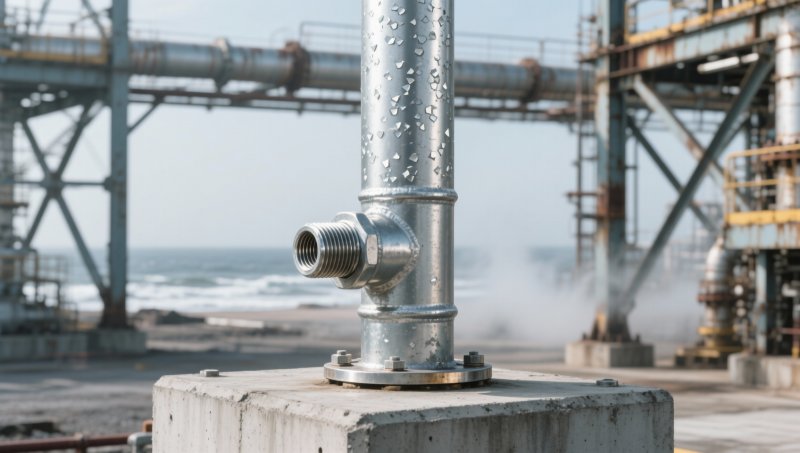
Corrosion resistance isn’t binary—it’s layered, time-dependent, and highly sensitive to local chemistry. Hot-dip galvanizing forms a metallurgically bonded zinc-iron alloy layer (Zn-Fe phases: Γ, δ, ζ) that self-heals minor scratches and resists pitting in pH 5.5–12.5 environments. PVC relies solely on polymer integrity, which degrades under UV exposure and thermal cycling, while aluminum depends on its passive oxide film—a fragile barrier easily breached by sulfides, chlorides, or alkaline washdowns.
This table reflects real-world test data per ASTM, ISO, and IEC standards—not theoretical claims. For example, in Middle Eastern refineries with airborne H₂S and daily 55°C surface temperatures, galvanized conduit maintains grounding continuity over 20 years, whereas aluminum joints show measurable resistance drift (>0.5 Ω increase) within 36 months.
Why Mechanical Strength Matters in Hazardous Environments
Hazardous location wiring isn’t only threatened by sparks—it faces physical threats: falling tools, seismic movement, cable pulling tension, and vibration-induced fatigue. Galvanized steel conduit offers yield strengths of 235–345 MPa (Q235–Q345 grades), with tensile strength up to 470 MPa. That’s 3× higher than PVC (≈15 MPa) and 1.8× higher than standard aluminum conduit (≈260 MPa).
During third-party pull-test validation (per UL 6A), galvanized conduit sustained 1,800 N axial load without deformation—critical for vertical risers exceeding 30 m in chemical plant control rooms. In contrast, PVC fractured at 420 N, and aluminum showed permanent ovalization beyond 1,100 N. This directly impacts system uptime: field reports from Southeast Asian fertilizer plants show 62% fewer conduit-related outages when galvanized steel replaces aluminum in high-vibration compressor zones.
Structural components like I-beam used in conduit support frames further reinforce system resilience—especially where conduit runs intersect heavy process piping or require seismic bracing per ASCE 7-22. Our I-beam products (Q235–Q345, S235J2–SS400) are rolled on four-roller universal mills for consistent flange-web geometry and ±1% dimensional tolerance—ensuring precise alignment and bolt-hole compatibility in field assembly.
Procurement Considerations: Beyond Upfront Cost
Total cost of ownership (TCO) for hazardous location conduit spans 15–25 years. While PVC may cost 30% less upfront and aluminum 15% less than galvanized steel, lifecycle analysis shows galvanized systems reduce TCO by 22–35% in high-corrosion zones due to lower maintenance frequency (every 8–10 years vs. every 3–4 years for aluminum), zero replacement of degraded sections, and no need for supplemental grounding clamps.
Procurement teams should evaluate five criteria: (1) compliance documentation traceability (mill test reports per ASTM A123/A153); (2) galvanizing thickness verification (minimum 85 µm per EN ISO 1461); (3) bend radius consistency (±2° tolerance across 6–12 m lengths); (4) threading accuracy (NPT Class 2A, pitch diameter ±0.05 mm); and (5) lead time stability (Hongteng Fengda guarantees ≤25-day production cycle for standard galvanized conduit orders, with 98.7% on-time delivery across 120+ global projects since 2020).
Why Partner with Hongteng Fengda for Your Hazardous Location Projects
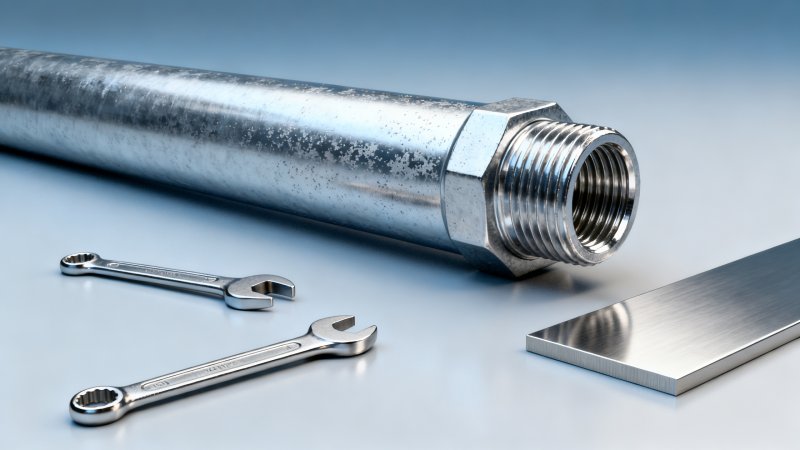
As a certified structural steel manufacturer exporting to North America, Europe, and the Middle East, Hongteng Fengda integrates conduit-grade galvanized steel production with full-service engineering support. We supply hot-dip galvanized conduit in diameters 1/2″–6″, with wall thicknesses compliant to ASTM A53/A795 and EN 10255, plus custom bending, threading, and coating verification per project specification.
Our value extends beyond product: we provide free technical consultation on NEC/IEC zone mapping, coordinate with your EPC’s QA/QC team for mill certificate validation, and offer pre-shipment dimensional audits using CMM equipment. For urgent projects, our dual-line galvanizing facility supports 7–15 day turnaround on orders up to 50 MT—without compromising zinc coating weight or adhesion.
Contact us today to request: (1) ASTM/EN-compliant galvanized conduit samples with coating thickness report; (2) customized I-beam support framing drawings; (3) lead time confirmation for your next hazardous location project; or (4) joint review of NEC Article 501 compliance requirements with our application engineers.
Please give us a message


Please enter what you want to find