Choosing the right conduit for electrical wiring isn’t just about compliance—it’s about durability, safety, and lifecycle cost. When comparing galvanized steel conduit against PVC or aluminum alternatives, factors like corrosion resistance, mechanical strength, and fire performance become decisive—especially in industrial or outdoor applications. For structural integrations where load-bearing capacity matters, understanding the weight of I beam per meter helps engineers coordinate conduit support systems efficiently. As a trusted structural steel manufacturer & exporter from China, Hongteng Fengda supplies high-quality steel conduit for electrical wiring—engineered to meet ASTM, EN, and GB standards—supporting global projects with reliability, traceability, and technical partnership.
When Does Galvanized Steel Conduit Deliver Clear Technical Advantage?
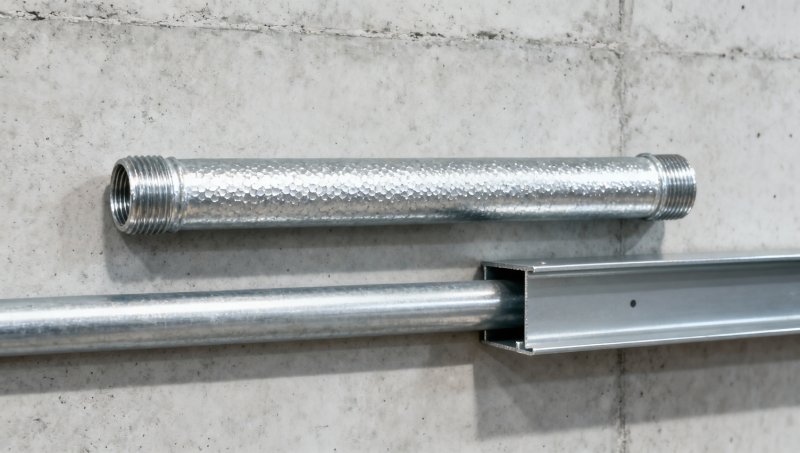
Galvanized steel conduit (GSC) is not a universal replacement—but it excels where environmental stress, physical impact, or regulatory rigor demands more than standard PVC or thin-walled aluminum solutions. Its hot-dip galvanization provides a zinc-iron alloy layer (typically 45–85 µm thick), delivering proven corrosion resistance for 20+ years in moderate industrial environments and up to 10 years in coastal or high-humidity zones—far exceeding aluminum’s susceptibility to galvanic corrosion and PVC’s UV degradation risk beyond 5–8 years without UV stabilizers.
Mechanically, GSC offers yield strength ≥235 MPa (Q235 grade) and tensile strength ≥370 MPa—critical when conduit must double as structural bracing, withstand equipment vibration, or support heavy cable bundles in vertical risers. In contrast, rigid PVC conduit typically fails under impact loads >15 J, while aluminum EMT rarely exceeds 110 MPa yield strength and requires additional grounding continuity verification per NEC Article 250.118.
Fire performance is another decisive factor: GSC is non-combustible (ASTM E136), contributes zero flame spread or smoke density, and maintains integrity during 2-hour fire exposure tests (UL 1569). PVC conduit, even flame-retardant grades, releases hydrogen chloride gas and dense smoke above 200°C—posing serious life-safety risks in enclosed or transit corridors.
Which Applications Justify the Higher Upfront Cost?
The ROI of galvanized steel conduit emerges most clearly in four high-stakes scenarios:
- Outdoor & exposed industrial sites: Refineries, power substations, and marine terminals—where salt spray, temperature cycling (−20°C to +60°C), and mechanical abrasion degrade PVC within 3–5 years and compromise aluminum’s oxide layer.
- High-risk fire zones: Data centers, hospitals, and manufacturing cleanrooms—where non-combustibility and zero toxic off-gassing are mandated by NFPA 130, IEC 61000-4-5, and local building codes.
- Structural-integrated conduit routing: When conduit runs parallel to or mounts directly onto primary steel members—requiring compatible thermal expansion (steel: ~12 × 10⁻⁶/°C vs. PVC: ~60–80 × 10⁻⁶/°C) and shared anchoring points.
- Long-term infrastructure projects: Municipal water treatment plants or rail signaling systems with design lifespans >30 years—where lifecycle cost analysis shows GSC reduces maintenance, rework, and outage costs by 35–50% versus PVC over 25 years.
In these cases, the 25–40% higher initial material cost of GSC is offset within 4–7 years—especially when factoring labor for conduit replacement, downtime penalties, and third-party inspection fees for non-compliant installations.
How to Evaluate Compatibility with Your Structural Steel System
Conduit selection cannot be isolated from the broader structural framework. For example, integrating conduit into roof purlins or wall beams requires alignment with load paths, fastener spacing, and thermal movement tolerances. That’s why many engineering teams pair galvanized steel conduit with standardized C Channel Beam sections—offering identical galvanized coating chemistry, matching CTE, and pre-engineered mounting flanges.
Hongteng Fengda’s C Channel Beam supports seamless conduit integration through:
- Standardized thickness range (1–12 mm) and length options (6 m / 9 m / 12 m), enabling precise bracket placement every 1.2–1.8 m per NEC 344.30(B).
- Hot-rolled or cold-formed variants (Q235, Q345, A36, S235JR) with ±1% dimensional tolerance—ensuring consistent conduit support rigidity across 100+ meter runs.
- Galvanized surface treatment compliant with ASTM A123 and ISO 1461, guaranteeing coating adhesion and uniformity at weld joints and cut edges.
Key Integration Parameters
This alignment minimizes differential stress, eliminates galvanic coupling risks, and accelerates installation—reducing on-site labor time by up to 22% compared to mixed-material assemblies.
Procurement Checklist: What to Verify Before Ordering
For procurement, technical, and safety teams, verifying five core dimensions prevents field rework and compliance gaps:
- Zinc coating mass: Minimum 610 g/m² (ASTM A123 Class B) for outdoor use—verified via gravimetric testing or cross-section microscopy.
- Thread compatibility: NPT threads per ANSI B1.20.1, with torque rating ≥25 N·m for 1″ conduit—ensuring EMI shielding continuity.
- Traceability documentation: Mill test reports (MTRs) showing chemical composition (e.g., Q235: C ≤0.22%, Mn 0.30–0.65%) and mechanical test results.
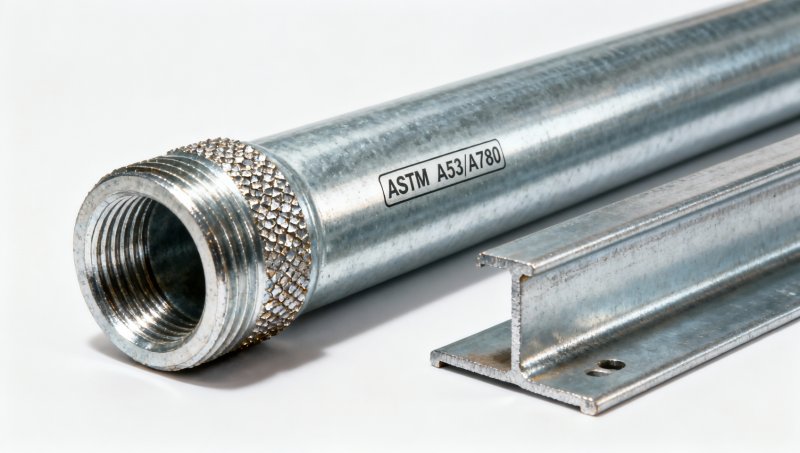
- Packaging & marking: Individual bundle labeling with heat number, standard (ASTM A53/A780), and galvanizing date—critical for audit trails in nuclear or pharmaceutical facilities.
- Lead time consistency: Verified production capacity supporting 15–20 days delivery for standard sizes—Hongteng Fengda maintains this across 98% of orders via dual-line galvanizing lines and real-time inventory tracking.
Certifications matter beyond paperwork: CE, SGS, BV, and ISO 9001 audits confirm process control—not just final product conformity.
Why Partner with Hongteng Fengda for Integrated Steel Solutions?
Sourcing galvanized conduit—and its structural counterparts—from separate vendors introduces coordination delays, coating mismatch risks, and fragmented accountability. Hongteng Fengda delivers integrated assurance: same raw material batches, synchronized galvanizing cycles, unified QA protocols, and single-point responsibility from coil to coated beam.
We support your project with:
- Custom cutting, punching, and bending services—enabling pre-fabricated conduit support brackets ready for bolt-on installation.
- Technical collaboration on load calculations, fire-rating validation, and corrosion modeling for site-specific conditions.
- FOB/CFR/CIF trade terms with 30% TT deposit and 70% balance before shipment—or LC at sight—for financial flexibility.
- Full documentation package: EN 10219-compliant MTRs, galvanizing certificates, and packaging compliance reports for customs clearance in North America, EU, and GCC markets.
Ready to align your conduit specification with structural steel procurement? Contact us for conduit sizing guidance, C-channel compatibility review, ASTM/EN certification confirmation, or sample shipments—including galvanized conduit + matching C Channel Beam test sets.
Please give us a message


Please enter what you want to find